
NASA vs SpaceX: Comparing 2026 Space Missions and Strategies
NASA and SpaceX are pursuing divergent approaches to space exploration in 2026, from crewed lunar missions to commercial cargo resupply. Here's how their technologies and timelines stack up.

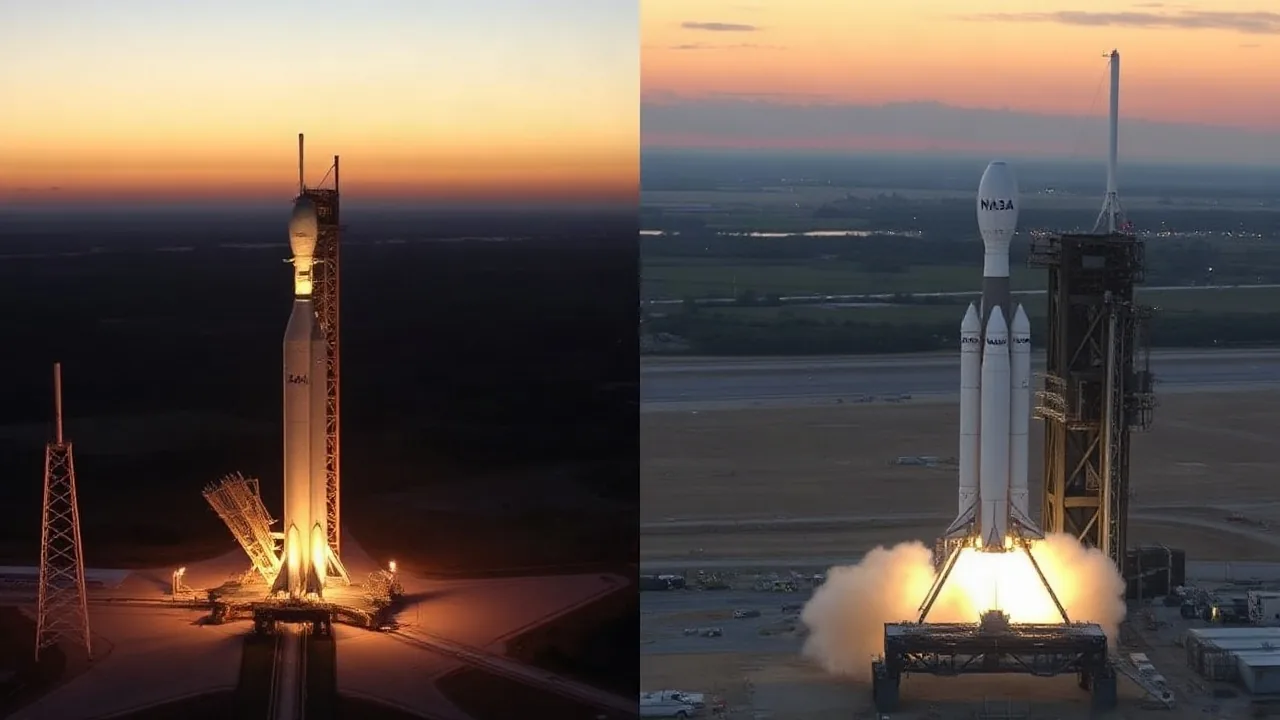
On August 15, 2026, SpaceX completed its forty-third cargo delivery to the International Space Station aboard a Falcon 9 rocket, while NASA simultaneously announced the postponement of its Artemis III lunar landing mission to 2027. These parallel developments underscore a fundamental shift in how America approaches space exploration: NASA now partners with commercial operators rather than monopolizing human spaceflight.
The rivalry between the two organizations is not zero-sum. NASA provides contracts, regulatory oversight, and scientific directives; SpaceX delivers launch capacity, rapid iteration, and cost efficiency. Yet their strategies diverge sharply on risk tolerance, timeline pressure, and technological philosophy.
Current Missions and Technical Approaches
NASA's human spaceflight program relies on the Space Launch System (SLS) and Orion capsule for lunar missions. As of mid-2026, the agency has logged four crewed flights of the Orion under the Artemis program, with the most recent mission in November 2025. The SLS has maintained a launch cadence of roughly one mission per 12-18 months, limited by the complexity of assembling and testing its four RS-25 engines and 32-story-tall vehicle stack.
SpaceX's approach centers on the fully reusable Starship system. Since its first integrated flight test in April 2023, the company has completed seventeen test flights as of August 2026, progressively advancing booster catch capability, in-space refueling, and payload deployment. Starship does not yet carry astronauts, but NASA awarded SpaceX a $2.9 billion contract in 2024 to develop the lunar lander variant (HLS) for Artemis missions.
The cost differential is stark. A single Artemis SLS-Orion flight carries an estimated program cost exceeding $2 billion when development and infrastructure are factored in. SpaceX has stated that marginal Starship flights cost around $10 million per launch, though independent verification of this figure remains contested among aerospace analysts.
Commercial Competition and Private Spaceflight Growth
Beyond government contracts, SpaceX operates the only operational human spaceflight service to orbit outside of Russia and China. Since 2020, the company has flown six private astronaut missions to the ISS through its Crew Dragon program. In June 2026, SpaceX transported four private citizens on a multi-day orbital mission that generated $60 million in revenue, according to space industry analyst Jonathan McDowell of Harvard-Smithsonian Center for Astrophysics.
"The commercial spaceflight sector is now self-sustaining," McDowell stated in an interview with aerospace publications this August. "SpaceX has proven that private companies can operate human missions safely and repeatedly. NASA's role has shifted from operator to customer and certifier."
Other commercial providers are accelerating development. Blue Origin's New Shepard suborbital vehicle continues passenger flights, and the company's orbital New Glenn rocket entered final assembly in 2026. Axiom Space has launched three commercial space station modules, with plans for four more modules by 2028. Relativity Space achieved its first orbital 3D-printed rocket launch in May 2026.
NASA's Commercial Cargo Program and Commercial Crew Program have mature contracts through 2030, with
The agency intends to transition the ISS to a mixed public-private operation by 2030, reducing government presence as commercial stations mature. Axiom, Orbital Reef (a Blue Origin-led venture), and others are preparing to replace NASA's guaranteed revenue stream.
Technology Divergence: Reusability vs. Proven Heritage
NASA's architecture favors proven, incremental technology with extensive preflight testing. The SLS traces its lineage to the Space Shuttle and Saturn V programs. Its solid rocket boosters originated in the Shuttle program and have ninety-plus flights of operational heritage. This conservative approach minimizes surprise failures but extends development timelines.
SpaceX prioritizes rapid prototyping and acceptance of in-flight failures as learning opportunities. Starship's development cost approximately $5 billion cumulatively through August 2026, versus estimates exceeding $20 billion for SLS development since 2011. Early Starship test flights resulted in total vehicle loss, but each iteration brought design refinements captured from telemetry and hardware examination.
The divergence reflects institutional culture. NASA employs 18,000 civil servants and manages a constellation of centers, contractors, and suppliers across fifty states. SpaceX operates as a vertically integrated private company with roughly 13,000 employees and internal manufacturing. Decision-making cycles differ by orders of magnitude.
Regarding rockets specifically, the Falcon 9 has now flown 356 times as of August 2026, with a 99.7 percent success rate. Its first stage lands and reflights routinely, with some boosters exceeding fifteen flights. The SLS has never flown more than twice in a calendar year and requires specialized infrastructure at Kennedy Space Center that limits launch rate.
For astronauts, NASA maintains a corps of 44 active astronauts trained on both Orion and Crew Dragon. SpaceX employs no astronauts in-house but has certified nine pilots and mission specialists for commercial operations. The distinction matters: NASA astronauts are government employees with decades of training; SpaceX commercial pilots are contractors with mission-specific preparation.
Looking forward to 2027 and beyond, NASA's Artemis III is slated to land the first woman and person of color on the lunar surface. SpaceX's HLS variant remains in development, with critical dock-and-entry tests scheduled for late 2026. Both organizations are also pursuing private spaceflight ventures: NASA through commercial station partnerships, SpaceX through direct ticket sales and cargo services.
The outcome is not a winner-takes-all competition but a recalibration of risk, speed, and investment. NASA retains authority over deep space missions and scientific objectives. SpaceX has captured the high-volume, lower-cost transportation market. Neither trajectory shows signs of convergence in 2026 or 2027.