
Perseverance Rover Breaks Mars Driving Record at 28 Miles
NASA's Perseverance rover has surpassed 28 miles driven on the Martian surface, establishing a new record for the longest distance covered by a robotic explorer on the Red Planet. The milestone highlights the rover's enduring capabilities in its ongoing mission.

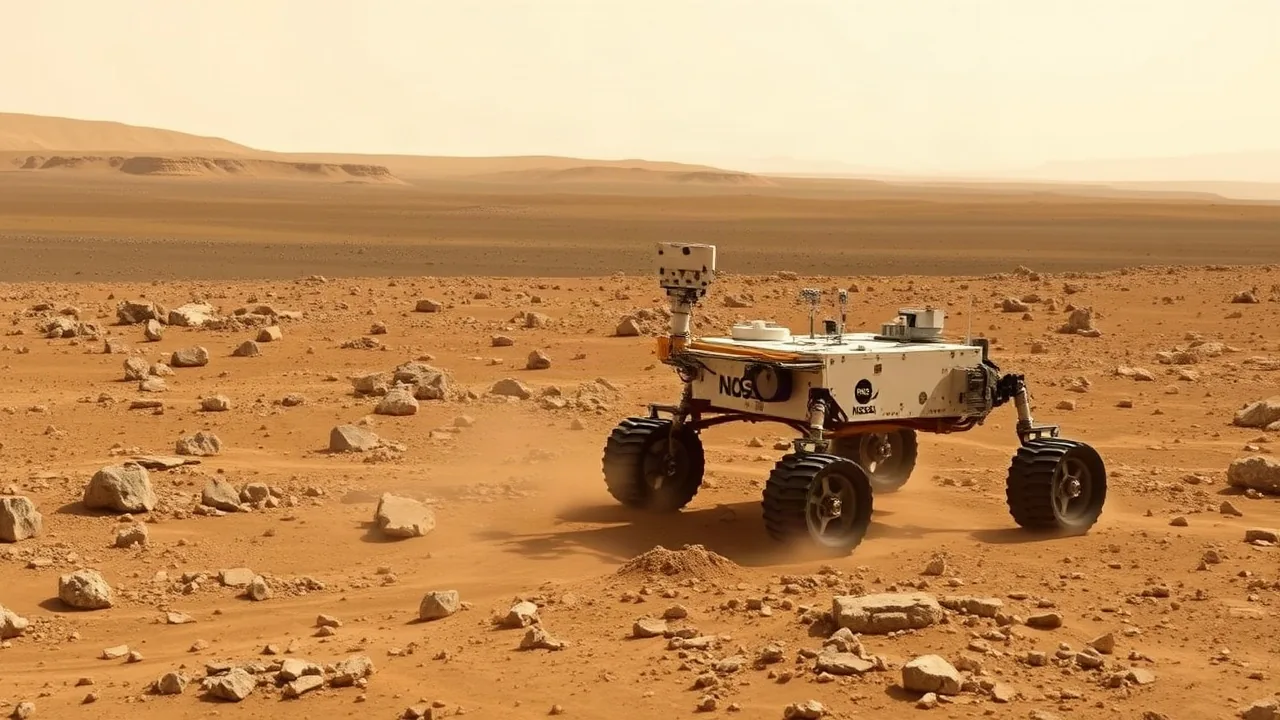
NASA's Perseverance rover has officially become the most-traveled robotic explorer on Mars, having driven over 28 miles (approximately 45 kilometers) across the Jezero Crater. This significant milestone was achieved on October 12, 2026, marking a new record for distance covered by an uncrewed vehicle on the Red Planet and underscoring the rover's robust performance and the mission's scientific longevity.
The achievement signifies more than just a numerical record; it represents the culmination of years of planning, deployment, and operational success for the rover, which landed in February 2021. Perseverance's primary mission objectives include seeking signs of ancient microbial life and collecting samples of rock and regolith for potential return to Earth. Its advanced instrumentation, including the Mastcam-Z cameras, SuperCam, and the SHERLOC and PIXL spectrometers, has been instrumental in its extensive exploration.
Navigating the Red Planet's Terrain
Perseverance's journey has been characterized by its ability to navigate challenging Martian terrains, from sandy plains to rocky outcrops. The rover's sophisticated autonomous driving capabilities, coupled with meticulous mission planning by engineers at NASA's Jet Propulsion Laboratory (JPL) in Southern California, have allowed it to cover significant ground efficiently and safely. The mission team has celebrated this achievement, recognizing the rover's resilience against the harsh Martian environment, which includes extreme temperature fluctuations and fine dust that can affect mechanical systems.
According to JPL rover driver Erisa K. Webb, "Each wheel turn on Mars is a testament to human ingenuity and perseverance. To have driven this far means we’ve been able to explore more diverse geological areas, increasing our chances of making groundbreaking discoveries." The record-breaking drive was logged during a traverse across the ancient river delta within Jezero Crater, an area believed to have once held a lake and river. This region is of particular interest for scientists studying Mars' past habitability.
The previous record for the longest distance driven by a Mars rover was held by NASA's Opportunity rover, which traveled approximately 26.2 miles (42.195 kilometers) over its 14-year mission before its power ceased in 2018. Perseverance has now surpassed this impressive feat, demonstrating advancements in mobility and power systems. The rover is equipped with a Radioisotope Thermoelectric Generator (RTG), which provides reliable power, allowing for continuous operation even through the long Martian nights and dust storms.
The scientific data gathered by Perseverance along its record-setting path is invaluable. The rover has transmitted thousands of images and gigabytes of scientific data, providing unprecedented insights into Mars' geological history and potential for past life. The samples collected are stored in sealed tubes, awaiting a future mission to bring them back to Earth for detailed analysis. The ongoing exploration by Perseverance rover is a critical step in humanity's quest to understand our solar system and our place within it. The rover's ability to cover such distances also allows for broader geological surveys, helping scientists piece together the planet's complex environmental evolution.