
Mars Rock Sample Holds Clues to Ancient Life, Awaiting Return to Earth
NASA's Perseverance rover collected a potentially groundbreaking Martian rock sample, but its return to Earth faces significant challenges, including a potential international retrieval effort.

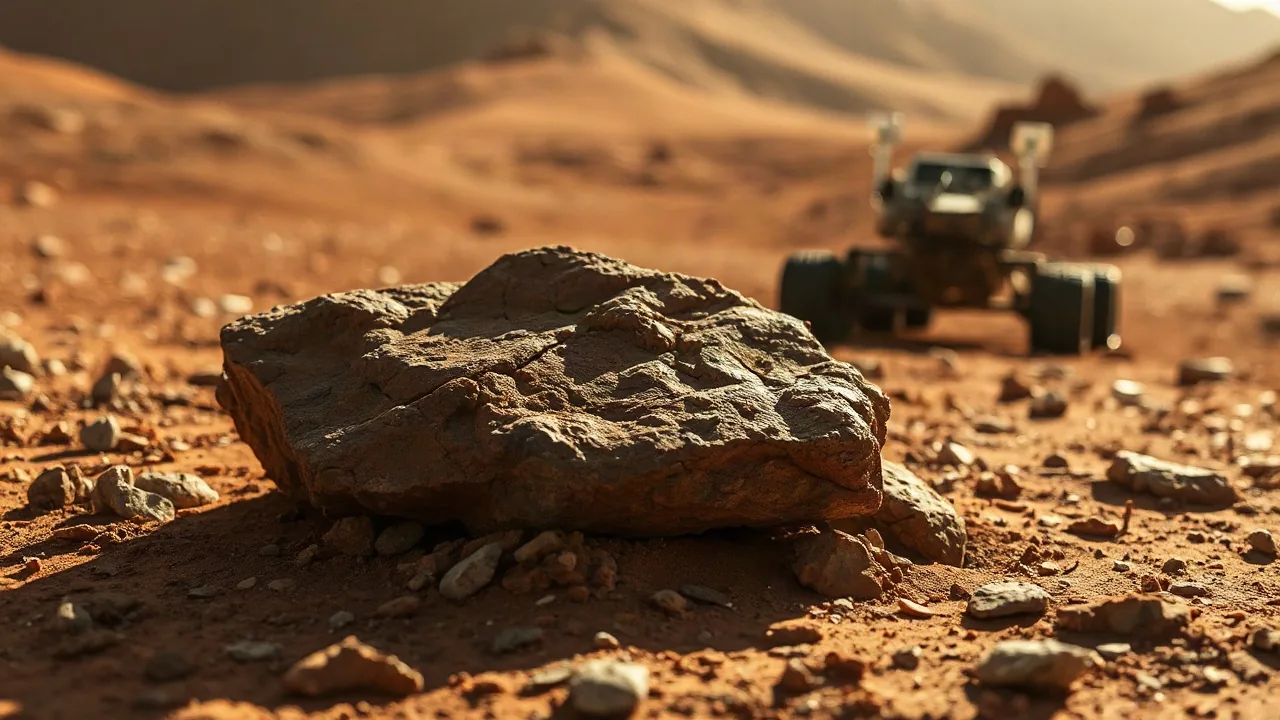
A small, forgotten rock sample retrieved by NASA's Perseverance rover from Mars holds the tantalizing possibility of containing evidence of ancient microbial life. The sample, collected from a site within the Jezero Crater, has been sitting on the Martian surface for months after its initial retrieval. Its future now hinges on complex logistical and potentially international efforts to bring it back to Earth for definitive analysis.
The rock, designated for return as part of NASA's ambitious Mars Sample Return (MSR) mission, was one of several collected by Perseverance in 2023. However, funding challenges and shifting program priorities within NASA have cast doubt on the original timeline for the mission. This has led to discussions about alternative retrieval strategies, including the possibility of collaboration with other space agencies, such as the China National Space Administration (CNSA).
A Race Against Time and Logistics
The sample was extracted from a region known as Sapphire Canyon, an area chosen for its geological significance and potential to preserve signs of past life. Scientists selected this particular sample due to preliminary spectral analysis suggesting a composition that could have harbored organic molecules. If life ever existed on Mars, the clues would likely be preserved within such geological formations.
"This is precisely the kind of sample we hoped to collect," said Dr. Elena Vance, lead astrobiologist for the Perseverance mission, in a statement released last month. "Its geological context suggests it could be a time capsule from a period when Mars may have been habitable. The challenge now is to get it home safely and efficiently."
The original MSR plan involved a complex sequence of events, including a fetch rover to retrieve samples cached by Perseverance, a Mars ascent vehicle to launch the samples into orbit, and an Earth return orbiter to bring them back. However, the U.S. Government Accountability Office (GAO) and NASA's own inspector general have raised concerns about the escalating costs and technical complexities of this multi-billion dollar endeavor. The mission's budget has reportedly ballooned, prompting NASA Administrator Bill Nelson to re-evaluate the strategy.
This re-evaluation has opened the door to discussions with international partners. While no formal agreements have been made, sources indicate that China, which has its own ambitious Mars exploration program, has expressed interest in contributing to sample return efforts. Such a collaboration, though unprecedented for Martian samples, could potentially accelerate the return timeline and share the immense financial burden.
The implications of confirming past life on Mars would be profound, fundamentally altering humanity's understanding of its place in the universe. It would suggest that life is not unique to Earth and could potentially arise on other planets. The scientific community is eagerly awaiting the analysis of these samples, which could revolutionize astrobiology and planetary science.
For now, the sample remains on the Red Planet, a silent testament to a potential ancient biosphere, its fate intertwined with the complex interplay of scientific ambition, budgetary constraints, and international space diplomacy. The journey from Jezero Crater to a laboratory on Earth is far from over, and the successful retrieval of this single rock could be a defining moment in space exploration history.