
NASA's X-59 Aircraft Nears First Supersonic Flight Milestone
NASA's experimental X-59 aircraft is set to embark on its inaugural supersonic flights this June. This critical phase of testing aims to gather data for the Quesst mission, paving the way for quieter supersonic travel.

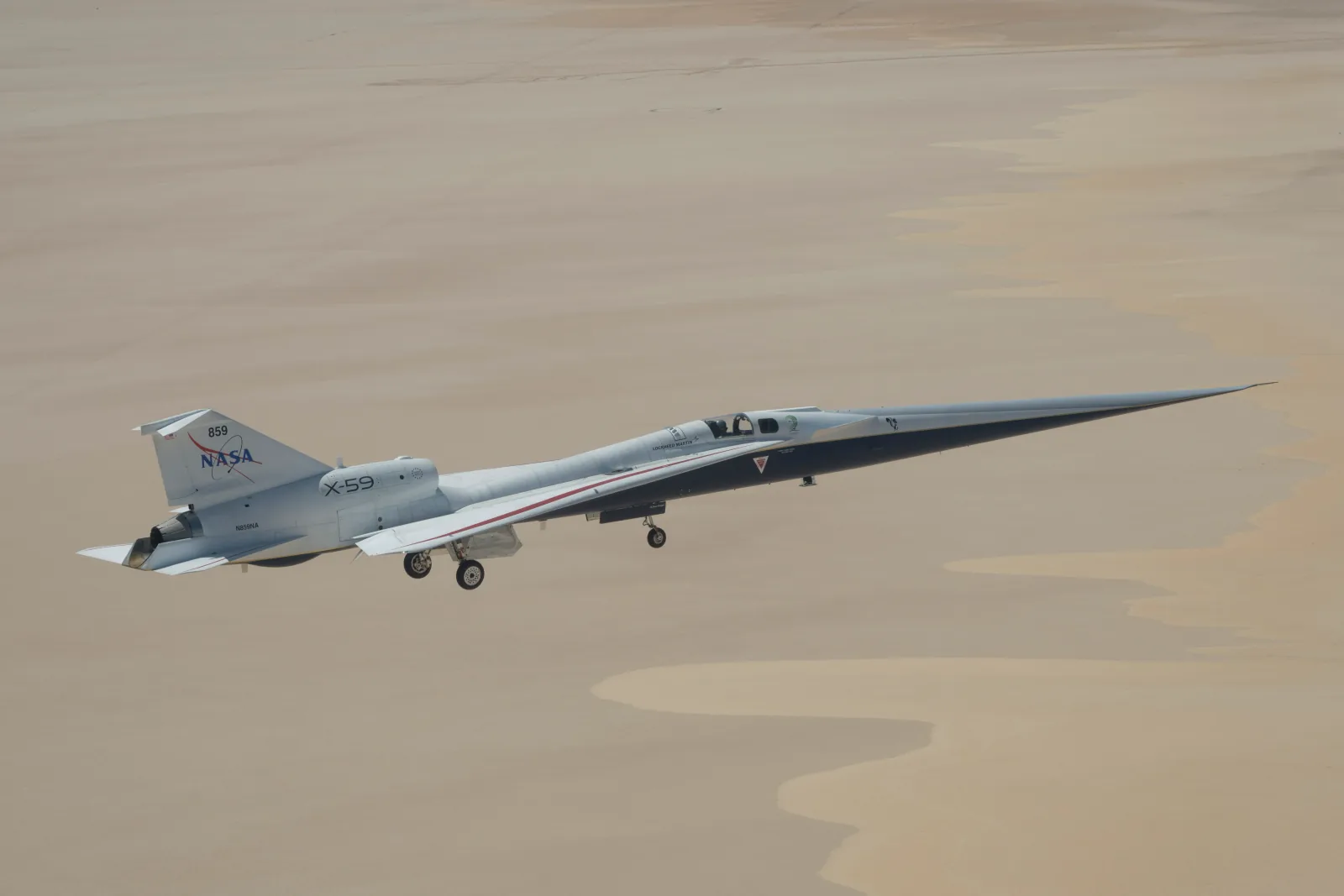
NASA's experimental X-59 aircraft is on the cusp of a significant milestone, preparing for its first-ever flights faster than the speed of sound. These upcoming tests are a crucial part of the Quesst mission, designed to prove the viability of quiet supersonic flight.
"What comes next is the first time this one-of-a-kind aircraft will fly supersonic," said Cathy Bahm, project manager for NASA’s Low Boom Flight Demonstrator. "We are starting toward the mission conditions test point that X-59 was designed for." The X-59 team has been meticulously reviewing progress from months of earlier flights, and now their focus shifts to a new series of tests involving higher altitudes and increased speeds.
Engineers will closely observe how the X-59 performs under conditions required for NASA’s Quesst mission, which aims to collect public feedback on the aircraft's distinct sonic "thump." The team anticipates the X-59 will exceed Mach 1 – achieving speeds over 630 mph – for the first time at an altitude of approximately 43,000 feet. This series of flights is slated to commence in early June.
Validating Design for Quieter Skies
Following its initial supersonic test, the X-59 will undertake a "mission conditions" flight. This phase targets Mach 1.4 (approximately 925 mph) at an altitude of around 55,000 feet. These specific speed and altitude parameters are vital as they represent NASA’s performance goals for the aircraft to eventually fly over U.S. communities. The primary objective is to demonstrate quiet supersonic flight and gauge public reaction to the aircraft's generated sound signature.
While the X-59 is engineered to fly at supersonic speeds without creating a traditional, loud sonic boom, these early flights are not intended to showcase its quiet capabilities. During this testing phase, the X-59 will be accompanied by a conventional supersonic chase plane. The louder sonic booms produced by the chase aircraft will obscure any quieter thump generated by the X-59. For these supersonic tests this summer, the chase aircraft will also be equipped with a specialized probe to collect initial measurements of the X-59's shock waves.
The X-59's initial flight block, which began with its first flight in October 2025, successfully met several key objectives, generating valuable data for the team. After a scheduled maintenance period, the aircraft returned to the skies in March 2026 and has since completed 14 additional flights. These flights have included significant milestones such as its first gear swing, demonstrating its sleek design, and reaching altitudes of up to 43,000 feet. The aircraft also approached near-supersonic speeds, hitting Mach 0.95 (about 627 mph), and the team progressively made dual-flight days routine, increasing the flight cadence.
Engineers collected comprehensive data throughout these flights, assessing critical systems like fuel, hydraulics, and environmental controls. A key innovation is the eXternal Vision System, a series of cameras feeding into a monitor that compensates for the lack of a traditional forward windshield. Strain gauges installed across the aircraft provided detailed information on structural response and forces experienced during takeoff, landing, and flight.
"Flying at supersonic speeds is a major milestone for the X-59 team," Bahm reiterated. "Every step of envelope expansion brings us closer to demonstrating the quiet supersonic capability that is at the heart of the Quesst mission. Completing the first mission-conditions flight is especially meaningful – it’s the moment where we begin validating the aircraft in the environment it was designed for."
Beyond achieving mission conditions, this upcoming block of tests will see the X-59 reach its maximum design speed of Mach 1.6 (1,218 mph) and an altitude of 60,000 feet. However, testing will continue to include a mix of subsonic and lower-altitude flights to monitor the aircraft's behavior across a wider range of conditions. "These flights not only deepen our confidence in the X-59’s performance – they mark our progression toward the future phases of the mission that will ultimately help shape the future of supersonic travel," Bahm added.
All flight operations conducted thus far and those planned for this test block are part of Phase 1 of the Quesst mission, focused on validating the aircraft's performance and airworthiness. Future flights will involve the early deployment of specialized equipment, including a probe on a NASA F-15 research aircraft to measure the X-59's unique shock wave signature. The data gathered will prepare engineers for Phase 2, later this year, when teams will begin verifying that the aircraft's supersonic flight produces the intended quiet thump. As aviation pioneer Otto Lilienthal famously said, "To design a flying machine is nothing. To build one is something. But to fly is everything." For the X-59 team, the 15 flights completed since March 2026 have been precisely that. "Every flight has pushed the boundaries of what’s possible, steadily expanding the envelope and strengthening our confidence in the aircraft," Bahm concluded. "As we look ahead to the upcoming flights, we’re poised to open the envelope even further – moving boldly toward the mission test point this aircraft was built to achieve."