
Northern Lights Expected Over 23 US States This Week
A severe geomagnetic storm alert has been issued, with the northern lights potentially visible in 23 U.S. states on Thursday and Friday, June 4-5. Forecasters predict conditions could be strong enough to be seen farther south than usual.

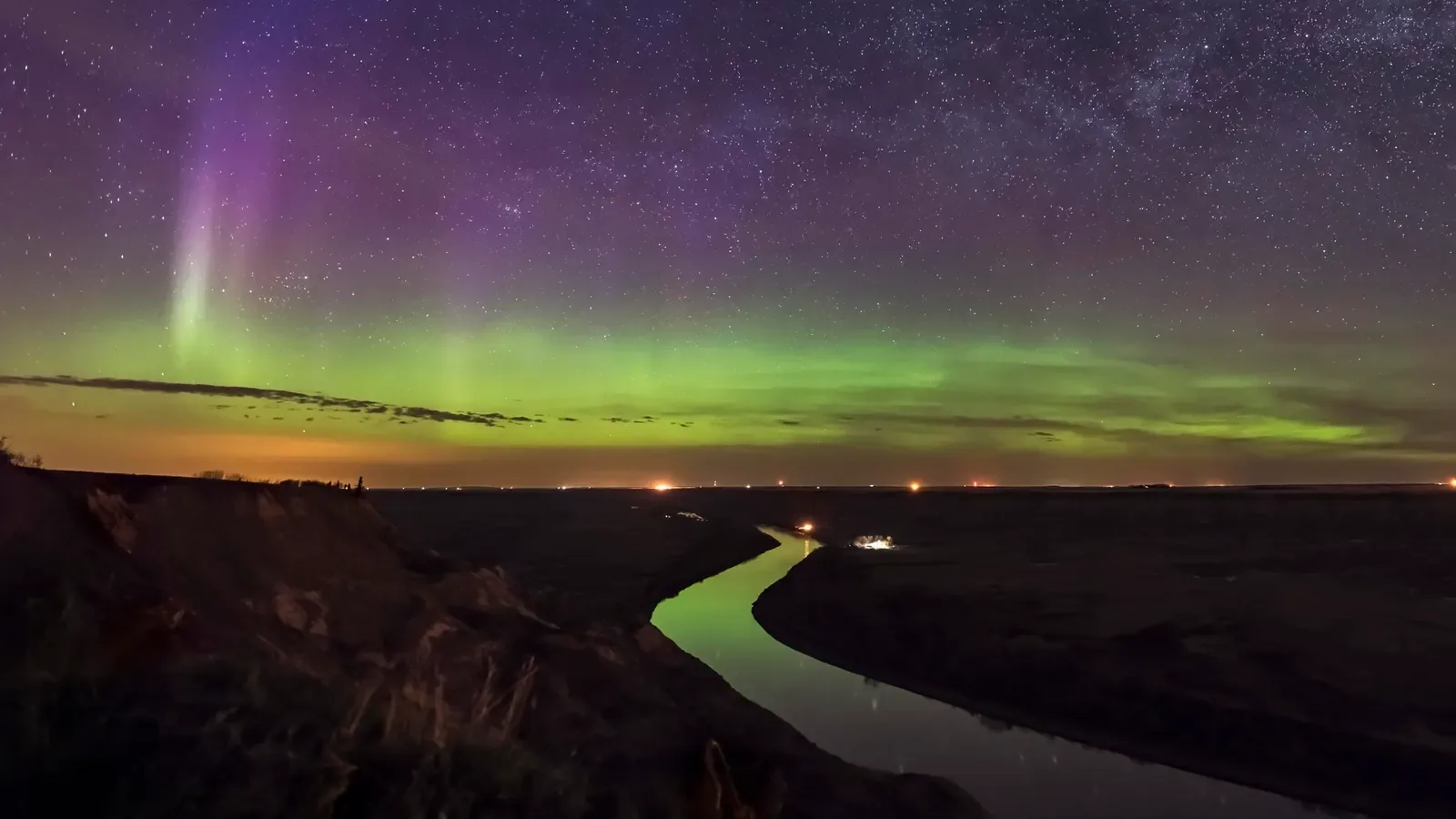
Northern lights displays are anticipated across 23 U.S. states and parts of Canada from Thursday, June 4, through Friday, June 5. Forecasters at the National Oceanic and Atmospheric Administration (NOAA) have predicted geomagnetic storms reaching G4 strength, a severe level that could push the aurora borealis to lower latitudes. However, a bright waning gibbous moon is expected to rise after midnight, potentially diminishing the visibility of fainter aurora displays.
Space-weather predictions are subject to rapid changes, but current forecasts indicate isolated periods of G1 geomagnetic storming are likely overnight on Thursday. This is due to three separate solar wind disturbances expected to converge near Earth simultaneously, increasing the probability of auroral activity. The forecast intensifies for Friday, with a potential G3 or even G4 geomagnetic storm capable of bringing auroras to mid-latitude regions.
Geomagnetic Activity and Solar Disturbances
The United Kingdom's Met Office has advised that geomagnetic activity is poised for a sharp increase on June 4. Minor to strong geomagnetic storm conditions (Kp 5–7) are likely, with a slight possibility of brief intervals of G4, or severe, geomagnetic storming. The Kp index, a measure of global geomagnetic disturbance, offers a rough estimate of how far from the poles auroras might be visible. A higher Kp index suggests auroras could be seen in more southerly regions.
Current monitoring is focused on a coronal mass ejection (CME) launched from the sun on May 30, alongside a co-rotating interaction region and a high-speed solar wind stream emanating from a coronal hole. While any single one of these events can trigger auroral activity, their arrival in close succession or overlap can amplify their effects, leading to more significant geomagnetic disturbances and thus more widespread aurora displays. Further complicating the forecast, a series of X-class solar flares on June 3 were followed by two to three CMEs, predicted to reach Earth on June 5, according to Spaceweather.com. These eruptive events originated from a sunspot that began unexpectedly producing flares.
For aurora enthusiasts, a G4 geomagnetic storm signifies that the northern lights could be visible from numerous U.S. states, typically appearing on the northern horizon. States with a high probability of viewing include the northern portions of Washington, Idaho, Montana, Wyoming, North Dakota, South Dakota, Minnesota, Wisconsin, Michigan, New York, and Maine. Those situated farther south, such as Oregon, Nebraska, Iowa, Illinois, Indiana, Ohio, Pennsylvania, Massachusetts, Connecticut, Rhode Island, Vermont, and New Hampshire, also have a chance of witnessing the phenomenon, though visibility will be best in northern locations.
Effective forecasting of auroras relies heavily on understanding the sun's approximately 27-day rotation cycle, which can bring active, aurora-producing sunspot regions back into Earth's view. However, precise predictions about whether a CME will impact Earth and its arrival time are only possible once its effect on the solar wind—a constant stream of charged particles from the sun—is measured. NOAA's DSCOVR satellite, orbiting one million miles from Earth, plays a crucial role by measuring the solar wind's speed and magnetic intensity. These measurements are critical for the NOAA's Space Weather Prediction Center to accurately forecast aurora displays, though the warning period can be as short as 30 minutes.
Aurora chasers frequently utilize the Kp index to gauge geomagnetic storm intensity. However, for visible aurora displays, the orientation of the interplanetary magnetic field within the solar wind is paramount. Specifically, a southward orientation of the magnetic field, known as Bz, allows solar wind energy to couple more efficiently with Earth's magnetic field, potentially intensifying geomagnetic activity rapidly. A sustained southward Bz of −5 nT or stronger is a strong indicator of an imminent aurora display. It is important to note that the upcoming period, leading up to the June solstice, presents a challenge for aurora viewing in northern U.S. states and Canada due to very short nights and prolonged twilight, which can significantly limit darkness even when geomagnetic conditions are favorable.