
Northrop Grumman Launches Advanced Robotic Satellite Servicer
Northrop Grumman's Mission Robotic Vehicle (MRV) has launched, marking a significant advancement in satellite servicing. This sophisticated craft is designed to extend the lifespan and capabilities of other satellites in geosynchronous orbit.

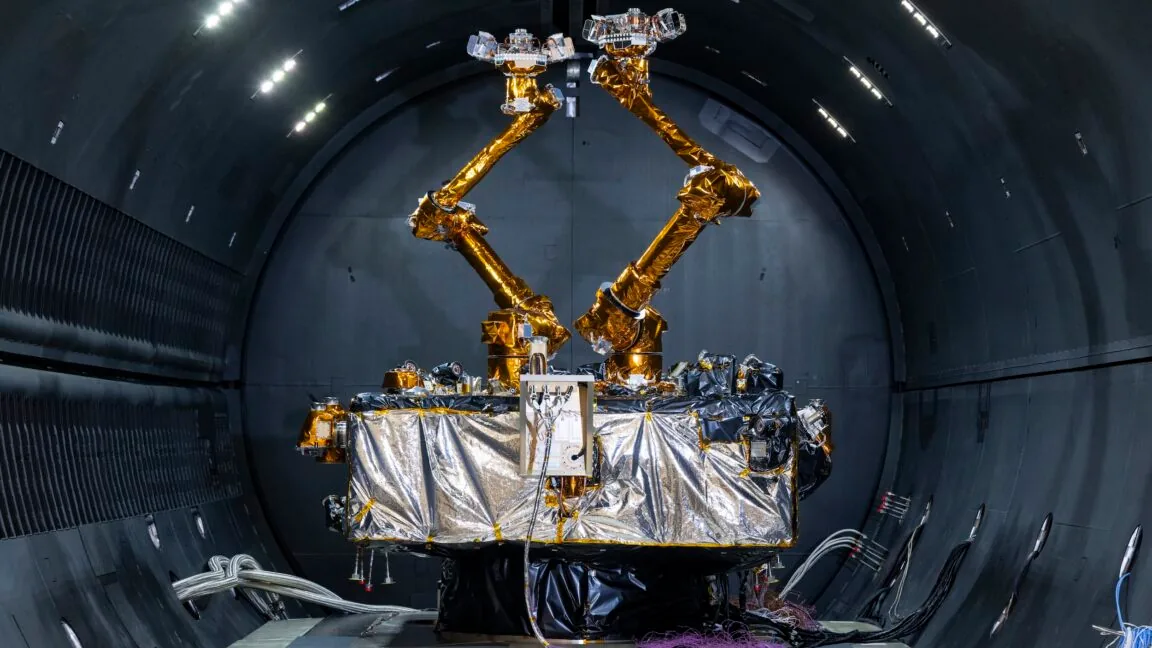
Northrop Grumman's cutting-edge Mission Robotic Vehicle (MRV), equipped with two highly advanced robotic arms, has successfully launched aboard a SpaceX Falcon 9 rocket, embarking on a ten-year mission to revolutionize satellite servicing. Launched from Cape Canaveral Space Force Station in Florida earlier this week, the MRV is poised to usher in a new era of on-orbit support and maintenance for spacecraft.
The MRV, along with three accompanying Mission Extension Pods (MEPs), reached orbit and will spend approximately a year maneuvering into a stable geosynchronous orbit, more than 22,000 miles above the equator. Once in position, the vehicle will operate in sync with Earth's rotation, a critical altitude for numerous communications, military, and intelligence-gathering satellites.
While China has demonstrated satellite servicing capabilities, including robotic arms and refueling missions with its Shijian series satellites, the MRV represents a significant leap for the United States. The development of the MRV's robotics payload was a collaborative effort, with the Pentagon's Defense Advanced Research Projects Agency (DARPA) investing approximately $420 million. This public-private partnership merged DARPA's Robotic Servicing of Geosynchronous Satellites (RSGS) program with Northrop Grumman's existing commercial satellite servicing initiatives.
A New Era of On-Orbit Capabilities
The MRV builds upon Northrop Grumman's earlier Mission Extension Vehicle (MEV) concept but offers far greater versatility. Unlike the MEVs, which were designed to permanently dock and provide propulsion to a single satellite, the MRV can utilize its robotic arms to install Mission Extension Pods on multiple spacecraft. These pods act as a new propulsion system, extending the operational life of client satellites for up to eight years.
Beyond simple life extension, the MRV is designed for more complex tasks. It can inspect, service, upgrade, and even repair satellites that were not originally designed for such interventions. This capability is crucial for maintaining critical infrastructure in orbit and responding to unforeseen issues. The robotic system, developed in partnership with the Naval Research Laboratory (NRL), adheres to stringent Defense Department reliability standards, featuring redundant arms and sophisticated avionics. Its advanced sensors and cameras enable autonomous rendezvous, capture, and servicing operations.
Bernard Kelm, acting director of NRL’s Naval Center for Space Technology, highlighted the significance of the mission, stating, "This journey to the launch pad represents the culmination of a multiple decades-long endeavor of vision, risk, and relentless engineering." The RSGS program's lineage traces back to DARPA's initial space robotics work in 2002. "The RSGS program shifts this paradigm by enabling on-orbit interventions, including inspections, mechanical anomaly resolution, satellite relocation and upgrades," Kelm added.
This initiative is part of a broader U.S. strategy to enhance its space capabilities. In recent years, U.S. military officials have expressed concerns about China's development of counterspace capabilities, citing their potential use against American assets. The MRV's ability to perform sophisticated on-orbit servicing directly addresses these concerns by providing a robust, domestically controlled platform for satellite maintenance and enhancement.
The MRV's first task will involve rendezvous with one of the three launched Mission Extension Pods. After attaching a pod, it will then proceed to its first client satellite, precisely aligning to install the pod into the satellite's engine compartment. The pod will then take over propulsion duties, effectively giving the client satellite a new lease on life and the ability to reposition itself within geosynchronous orbit.
Jim Shoemaker, RSGS program manager at DARPA, explained the sophisticated nature of the robotic operations, noting that the vast distance and time delay make real-time joystick control impossible. "You have to be able to either upload a mission script or let the satellite execute it on its own," Shoemaker said in an interview. Extensive ground testing has prepared the robotic arms for the unique challenges of microgravity, where inertia will play a different role than on Earth.