
Japan Launches Mission to Explore Mars's Moons
Japan's MMX mission has successfully launched, aiming to investigate the origins of Mars's two moons, Phobos and Deimos, and potentially retrieve samples. The spacecraft is expected to reach Mars in 2026.

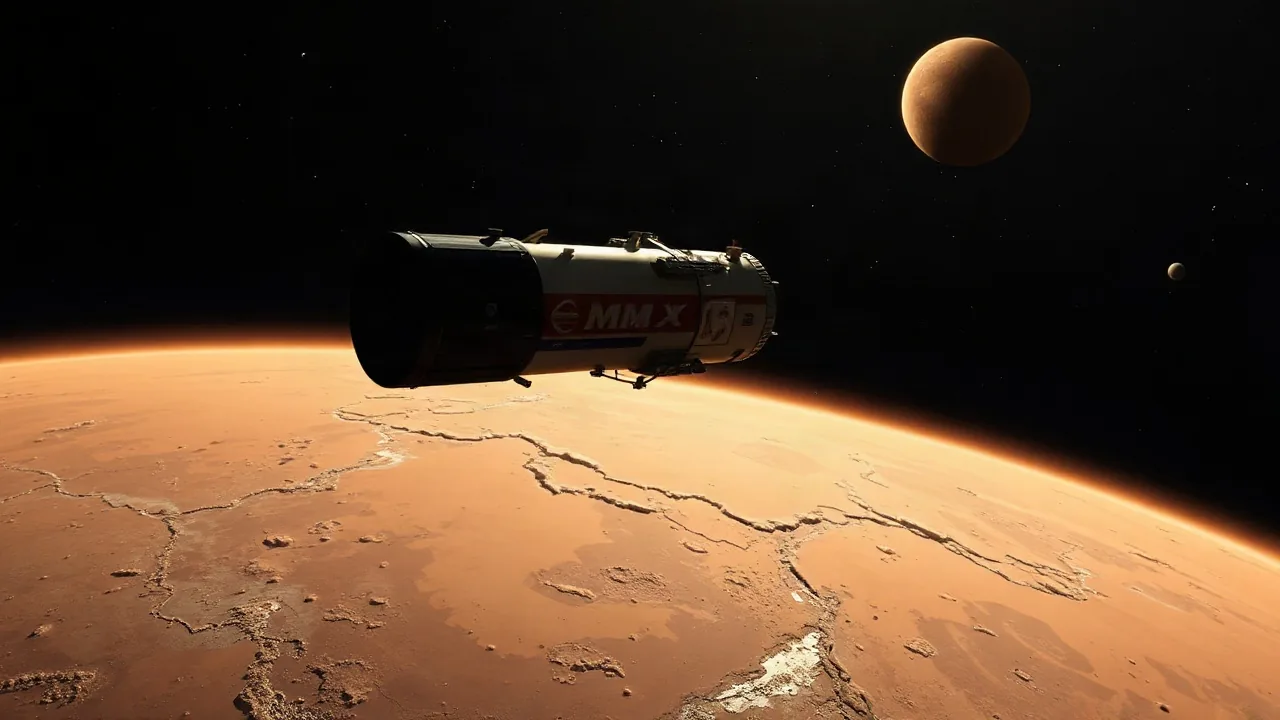
Japan's long-awaited Martian moons exploration mission, the Martian Moons eXploration (MMX), blasted off from the Tanegashima Space Center on October 21, 2026, embarking on a seven-year journey to study Mars's two small satellites. The primary objectives of the $580 million mission, managed by the Japan Aerospace Exploration Agency (JAXA), are to determine the origin of Phobos and Deimos and to observe Martian geological activity. The MMX spacecraft is also tasked with landing on Phobos, collecting a sample, and returning it to Earth for detailed analysis.
The launch marks a significant milestone for JAXA and for international space exploration efforts. Phobos and Deimos are thought to be captured asteroids, but their exact origins remain a scientific puzzle. Understanding these moons could provide crucial insights into the early history of the solar system and the conditions that might have once existed on Mars. The mission will deploy a small rover onto Phobos, developed by NASA, to explore the moon's surface. This collaboration highlights the global nature of current space endeavors.
Investigating Martian Origins and Future Exploration
The MMX spacecraft will first enter orbit around Mars in 2027, where it will conduct remote sensing observations of both moons. After several months of studying their surfaces and orbits, the probe will descend to Phobos. The landing is planned for 2029, after which the rover will be deployed. The primary goal is to collect at least 10 grams of Martian regolith from the moon's surface. This precious material will be sealed in a capsule and brought back to Earth, with the return journey scheduled to conclude in 2031. Scientists hope that the analysis of these samples will shed light on whether the moons formed from Martian debris or are remnants of asteroids captured by the planet's gravity.
This ambitious mission is not just about answering fundamental questions about Mars and its moons; it also serves as a stepping stone for future human exploration of the red planet. JAXA's expertise in sample return missions, demonstrated by the successful Hayabusa and Hayabusa2 asteroid sample return missions, is crucial for the success of MMX. The data gathered by MMX will be invaluable for planning future crewed missions and understanding the challenges associated with operating in the Martian environment. The mission also includes a plan to observe Mars's atmosphere and its interaction with the solar wind.
The launch was conducted atop an H-IIA rocket, which lifted off smoothly into the clear skies above the southern Japanese island. JAXA officials expressed confidence in the mission's capabilities, emphasizing the rigorous testing and development that has gone into the MMX spacecraft. The international scientific community is eagerly awaiting the data that MMX will provide, anticipating new discoveries that could reshape our understanding of planetary formation and the potential for life beyond Earth. This space exploration endeavor represents a significant investment in scientific knowledge and technological advancement.