
New Study Suggests Earth, Mars Formed Via Distinct Planetary Pathways
A recent study challenges long-held theories about planet formation, proposing that Earth and Mars developed through fundamentally different processes, impacting their current compositions and potential for life.

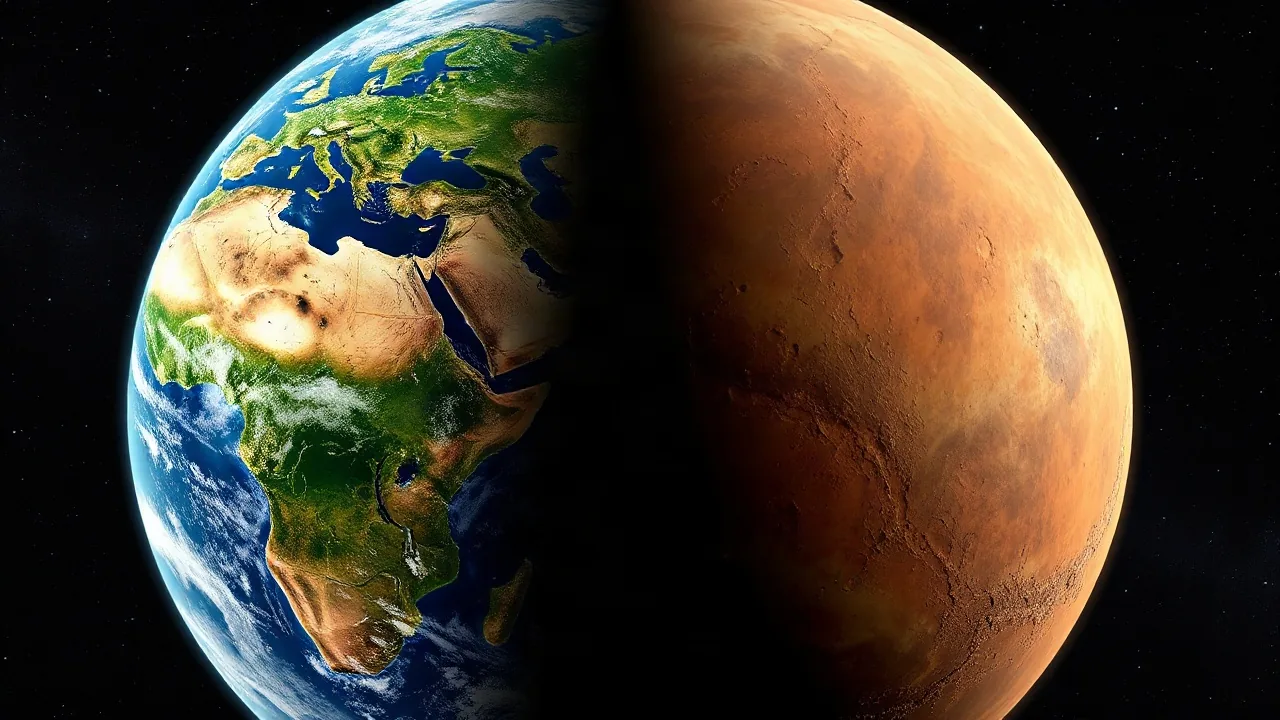
Scientists have proposed a new theory suggesting that Earth and Mars, despite their proximity in the solar system, may have formed through remarkably different processes. This hypothesis, detailed in a recent study published in Nature Astronomy, challenges the prevailing view that terrestrial planets coalesce from the same general type of material distribution.
The research indicates that Earth likely formed in a region rich in water-rich materials, contributing to its abundance of liquid water and an atmosphere conducive to life. In contrast, Mars appears to have accreted material from a much drier, inner region of the solar system. This fundamental difference in their building blocks could explain many of the stark contrasts observed between the two planets today, including Mars's arid surface and thin atmosphere.
Divergent Accretion Models
For decades, planetary scientists have operated under the assumption that planets like Earth and Mars formed from similar protoplanetary disk material, with variations primarily due to their distance from the Sun. However, new simulations and isotopic analyses of meteorites believed to originate from Mars suggest a more complex narrative. These findings point to a distinct and earlier enrichment of Mars's feeding zone with heavier, drier elements compared to Earth's accreting material.
Dr. Anya Sharma, lead author of the study and a planetary scientist at the California Institute of Technology, explained the implications. "Our models show that a significant difference in the composition of the early solar nebula, specifically in the material available for accretion, could lead to planets with vastly different properties even if they form relatively close to each other," Sharma stated. "This is not just about water content; it affects the bulk composition, the presence of core-mantle differentiation, and the development of magnetic fields."
The study analyzed the isotopic signatures of various elements, such as oxygen and silicon, found in Martian meteorites. These signatures are like fingerprints, offering clues about the original solar system material from which the planets accreted. The data revealed a pattern inconsistent with a uniform accretion model. Instead, it supports a scenario where Mars’s formation was dominated by material that had undergone significant processing or originated from a more depleted reservoir.
This research has profound implications for our understanding of planetary science and the search for extraterrestrial life. If Earth and Mars formed so differently, it suggests that the conditions necessary for habitability might be rarer than previously thought, or at least dependent on very specific accretion histories. Understanding these distinct pathways is crucial for interpreting data from current and future missions exploring Mars, such as those seeking evidence of past microbial life.
The findings also provide new avenues for research into the early dynamics of the solar system. The mechanisms that could have led to such a divergence in material distribution are still under investigation, but theories include early migration of giant planets or specific instabilities within the protoplanetary disk. This divergence might have played a role in shaping the orbital architecture we observe today.
Future research will focus on refining these models and gathering more direct evidence from Mars itself. The Perseverance rover's ongoing sample collection and the upcoming Mars Sample Return mission are expected to provide invaluable new data that could either corroborate or refine this groundbreaking theory about the separate origins of Earth and Mars.