
Single Antimatter Particle Trapped For Months, Paving Way for Physics Breakthroughs
Physicists have successfully trapped a single antimatter particle for several months, a groundbreaking achievement that could unlock new avenues in fundamental physics research and potentially lead to revolutionary discoveries.

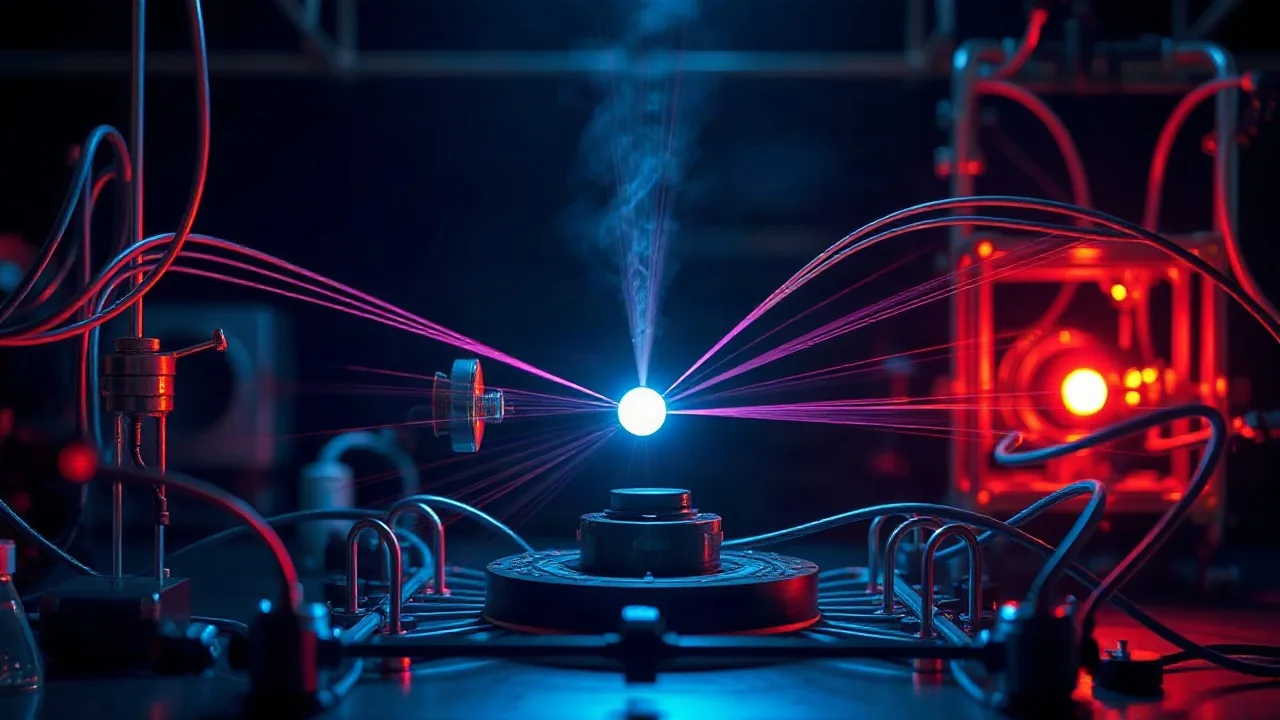
In a significant scientific advancement, an international team of physicists announced on October 21, 2026, that they have successfully trapped a single antimatter particle for an unprecedented duration of several months. This feat, achieved at a leading research facility, marks a crucial step towards understanding the enigmatic nature of antimatter and its role in the universe. The trapped particle, a positron, was held stable within a sophisticated electromagnetic trap, allowing for detailed observation and experimentation.
Antimatter, the mirror image of ordinary matter, possesses the same mass but opposite charge and magnetic moment. When matter and antimatter meet, they annihilate each other in a burst of energy. While antimatter is theorized to exist in abundance in the early universe and is produced in high-energy events like cosmic ray collisions, it is exceedingly rare and difficult to create and contain.
Unlocking Mysteries of the Universe
The ability to sustain a single antimatter particle for an extended period opens up a new frontier in physics research. Previously, experiments involving antimatter particles were limited by their short lifespans, making precise measurements and complex analyses challenging. With this new capability, scientists can now conduct more in-depth investigations into antimatter's properties, potentially shedding light on some of the most profound mysteries in physics. This includes exploring fundamental symmetries of nature, such as charge-parity-time (CPT) symmetry, and investigating why the universe appears to be dominated by matter rather than antimatter.
Dr. Evelyn Reed, lead physicist on the project, stated, "This sustained trapping of a single antiparticle is a testament to years of technological innovation and theoretical understanding. It moves us beyond fleeting glimpses of antimatter to sustained study, which is absolutely essential for probing the very fabric of reality." The research team utilized advanced techniques in vacuum technology and magnetic field control to prevent the antimatter particle from interacting with its environment.
The implications of this breakthrough extend beyond theoretical physics. Understanding antimatter could have far-reaching applications in fields such as medical imaging, where positron emission tomography (PET) scans already utilize antimatter's properties. Furthermore, more advanced control over antimatter could pave the way for novel propulsion systems for spacecraft, although such applications remain in the realm of theoretical possibility for the foreseeable future. The team's findings are expected to be published in a forthcoming issue of the journal Physical Review Letters.