
Japan's Martian Moon Mission Aims for Historic Phobos Rock Sample
Japan's Hayabusa2 successor, the Martian Moons eXploration (MMX) spacecraft, has launched on a historic mission to collect rock samples from Phobos, one of Mars's moons. The mission aims to unlock secrets about the formation of the solar system.

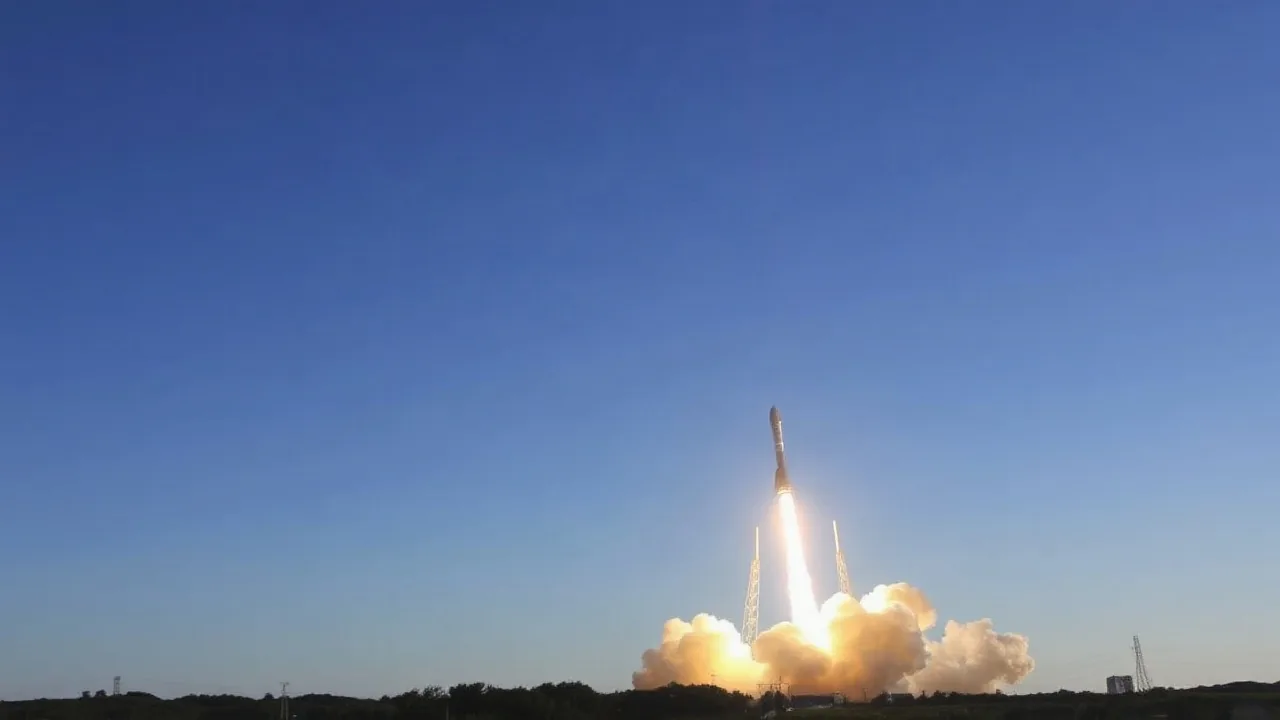
Japan launched a groundbreaking mission on October 21, 2026, aiming to collect the first-ever rock samples from Phobos, one of Mars's two moons. The Martian Moons eXploration (MMX) spacecraft, developed by the Japan Aerospace Exploration Agency (JAXA), embarked on its journey from the Tanegashima Space Center in southern Japan, marking a significant step in planetary science and space exploration. This ambitious endeavor seeks to shed light on the origins of the Martian moons and the broader solar system.
The MMX mission is designed to travel to the vicinity of Mars, orbit its moon Phobos, land on its surface, collect a sample, and then return the material to Earth. Scientists anticipate that the analysis of these samples could provide unprecedented insights into the conditions under which the Martian moons formed. Unlike Earth's Moon, Phobos and its sibling Deimos are thought to be captured asteroids, but their exact origin remains a subject of scientific debate.
Unlocking Solar System Secrets
The MMX spacecraft, a successor to the highly successful Hayabusa2 asteroid sample-return mission, is equipped with advanced instruments for observation and sample collection. It will spend approximately three years traveling to Mars. Upon arrival in 2027, it will observe Phobos for about a year, studying its surface and internal structure before attempting a brief landing. The collection process is expected to take mere seconds, utilizing a sampling mechanism that will capture regolith and potentially small rock fragments.
JAXA's chief scientist for the MMX mission, Dr. Hitoshi Kuninaka, stated, "This is a once-in-a-lifetime chance to retrieve material from a body that may hold clues to how our solar system evolved. The data we gather could rewrite textbooks." The mission is a collaborative effort, with NASA contributing to tracking and potential future operations. The return journey is scheduled to begin in 2029, with the sample capsule expected to land on Earth in 2031.
The unique nature of Phobos, which orbits Mars at a remarkably close distance, presents both opportunities and challenges. Its low gravity and irregular shape make landing and sample collection complex. MMX will employ a small rover, dubbed the "Little Giant," developed by the French space agency CNES, to assist in surface operations and imaging before the main lander touches down. The rover's data will be crucial in selecting a safe landing site for the lander.
Understanding the composition of Phobos samples is vital for understanding the early solar system's history. If Phobos and Deimos are indeed captured asteroids, their composition could reflect the primitive material present in the asteroid belt billions of years ago. This would offer a direct window into the building blocks of planets. Alternatively, if they formed from debris ejected by Mars-creating impacts, their analysis would reveal details about Mars's own early geological activity. The mission's success hinges on precise navigation and the spacecraft's ability to withstand the harsh space environment.
The launch itself was a significant logistical and technological achievement. The MMX spacecraft is powered by solar arrays and utilizes ion engines for propulsion, similar to its predecessor. The mission carries a suite of scientific instruments, including cameras, spectrometers, and a drill, all designed to comprehensively study Phobos and secure a viable sample. JAXA has emphasized the importance of international cooperation in achieving the mission's ambitious goals, fostering a spirit of shared discovery in space exploration.