
Pacific Mastodon Tooth Unearthed in San Francisco Bay Area Creek
A well-preserved Pacific mastodon tooth, estimated to be thousands of years old, was discovered by a geomorphologist working on a habitat restoration project in a San Mateo County creek.

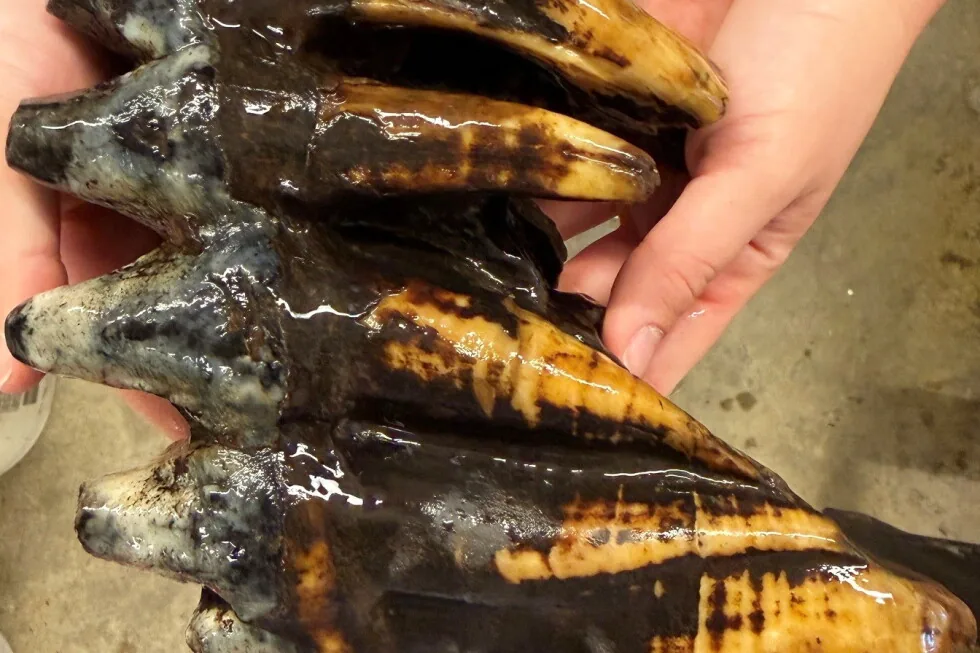
A fossilized tooth from a Pacific mastodon, an extinct elephant-like mammal, was discovered earlier this year in a wooded creek in the San Francisco Bay Area. Brigid Lynch, a geomorphologist with Balance Hydrologics, found the specimen while working on a habitat restoration project for the threatened California red-legged frog in a Midpeninsula Regional Open Space District preserve located in San Mateo County.
The find, announced this week by the Midpeninsula Regional Open Space District, is in remarkable condition. "It’s in great condition," said Chrissy Garcia, curator and manager of the specimen collections at Stanford University’s Doerr School of Sustainability, where the fossil has been donated. "So we’ve got both the crown and the root of the fossil. You can even see root canal." Garcia noted the tooth measures approximately 9 inches (23 centimeters) long.
Pacific mastodon fossils are not uncommon depending on the region, according to Ron Tykoski, vice president of science and curator of vertebrate paleontology at the Perot Museum of Nature and Science in Dallas. He explained that multiple mastodon species inhabited North America for millions of years, with the last ones disappearing between 10,000 and 12,000 years ago. "The way this was found is actually the way a lot of specimens are found, just somebody who happened to be in the right place," Tykoski said.
Conservation efforts highlight ancient discoveries
The discovery underscores the value of preserving natural lands. Ryan McCauley, a spokesperson for the Midpeninsula Regional Open Space District, stated that finding such a significant piece of ancient history during a project aimed at protecting current species reinforces the importance of these efforts. "That this tooth, that this molar, was found in the context of trying to protect the habitat and save another species from potentially going extinct I think really just drives home the point of why it’s so important to care for these open spaces and these natural lands," McCauley said.
Stanford University plans to conduct further analysis on the tooth to determine its exact age. The university will also create a 3D replica of the fossil for the Midpeninsula Regional Open Space District to use for public outreach and educational purposes. This specimen represents a tangible link to the prehistoric past of the San Francisco Bay Area, offering insights into the megafauna that once roamed the region. The recovery of such well-preserved fossils, like this Pacific mastodon molar, provides invaluable data for paleontologists studying ancient ecosystems and climate change. The ongoing work in San Mateo County to restore habitats for species like the California red-legged frog not only aids current wildlife but also potentially uncovers more secrets from California's ancient past.