
Physicists Challenge Dark Energy Theory, Proposing New Cosmological Model
A growing number of physicists are questioning the existence of dark energy, a mysterious force believed to drive the universe's accelerated expansion. They are developing alternative models to explain cosmic observations.

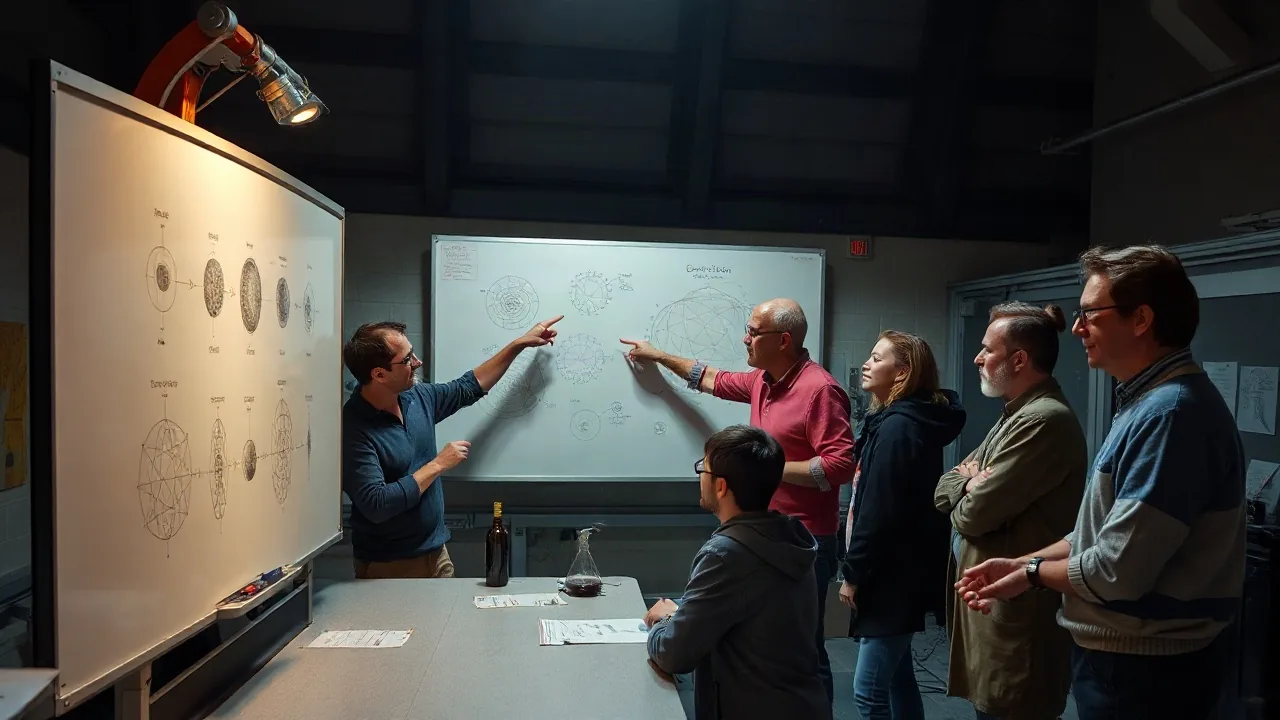
A bold proposition is reshaping the landscape of cosmology: the idea that dark energy, a concept introduced to explain the accelerating expansion of the universe, might not exist at all. This radical notion is being championed by a growing contingent of physicists who believe that existing observations can be explained by modifying our understanding of gravity, rather than invoking a new, unseen energy. The implications of this potential paradigm shift could fundamentally alter our comprehension of the cosmos.
For decades, the standard model of cosmology, known as Lambda-CDM, has relied on the existence of dark energy and dark matter to account for a wide range of astronomical phenomena. Dark energy, in particular, is thought to constitute roughly 68% of the universe and exert a repulsive force that pushes galaxies apart at an ever-increasing rate. However, some researchers argue that the evidence for dark energy is not as conclusive as commonly believed, and that its proposed existence leads to theoretical inconsistencies.
Rethinking the Cosmic Expansion
One of the leading figures in this reevaluation is theoretical physicist Professor Geraint Lewis from the University of Sydney. Lewis, alongside colleagues, has been exploring alternative theories that challenge the necessity of dark energy. He has even gone so far as to jest that if the established theories are proven wrong, he could retire. "If I'm wrong, I can retire," Lewis reportedly quipped, highlighting the conviction some hold in their alternative explanations.
The core of the alternative argument lies in the possibility that our interpretation of cosmic expansion might be flawed. Instead of attributing the acceleration to a mysterious force, these physicists suggest that the observed acceleration could be an illusion caused by our position in the universe or by modifications to Einstein's theory of general relativity. For instance, a theory proposed by Lewis and his collaborators suggests that the universe might not be expanding uniformly. Instead, what appears as acceleration could be a consequence of our vantage point within a specific cosmic structure.
Another avenue of research involves scrutinizing the precision of current measurements. Cosmological data, such as that from the cosmic microwave background radiation and distant supernovae, are used to infer the universe's expansion rate. However, subtle biases or limitations in these measurement techniques could potentially lead to misinterpretations. The so-called "Hubble tension"—a persistent discrepancy between measurements of the universe's expansion rate derived from early universe data and those from later epochs—further fuels the debate and underscores the need for robust explanations.
The implications of debunking dark energy would be profound. It would not only simplify our cosmological model but also necessitate a deeper understanding of gravity on cosmic scales. If a new theory of gravity can adequately explain the observed expansion without resorting to dark energy, it would represent a monumental achievement in theoretical physics. Such a development could also shed light on other cosmic mysteries, potentially unifying different branches of physics.
The scientific community remains divided on this issue. While many cosmologists continue to work within the Lambda-CDM framework, the challenges posed by these alternative theories are prompting a renewed focus on fundamental assumptions. The rigorous process of scientific inquiry demands that even the most established theories be subject to constant scrutiny and reevaluation. The quest to understand the universe's ultimate fate and composition is far from over, and these bold new ideas are pushing the boundaries of our cosmic knowledge.