
Physicists Uncover Hidden Gluon Structure in Protons, Rewriting Fundamental Physics
New findings from RHIC experiments suggest gluons, not just quarks, carry baryon number within protons, potentially altering foundational physics models taught worldwide.

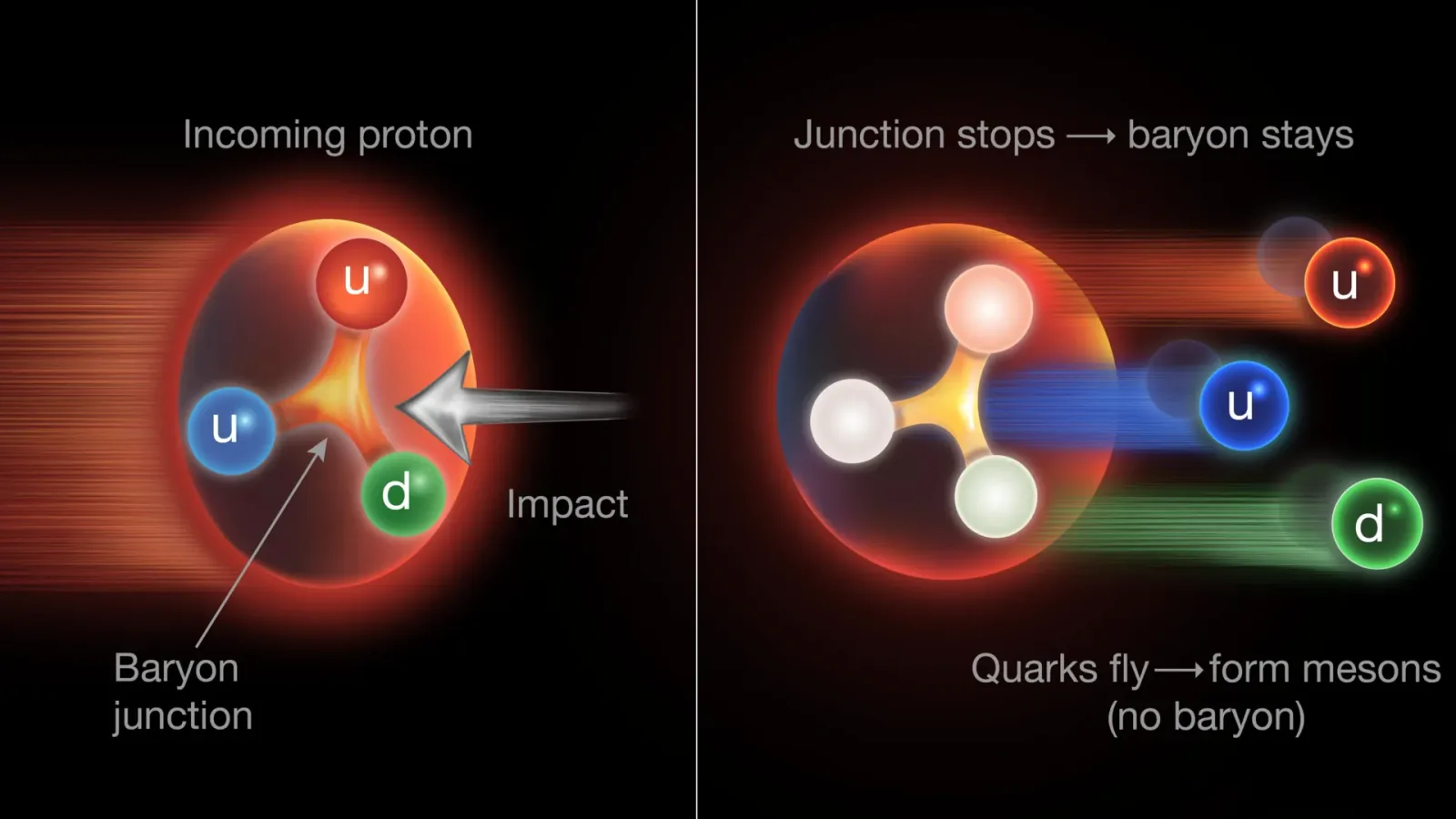
Physicists at the Relativistic Heavy Ion Collider (RHIC), a U.S. Department of Energy facility, have uncovered compelling evidence for a hidden structure within protons, where gluons may play a more significant role in defining baryon number than previously assumed. The research, published in the journal Science, indicates that a Y-shaped junction of gluons might be responsible for carrying this fundamental property, challenging decades-old assumptions about proton composition.
For years, the standard model posited that the baryon number of a proton is equally distributed among its three primary 'valence' quarks, with each quark carrying one-third. However, the recent findings from the STAR collaboration at RHIC suggest a different scenario. "Traditionally, scientists have assumed that each of the three main 'valence' quarks inside a proton or neutron carries one-third of the baryon number," explained Zhangbu Xu, a professor at Kent State University and a researcher at Brookhaven National Laboratory. "Our results suggest that the baryon number is not simply carried by individual quarks. Our findings strongly support the idea that baryon number is more favorably carried and transported by gluons... when arranged in this special configuration."'
A Decades-Old Theory Gains Traction
The concept of a 'baryon junction,' or a gluon junction, was first theorized in the 1970s as a mechanism connecting a proton's valence quarks via gluons. In 1996, theoretical physicist Dmitri Kharzeev proposed that this junction itself, rather than the quarks, could be the primary carrier of baryon number. The STAR collaboration's recent experimental work has now provided strong evidence to test this intriguing hypothesis.
The implications of accurately identifying what carries baryon number extend far beyond the subatomic realm. Baryon number conservation is a fundamental principle in particle physics, ensuring that the total number of baryons—three-quark particles like protons and neutrons—remains constant in all interactions, from particle collisions to the evolution of the universe since the Big Bang. "Since the Big Bang, the number of protons and neutrons all together never changes as a function of time," stated Nicole Lewis, a STAR physicist at Rice University. "The reasons for this conservation are not well understood. It's one of the mysteries of the universe, related to why we have more matter than antimatter." This conservation is also critical for the stability of matter as we know it, underpinning the extraordinarily long, theoretically greater-than-the-age-of-the-universe, lifetime of protons.
The established view, often depicted in textbooks, simplifies the proton's internal structure. It suggests three quarks carrying the baryon number, analogous to how electric charge is distributed. However, real protons are far more complex, teeming with interacting gluons and transient quark-antiquark pairs generated from the vacuum, as described by Quantum Chromodynamics (QCD). "In the naïve quark model, there are three quarks inside a proton, but nothing else," said Tommy Tsang, formerly a postdoc at Kent State University. "But if we look at details inside, there are not only three quarks but also a lot of gluons interacting... and there are also quarks and antiquarks that pop up from the vacuum, so it's actually a really complex object."
A key observation driving the new research was an unexpected excess of baryons detected emerging sideways, or perpendicular, from particle collisions at RHIC. If only valence quarks carried baryon number, this sideways excess would require all three quarks from a colliding proton to effectively stop, convert their energy into new particles, and then reform into baryons. The STAR researchers proposed that the gluon junction might offer a more plausible explanation.
To investigate this, the team ingeniously used the redistribution of electric charge during collisions as a benchmark. By comparing the net baryon number with the electric charge patterns, they found a significant discrepancy. The number of baryons observed perpendicular to the collision beams was roughly twice what would be expected if only stopped quarks accounted for the baryon number. This mismatch suggests that fewer quarks were stopping than the baryon excess would imply, leaving the question of what carried the additional baryon number.
The researchers theorize that the gluon junction, being more susceptible to stopping at high energies than the valence quarks themselves, could be the missing piece. When protons collide at RHIC's immense energies, the gluons within them multiply and distribute momentum. The junction, though always present, carries less individual momentum at these energies. If the junction is halted in a collision, its energy could directly convert into new baryons that are expelled sideways, while the quarks, still carrying significant forward momentum, continue along the original path. "The baryon junction is always there even as protons are accelerated to higher and higher energy," noted Prithwish Tribedy, a STAR physicist at Brookhaven Lab. "But at high energy, gluons within the proton split and multiply." This dynamic process within the proton fundamentally alters how baryon number is carried and conserved.