
2,000 Volunteers Aid Restoration of Giant Prehistoric Predator Skeleton
Over 2,000 volunteers are meticulously restoring the massive skeleton of a 240-million-year-old aquatic predator, the Mastodonsaurus, in Warsaw, Poland. This public science project offers a unique glimpse into paleontological work and Earth's ancient past.

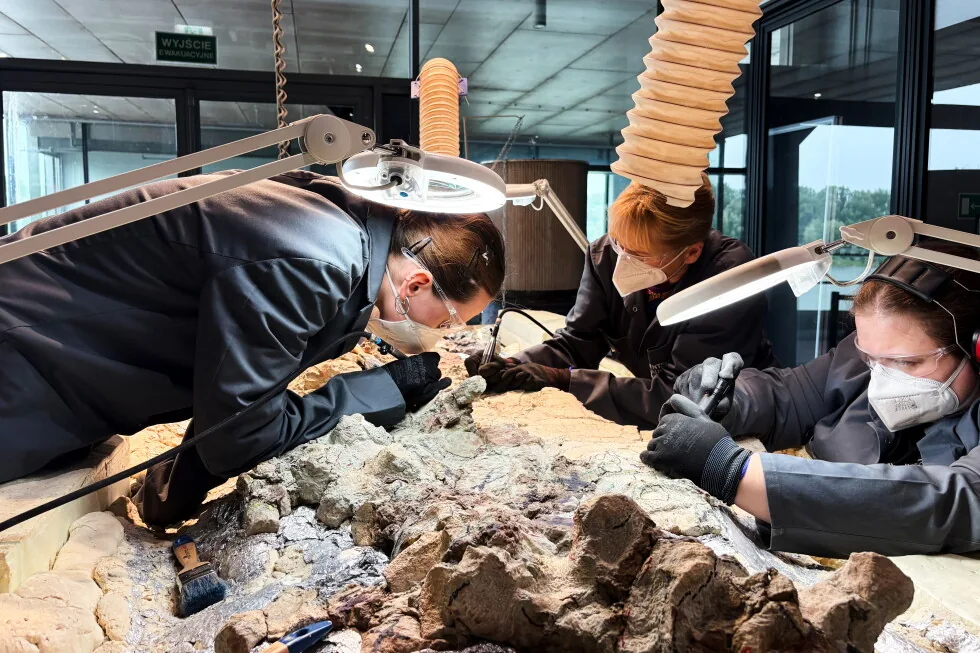
In a unique public science initiative in Warsaw, Poland, over 2,000 volunteers are painstakingly restoring the colossal skeleton of a prehistoric aquatic predator. Working in a specially designed laboratory at the Copernicus Science Centre, these citizen scientists, equipped with chisels, brushes, and protective gear, are carefully freeing the nearly six-meter (20-foot)-long remains of the Mastodonsaurus from the rock that encased them for roughly 240 million years. On the other side of a glass wall, the public can observe the intricate process, watching as ordinary citizens engage directly with paleontology.
The volunteers, a diverse group comprising managers, cleaners, and tattoo artists, undergo training before undertaking two-hour shifts under supervision. The technique involves meticulously separating bone from rock millimeter by millimeter, aided by pneumatic chisels and ultraviolet light that highlights the bone's edges. "I imagine that those bones were lying underground for 240 million years and I am the first human on earth to touch them," said Tatyana Kozyk, coordinator of the volunteer teams, describing the profound personal experience. "I’m still trying to wrap my head around this experience."
Unearthing a Prehistoric Giant
The Mastodonsaurus was one of the largest amphibians ever to inhabit Earth, thriving approximately 240 million years ago during the Middle Triassic period, a time when early dinosaurs were emerging but had not yet become dominant. This fearsome creature was an ambush predator, adapted for an aquatic lifestyle, with a broad, flat head, elongated jaws, and sharp conical teeth, bearing a superficial resemblance to a crocodile but belonging to a distinct evolutionary lineage. Scientists estimate its potential length at nearly six meters (20 feet).
The current skeleton, weighing an impressive 1,300 kilograms (2,865 pounds), is poised to be the largest exhibited globally, according to paleontologist Tomasz Sulej from the Polish Academy of Sciences. Sulej and his colleague Wojciech Pawlak discovered the remarkably intact specimen in southern Poland in 2023. Their decision to involve the public in the restoration process stemmed from the sheer scale of the find and a desire to foster public engagement with science. "The structure of the body is different from what we knew so far," Sulej stated. "This is information that is completely new to the scientific world." While other Mastodonsaurus skeletons have been found in locations such as Germany and Russia, they measure only about 2 to 3 meters (6½ to 10 feet) in length, making the Polish discovery exceptionally significant for understanding the species.
The project offers participants more than just an encounter with ancient life; it provides a philosophical perspective on deep time and nature's resilience. Dorota Serafin, a 51-year-old manager and volunteer, described the experience as simultaneously "relaxing and philosophical, even mystical." She plans to bring her family to see the exhibit when it is expected to open in October or November 2026.
The Mastodonsaurus lived during a period of significant ecological transition, emerging after the most devastating mass extinction event in Earth's history and preceding the rise of the dinosaurs. In an era grappling with the potential ramifications of climate change, Sulej sees the amphibian's story as a source of encouragement. "The Mastodonsaurus lived after the great extinction, which shows one thing, that nature always manages," he explained. "It’s not true that humans can destroy life on this planet. Nature and life always find ways to survive." This perspective underscores the enduring power of nature and the cyclical processes of life and extinction that have shaped our planet over millions of years.