
Astronomers Detect Possible Primordial Black Hole Near Distant Star
A rare gravitational microlensing event in 2019 briefly brightened a distant star, revealing a potential primordial black hole named Phoebe. This discovery could offer insights into the early universe.

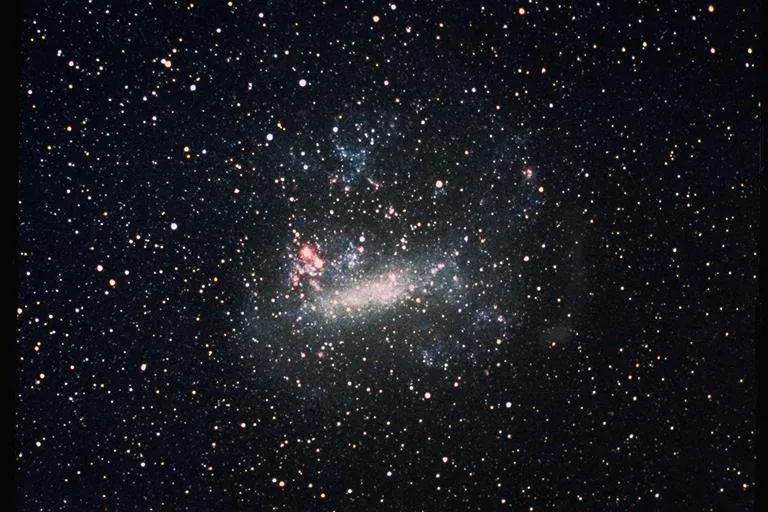
Astronomers have identified a fleeting celestial event from December 18, 2019, as a potential signpost for one of the universe's most enigmatic objects: a primordial black hole. The event, observed in data from the Large Magellanic Cloud, involved a distant star briefly brightening as an unseen object passed in front of it, a phenomenon known as gravitational microlensing. The mysterious object, now dubbed Phoebe, has presented scientists with a profound puzzle regarding its true nature and origin.
Gravitational microlensing, a direct prediction of Albert Einstein's general theory of relativity, occurs when the gravity of a massive object acts like a lens, magnifying the light of a more distant star. The characteristic rise and fall in brightness observed during the Phoebe event, lasting approximately an hour, is distinct from typical stellar variations or asteroid transits. This unique signature led a team from Swinburne University in Melbourne to conclude they were witnessing a genuine microlensing occurrence.
The primary question now is the identity of Phoebe. Scientists are considering three main possibilities. The first is a rogue planet, a world ejected from its home solar system and drifting independently through the galaxy. The second option is a similar planet, but originating from the Large Magellanic Cloud itself, which would mark the first detection of an extragalactic microlensing planet. The third, and perhaps most intriguing, scenario suggests Phoebe could be a primordial black hole. Unlike stellar black holes formed from collapsing stars, primordial black holes are theorized to have formed from density fluctuations in the immediate aftermath of the Big Bang, potentially existing before any stars.
Unraveling Phoebe's Identity
The duration of a microlensing event provides a crucial clue to the mass of the lensing object. Shorter events typically indicate lighter objects crossing the line of sight. Phoebe's event, lasting around 60 minutes, is at the very limit of detection for current astronomical surveys. Detailed analysis of the event's physics allowed the research team to calculate Phoebe's mass at approximately three times that of Earth's Moon.
This estimated mass presents a significant challenge to the planetary or stellar remnant black hole hypotheses. Stellar black holes possess a minimum mass roughly five times that of the Sun. Phoebe's calculated mass is orders of magnitude smaller, falling far below this threshold. This mass range is consistent with theoretical models of primordial black holes, which could be significantly less massive.
The Swinburne University team further calculated the probabilities of the lensing object belonging to various cosmic populations: stars within the Milky Way, stars within the Large Magellanic Cloud, or objects within the intervening dark matter halo. The results strongly favored the dark matter hypothesis, indicating that Phoebe is approximately 100,000 times more likely to be a dark matter object than any form of normal stellar matter.
If these findings are confirmed, Phoebe would represent one of the most ancient objects ever detected. Its existence would date back to the universe's infancy, formed in the chaotic conditions preceding the formation of the first stars and even the first atoms. The object, believed to have been drifting silently through the cosmos for roughly 13 billion years, made its presence known for a single hour by subtly bending the light from a distant star, offering a tantalizing glimpse into the universe's earliest moments. The search for and characterization of primordial black hole candidates continues to be a key goal in modern astrophysics, potentially unlocking secrets about the fundamental nature of dark matter and the very fabric of the early universe. Understanding such ancient objects could revolutionize our comprehension of cosmology and the evolution of the cosmos. The implications for astronomy are vast, potentially rewriting textbooks on galactic formation and the universe's first billion years. This single, brief event, linked to Phoebe, has opened a new avenue for exploring cosmic origins.