
Roman Space Telescope Lands on Launch Pad for Falcon Heavy Ascent
NASA's Nancy Grace Roman Space Telescope has arrived at its launch pad atop a SpaceX Falcon Heavy rocket. The mission is slated for liftoff from Florida's Kennedy Space Center on Sunday, August 30, 2026.

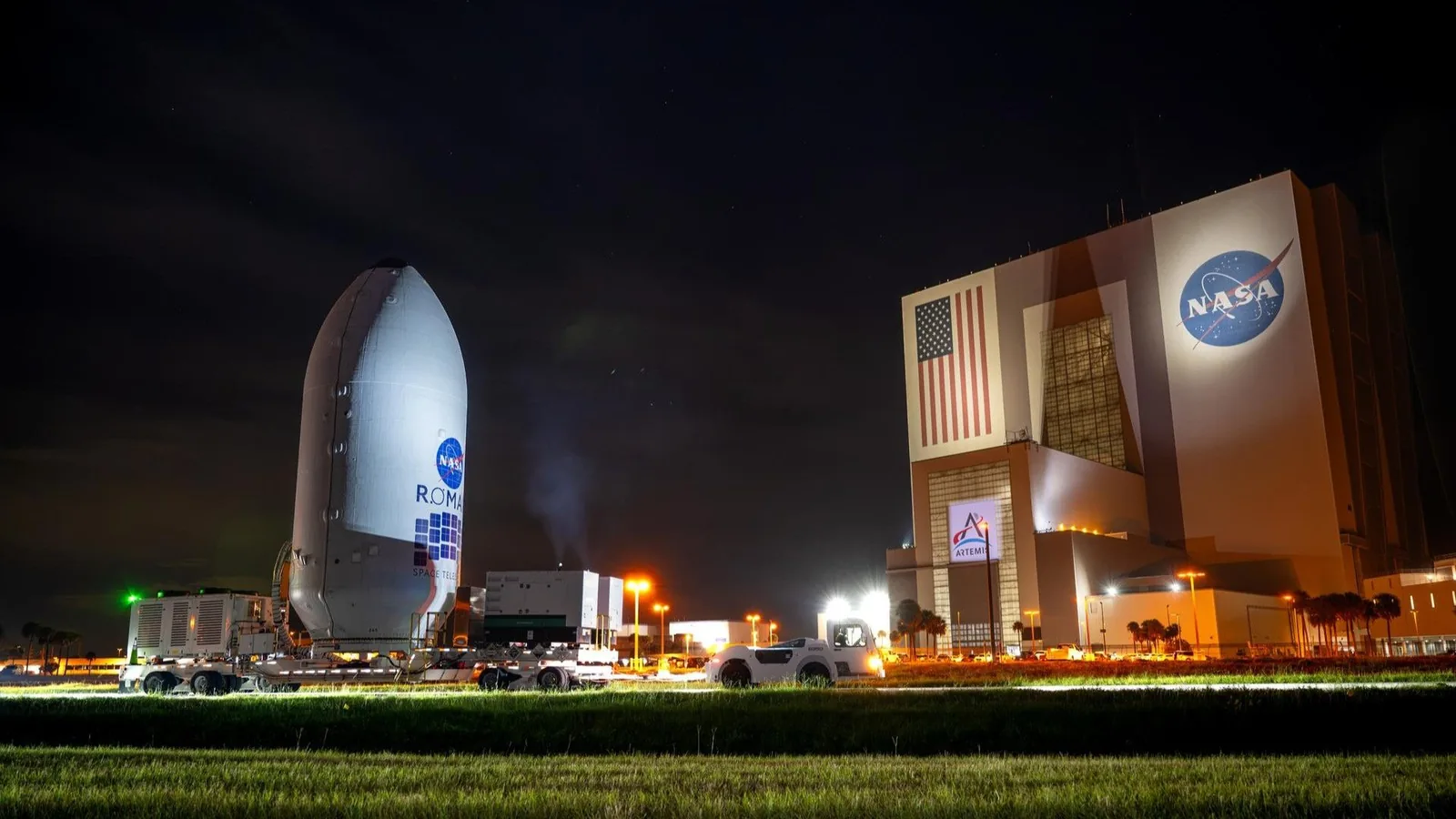
NASA's highly anticipated Nancy Grace Roman Space Telescope has officially arrived at its launch pad, situated atop a SpaceX Falcon Heavy rocket at Launch Complex-39A at the Kennedy Space Center in Florida. With the liftoff window opening Sunday, August 30, 2026, at 7:26 a.m. EDT, preparations are entering their final crucial hours. NASA and SpaceX teams have been conducting a series of press conferences and interviews throughout the day on August 29, providing mission overviews and the latest updates on weather conditions and rocket readiness.
The Roman Space Telescope, named after the pioneering astronomer Nancy Grace Roman, is a next-generation observatory designed to tackle some of the universe's most profound mysteries. Its mission objectives include conducting a wide-field survey to study dark energy and dark matter, as well as searching for and characterizing exoplanets using gravitational microlensing techniques. The telescope is equipped with two primary instruments: a wide-field instrument offering a field of view 100 times larger than the Hubble Space Telescope's camera, and a coronagraph capable of blocking starlight to directly image exoplanets.
Mission Overview and Launch Preparations
The science team for the Roman mission provided a detailed overview on August 29, discussing the telescope's sophisticated instruments and the groundbreaking discoveries anticipated. A prelaunch press briefing followed, offering the most current weather forecasts for the Sunday morning liftoff and confirming the status of the Falcon Heavy rocket. Both briefings were streamed live, allowing a global audience to follow the final countdown.
NASA announced on August 28 that the Roman Space Telescope was officially "go" for launch, following the successful conclusion of the mission's Launch Readiness Review at the Kennedy Space Center. This review involved extensive collaboration between NASA and SpaceX, the provider of the powerful Falcon Heavy rocket that will carry Roman into orbit. The launch is targeted for Sunday, August 30, at 7:26 a.m. EDT (1126 GMT) from Launch Complex-39A.
The Roman telescope will journey approximately 930,000 miles from Earth to the Sun-Earth Lagrange point 2 (L2). This gravitationally stable location allows the telescope to maintain a consistent orbit on the side of Earth opposite the sun, providing an unobstructed view of the cosmos. The journey to L2 is expected to take about 30 days, followed by a roughly three-month checkout period before scientific operations commence.
Weather forecasts for Sunday morning indicated favorable conditions, though a small chance of showers or thunderstorms existed. Clouds and lightning were identified as the primary meteorological concerns, with conditions expected to worsen later in the day. If the launch is postponed due to weather or technical issues, an immediate backup launch window opens on Monday, August 31, at 7:22 a.m. EDT (1122 GMT).
Earlier this week, SpaceX shared images of the Falcon Heavy rocket, highlighting its unique configuration: a core stage composed of three modified Falcon 9 boosters strapped together. This immense power is necessary to propel the Roman telescope to its distant operational orbit. The telescope itself underwent significant preparation at the Kennedy Space Center, including being loaded with 290 gallons of hydrazine fuel on July 25 and attached to its payload adapter in early August. It was then encapsulated within the Falcon Heavy's payload fairing and underwent a full launch-day dress rehearsal on August 20.
The successful encapsulation of Roman within its protective fairings marked a critical milestone. Following this, the observatory was transported overnight on August 25 from the Payload Hazardous Servicing Facility to SpaceX's hangar at Launch Complex-39A. There, it was mated to the Falcon Heavy rocket, and final fit checks and tests were conducted before the towering rocket was moved to the launch pad. The mission's success hinges on the intricate coordination between NASA's scientific objectives and SpaceX's launch capabilities, a testament to the collaborative spirit driving modern space exploration.