
Roman Telescope Separates from Rocket, Begins Space Journey
NASA's Nancy Grace Roman Space Telescope successfully detached from its SpaceX Falcon Heavy rocket on August 30, 2026. The observatory is now en route to its operational orbit at the Sun-Earth L2 point.

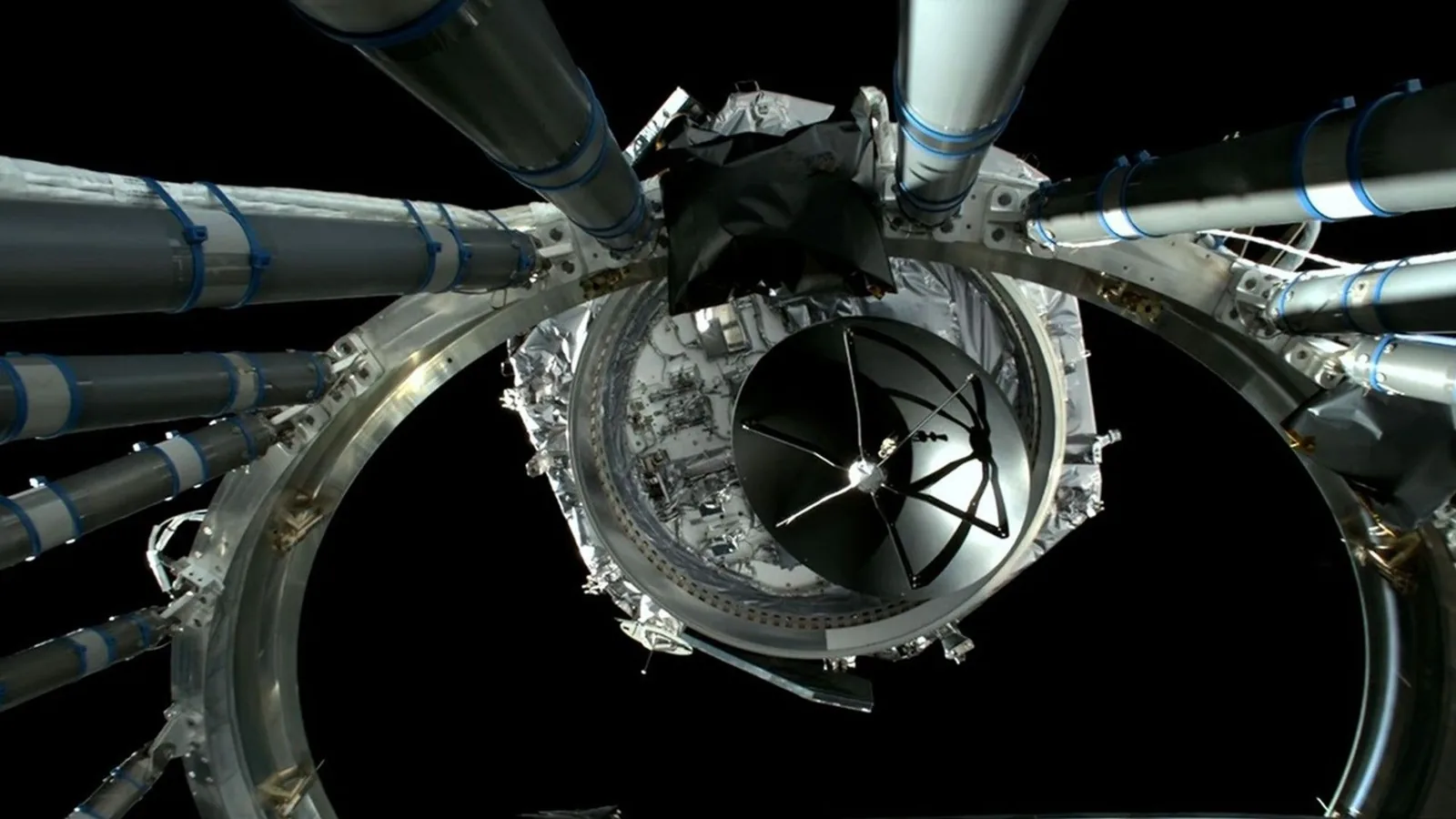
NASA shared a striking image on August 31, 2026, capturing the moment the Nancy Grace Roman Space Telescope deployed into orbit, successfully separating from its SpaceX Falcon Heavy rocket. The photograph, taken approximately 31 minutes after liftoff from NASA's Kennedy Space Center in Florida on August 30, shows the observatory floating independently against the blackness of space.
The image highlights the telescope's payload adapter in the foreground, with the Roman telescope itself appearing just behind. Its solar arrays are still folded, a configuration maintained for the launch phase. The view also reveals the rear of the telescope, including its High Gain Antenna (HGA), which will be crucial for transmitting scientific data and communicating with mission controllers on Earth.
Following its separation, the Nancy Grace Roman Space Telescope is beginning a 90-day commissioning period. Its journey will take it to the Sun-Earth Lagrange Point 2 (L2), a stable gravitational orbit located between the Earth and the Sun, approximately 1.5 million kilometers (930,000 miles) from Earth.
A Culmination of Years of Work
The successful deployment represents the culmination of over two decades of dedicated effort by NASA and its numerous contractors. The $4 billion Roman Space Telescope, a project known for its ambitious scientific goals, has notably been completed ahead of schedule and under budget, a rare achievement in the complex world of space exploration. This mission promises to revolutionize our understanding of the universe by conducting wide-field visual and infrared surveys.
This particular image offers a rare glimpse into the harsh conditions spacecraft face upon entering the vacuum of space. Witnessing such a deployment is not only visually stunning but also a testament to the intricate engineering and planning involved in modern space missions. The telescope's advanced instruments, including its ultra-wide field of view, will enable it to study dark energy, exoplanets, and a wide range of astrophysical phenomena.
The NASA observatory is designed to observe the universe with unprecedented clarity and breadth. Its primary scientific objectives include mapping the distribution of dark matter through gravitational lensing, searching for and characterizing exoplanets using microlensing techniques, and investigating the causes of the accelerating expansion of the universe. The SpaceX Falcon Heavy rocket provided the powerful boost necessary to send the substantial telescope on its way.
The telescope's mission duration is expected to be at least five years, but its design suggests it could operate for much longer. The data collected by the Roman telescope will be publicly available, fostering global scientific collaboration and accelerating discoveries across multiple fields of astronomy and cosmology. Its unique capabilities are expected to complement and extend the findings of other major observatories like the James Webb Space Telescope.