
Saturn's South Pole Hosts Mysterious 10-Sided Cloud Formation
The Hubble Space Telescope has detected a striking, 10-sided geometric pattern in Saturn's southern clouds. This newly observed phenomenon differs significantly from Saturn's well-known northern hexagon.

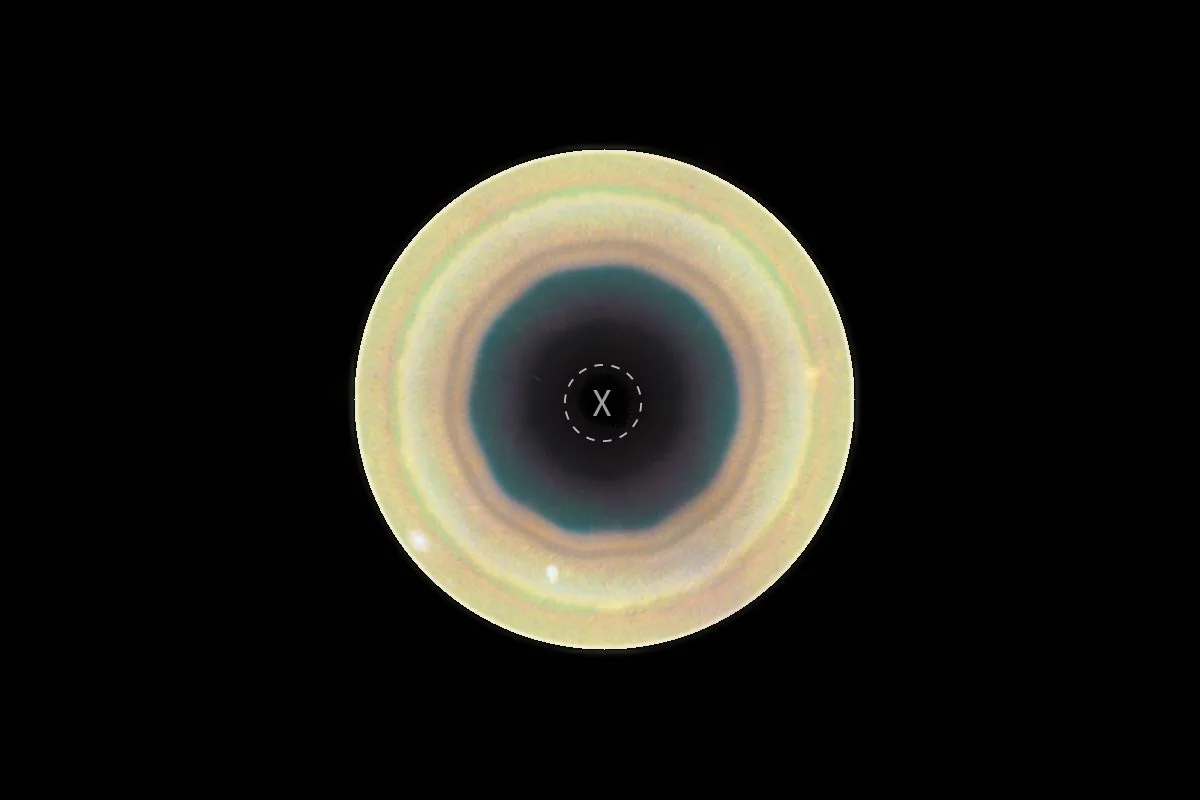
Astronomers have discovered a peculiar 10-sided geometric formation in the clouds of Saturn, encircling the planet's south pole. The unprecedented feature was identified using observations from the Hubble Space Telescope, revealing a dynamic atmospheric event unlike anything previously witnessed in the southern hemisphere. This discovery raises new questions about the complex weather systems operating on the ringed planet.
Saturn, a gas giant composed primarily of hydrogen and helium, is known for its powerful atmospheric jet streams, with winds capable of reaching speeds of up to 500 miles per hour. Within this turbulent atmosphere, the newly observed decagon has emerged as a significant point of scientific interest. While Saturn's northern pole is famously home to an eight-sided jet stream pattern, the well-documented "hexagon storm," this newly identified 10-sided feature presents a distinct and novel atmospheric phenomenon. Scientists are actively studying the formation to understand its origins and behavior.
New Phenomenon in Saturn's Southern Hemisphere
The identification of Saturn's decagon was made possible by analyzing years of Hubble Space Telescope data, with observations dating back to 2023. The changing seasons on Saturn have gradually brought its southern pole back into view from Earth, allowing astronomers to detect the emerging pattern. Agustín Sánchez-Lavega of the University of the Basque Country in Spain, the lead author of the study, first noticed subtle indications of the decagon through the university's Planetary Virtual Observatory Laboratory website. This site aggregates planetary images captured by observers worldwide.
In 2024, Sánchez-Lavega, along with amateur astronomers Trevor Barry and Jean-Paul Oger, identified a faint band along Saturn's southern pole. Subsequent analysis of images from 2025, captured from ground-based observatories, further suggested the presence of a decagon storm. The Hubble telescope's superior vantage point from space provided the crucial high-resolution imagery needed to confirm and fully characterize the feature. "Given Saturn’s symmetry in its north-south jet stream system, we have been searching for a counterpart to Saturn’s northern hexagon on the south pole in Hubble images since 1990," Sánchez-Lavega stated. "Images from the Cassini spacecraft, which orbited Saturn between 2004 and 2017, showed no inkling of a long-lived formation, either. The Hubble data confirmed the feature’s presence back to 2023."
The newly discovered wave-like feature is situated within one of Saturn's powerful jet streams and extends deep below the planet's visible cloud tops, permeating multiple atmospheric layers. This indicates it is not merely a surface-level cloud formation but a substantial atmospheric structure. The apparent shift in the decagon's position is attributed to Hubble's ability to capture images across different wavelengths of light, offering astronomers perspectives of various atmospheric altitudes. "We’ve never seen anything quite like this in Saturn’s southern hemisphere," said Amy Simon, a study co-author from NASA’s Goddard Space Flight Center. "The northern hexagon has been there every time we’ve looked for more than 40 years. This feature is different – it appears to be strengthening, giving us the rare opportunity to watch a giant atmospheric pattern develop."
Scientists are now planning further investigations into this enigmatic formation. Both the Hubble Space Telescope and the James Webb Space Telescope will be utilized to gather more detailed observations. Additionally, researchers will employ sophisticated computer models to simulate the decagon's formation process, estimate its potential lifespan, and draw comparisons with the enduring hexagon storm on Saturn's north pole. Understanding this unique atmospheric event could provide significant insights into planetary meteorology and the diverse range of phenomena that occur across our solar system. The rapid development of the decagon is particularly intriguing, prompting the question of why such a feature would emerge so suddenly after decades of observation.