
3 Major Solar Flares Ignite, Increasing Northern Lights Forecast
The sun unleashed three powerful solar flares and multiple CMEs in under 24 hours, boosting the chances for visible aurora displays across the Northern Hemisphere.

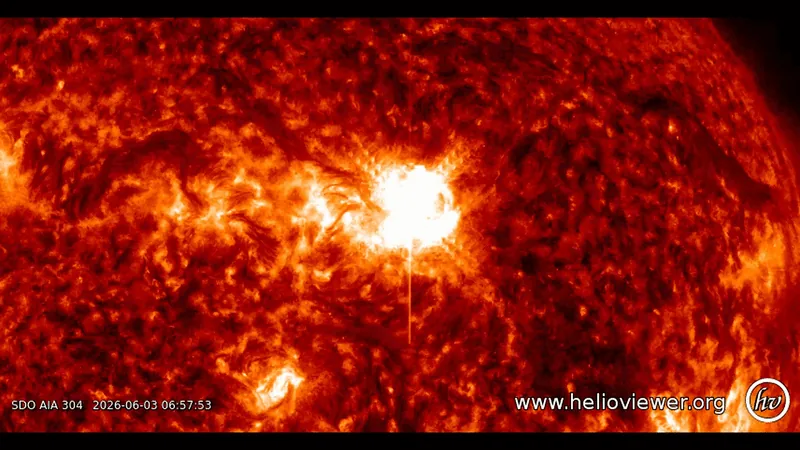
The sun erupted with three significant solar flares within a 24-hour period, prompting concerns about radio blackouts and raising the possibility of spectacular aurora displays reaching lower latitudes. The intense solar activity originated from sunspot region 4455, which has shown a pattern of instability. The flares, classified as M9.3, M7.9, and X1, occurred on June 2nd and 3rd, 2026, with the X1 event being the most powerful category. These eruptions triggered various levels of radio blackouts across different parts of the globe, affecting communication systems.
Space weather physicist Tamitha Skov noted the growing complexity of region 4455, warning that the risk of further X-class flares remained elevated. Her prediction proved accurate as the sunspot subsequently produced the powerful X1 flare. The multiple solar events have sent several coronal mass ejections (CMEs) towards Earth, though their exact trajectories and speeds are still under analysis by space weather agencies.
Geomagnetic Storm Watch Issued
The UK Met Office has confirmed at least one Earth-directed CME associated with the M9.3 flare, expected to arrive on June 4th. They are also examining a CME linked to the M7.9 flare. While the trajectory of the eruption from the X1 flare is still being investigated, the potential for significant geomagnetic storm activity is high. A strong (G3) geomagnetic storm watch has been issued for June 4th to 6th, with forecasts indicating potential G1-G3 storm levels. There is even a slight chance of isolated severe (G4) conditions if the incoming CMEs impact Earth with greater intensity than anticipated.
Geomagnetic storms are crucial for aurora visibility. When charged particles from the sun interact with Earth's magnetosphere, they create the stunning light displays known as the aurora borealis (northern lights) and aurora australis (southern lights). Stronger geomagnetic storms can drive these auroras much farther from the poles, making them visible in regions where they are not typically seen. This increased potential for auroras is exciting news for skywatchers across the Northern Hemisphere.
Vincent Ledvina, an aurora chaser, reported that three potentially Earth-directed CMEs are currently en route. Forecasters are diligently working to determine their precise paths and impact. The current situation highlights the dynamic nature of the sun and the ongoing efforts by scientists to predict and understand space weather events. The Sun's constant activity, particularly from active regions like 4455, poses both challenges to technology and opportunities for breathtaking natural phenomena. As scientists continue their analysis, all eyes remain on region 4455 for any further significant solar flares or CMEs in the coming days.