
SpaceX NASA Roman Space Telescope Launch Sets Dark Energy Probe
SpaceX successfully launches NASA's Roman Space Telescope, a landmark mission to investigate dark energy and dark matter. The 2026 deployment marks a major step in understanding the universe's expansion and composition.

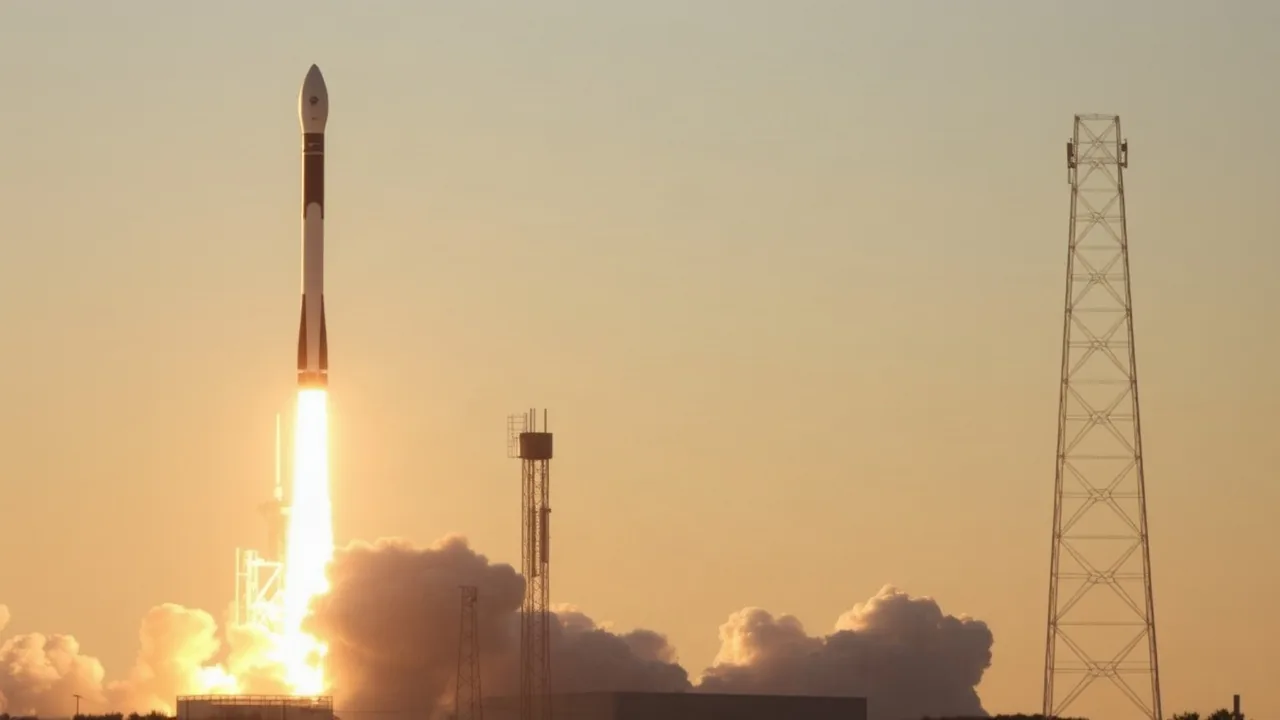
SpaceX's Falcon Heavy rocket lifted the Nancy Grace Roman Space Telescope into orbit on September 3, 2026, beginning one of NASA's most ambitious astrophysics missions. The deployment from Kennedy Space Center in Florida occurred at 7:14 a.m. EDT, with all three booster stages performing nominally before the payload achieved its target trajectory toward the second Lagrange point, approximately one million miles from Earth.
The Roman telescope represents a decade of development and represents a partnership between multiple space agencies and institutions. Unlike its famous predecessor, Hubble, Roman focuses on wide-field imaging and spectroscopy, capturing views of the universe as much as 100 times larger than Hubble's field of view while maintaining comparable image sharpness.
"This launch is a transformative moment for observational cosmology," said Dr. Yun Wang, principal investigator at NASA's Jet Propulsion Laboratory. "Roman's instruments will help us understand what is driving the accelerated expansion of the universe, a mystery that has puzzled astrophysicists for nearly three decades."
Mission Architecture and Scientific Objectives
The Roman Space Telescope carries two primary scientific instruments designed to detect dark energy through multiple observational techniques. The Wide Field Instrument (WFI) will survey billions of galaxies across billions of years of cosmic history, while the Coronagraph Instrument will directly image exoplanets and study their atmospheres.
Roman's core mission focuses on three major scientific questions:
- Measuring the expansion history of the universe and constraining dark energy parameters
- Cataloging exoplanet populations and their diversity across stellar types
- Studying supernovae and dark matter distributions in distant galaxies
The spacecraft entered a period of autonomous deployment after separation from the rocket's upper stage. Solar panels extended successfully, and initial telemetry confirmed all systems operating within nominal parameters. The journey to the L2 point, where it will remain for its primary mission duration, takes approximately three months, during which the telescope's optical elements will reach cryogenic operating temperatures.
NASA and SpaceX teams spent the launch day monitoring critical deployment sequences from Johnson Space Center in Houston and SpaceX Mission Control in Hawthorne, California. The successful launch represents the culmination of rigorous pre-flight verification protocols that had been underway since 2024.
Why Dark Energy and Dark Matter Remain Cosmic Frontiers
Observations made by the Hubble Space Telescope in 1998 revealed that the universe's expansion is accelerating rather than slowing under gravity's pull. This discovery, which earned the 2011 Nobel Prize in Physics, led to the introduction of "dark energy" as a placeholder for an unknown repulsive force permeating all of space. Dark energy comprises approximately 68 percent of the universe's total energy content.
Dark matter, invisible material detected only through its gravitational effects, accounts for roughly 27 percent of the universe. Ordinary matter, the atoms forming stars, planets, and people, comprises less than 5 percent. Understanding these invisible components represents one of fundamental physics' grand challenges.
Roman's observational strategy employs a technique called weak gravitational lensing, which measures minute distortions in light from distant galaxies caused by dark matter. By analyzing how dark matter bends space across billions of galaxies, scientists can map the universe's invisible scaffolding and test competing theories about dark energy's nature and strength.
The mission will conduct a detailed census of supernovae across cosmic time, providing independent constraints on dark energy's equation of state. Different types of stellar explosions produce different brightness profiles, and measuring thousands of supernovae at known distances yields information about how the universe's expansion rate has changed over billions of years.
Integration with the Broader Space Astronomy Landscape
The Roman telescope's arrival represents the third major space-based observatory in NASA's current fleet, alongside NASA's James Webb Space Telescope, which focuses on infrared observations of the early universe, and the Hubble telescope, still active after 36 years in orbit. The three observatories work synergistically, with Roman's wide-field capabilities complementing Webb's deep imaging and Hubble's ultraviolet-to-near-infrared spectrum.
SpaceX's role in the space launch infrastructure has transformed NASA's mission deployment timeline. The Falcon Heavy's reusability reduced costs significantly compared to previous heavy-lift vehicle options. The rocket's performance on September 3 included successful recovery of two of three side boosters, adding to SpaceX's operational flight data.
International partners contributed components and scientific expertise to Roman. The mission reflects NASA's collaborative approach to 2026 space missions, with contributions from astronomers and engineers across North America and Europe.
The telescope will undergo a six-month commissioning phase, during which mission operators will test all instruments, calibrate optical systems, and verify that observed data matches predictions from ground-based testing. First scientific observations are expected in early 2027, with results potentially reshaping our understanding of the universe's fundamental nature.