
SpaceX and NASA Chart Divergent Paths in Space Exploration Race
SpaceX's commercial focus and NASA's science-driven missions represent two distinct strategies reshaping the future of spaceflight in 2026. Both organizations are accelerating launches and advancing rocket technology.

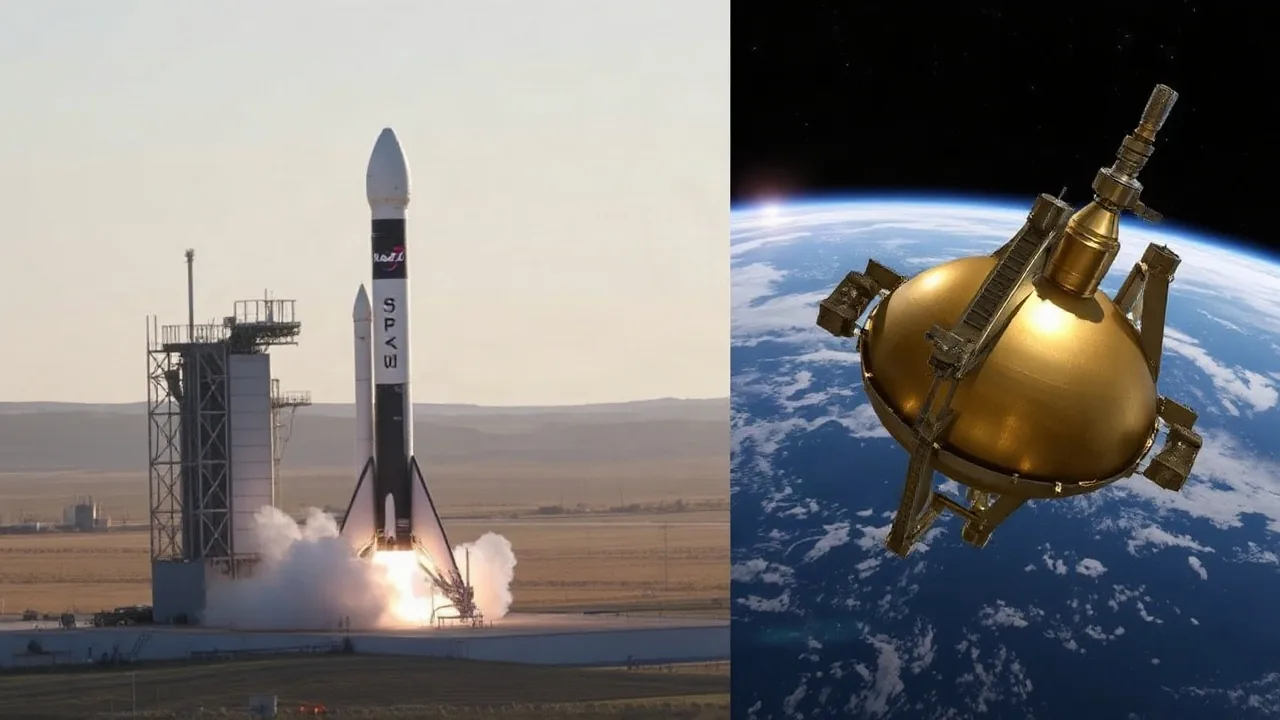
SpaceX sent its 23rd Starship integrated flight test to orbit in mid-August 2026, while NASA's Nancy Grace Roman Space Telescope continues delivering unprecedented infrared images from deep space. These parallel achievements underscore a fundamental shift in how humanity explores beyond Earth: private industry and government agencies are pursuing different but complementary objectives.
The contrast reflects two competing visions. SpaceX prioritizes rapid iteration and commercial returns through cargo delivery, satellite deployment, and eventual human missions to Mars. NASA, by contrast, emphasizes fundamental astronomy, planetary science, and international collaboration through robotic probes and space telescopes.
"We're seeing the emergence of a dual-track space economy," said Dr. Sarah Chen, senior analyst at the Aerospace Industries Association, in an interview on September 3, 2026. "SpaceX is optimizing for frequency and cost reduction, while NASA is optimizing for scientific discovery and risk management."
SpaceX's Commercial Acceleration
SpaceX has maintained a launch cadence of roughly one Starship flight test every two to three weeks throughout 2026. Each iteration incorporates hardware changes and software refinements designed to achieve reusability and eventual payload capacity. The company's focus extends across multiple markets: government contracts for national security launches, commercial satellite deployment for Starlink expansion, and deep-space cargo missions in support of NASA's Artemis program.
Elon Musk's company has also begun accepting customer payloads for dedicated Starship missions. In June 2026, SpaceX signed agreements with three commercial space companies to transport cargo to lunar orbit by 2027. This represents a shift from launch provider to mission enabler, directly competing with established aerospace contractors.
The business model depends on rocket technology that is far more reusable than anything previously flown. SpaceX's current booster design demonstrates sustained recovery rates above 95 percent, allowing rapid turnaround and predictable per-flight costs. This economic advantage has forced competitors and government agencies to reconsider procurement strategies.
NASA's Science Mission Advancement
NASA's Roman Space Telescope, launched in May 2024 and now operating at full capacity, has fundamentally changed how astronomers study distant galaxies and exoplanet candidates. The infrared observatory completed its first all-sky survey in July 2026, cataloging over 180 million objects. Roman's wide field of view and sensitivity to infrared wavelengths exceed those of the James Webb Space Telescope, making it essential for population surveys and statistical cosmology.
Beyond Roman, NASA is preparing the Artemis II lunar mission for November 2026, which will send four astronauts around the Moon for the first time in half a century. This precursor to lunar landing missions represents a strategic commitment to sustained human exploration of the cislunar environment. The mission depends entirely on SpaceX's Starship Human Landing System and Boeing's Space Launch System, demonstrating that NASA's long-term strategy requires private sector partnership.
NASA's planetary science division has also launched two new rovers to Mars in the 2026 launch window and approved funding for a sample return mission targeting the 2031 launch. These commitments reflect a sustained research agenda that operates on timescales of years or decades, distinct from SpaceX's quarterly iteration cycle.
Complementary Roles in Future Exploration
The divergence between SpaceX and NASA reflects different mandates and risk tolerances. SpaceX accepts higher failure rates as part of rapid development and can make unilateral design decisions. NASA operates under congressional oversight, environmental regulations, and international treaties that require detailed documentation and approval processes. Both approaches have merit.
Future space missions will likely depend on collaboration between these organizations. NASA has contracted SpaceX to deliver cargo and crew to lunar orbit during Artemis III (scheduled for 2027 or 2028). Simultaneously, SpaceX is pursuing independent Mars cargo missions that could prepare landing sites for NASA-sponsored human exploration in the 2030s.
The Roman Space Telescope's discoveries are already informing target selection for future deep-space missions. In August 2026, Roman data identified a galaxy cluster at redshift 3.8 (roughly 12 billion light-years distant) that NASA has nominated for follow-up observations by the James Webb Space Telescope and future flagship observatories.
Investment in aerospace technology is accelerating across both sectors. The U.S. government allocated $28.4 billion to NASA in fiscal 2026, while SpaceX received approximately $5.2 billion in government contracts. Private venture capital continues funding smaller launch providers and space technology startups, suggesting that competition will intensify over the next five years.
By 2026, it is clear that space exploration is no longer a single endeavor but a constellation of overlapping initiatives. SpaceX's emphasis on rapid innovation complements NASA's emphasis on scientific rigor and international cooperation. Both pathways are necessary to achieve humanity's long-term presence beyond Earth.