
New Earth Interior Map Reveals Hidden Structures Near Core
Scientists have mapped previously unknown structures deep within Earth's interior, located near the boundary of the solid mantle and liquid outer core. These findings, based on analysis of earthquake data and machine learning, offer new insights into our planet's formation.

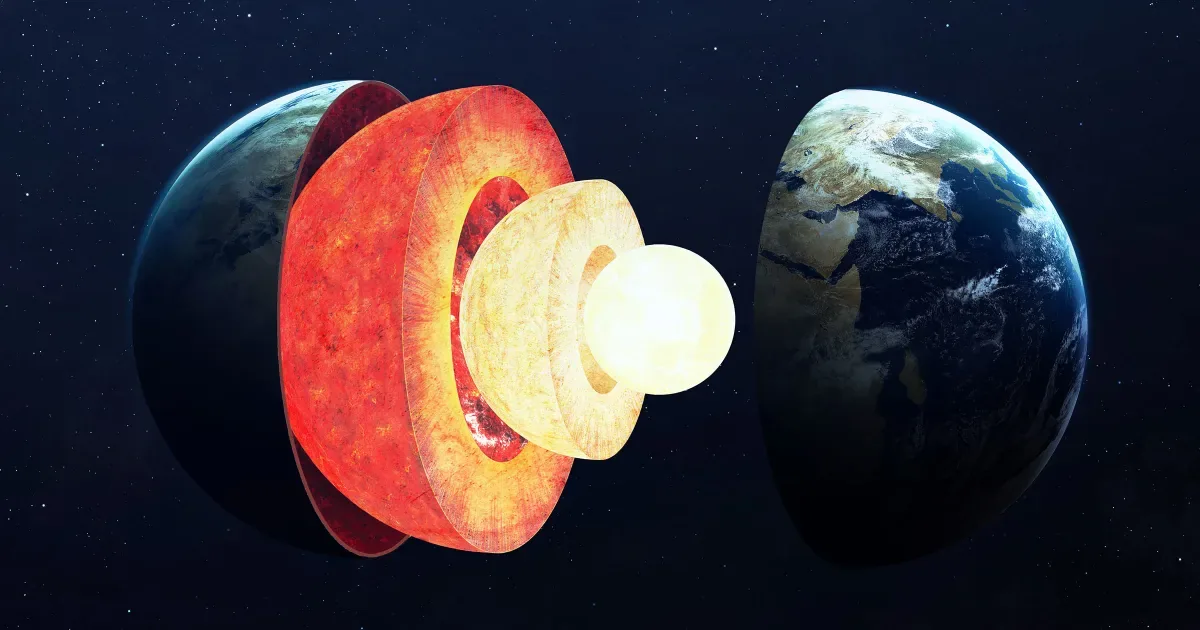
Researchers have unveiled an unprecedentedly detailed map of structures hidden deep within the Earth's interior, near the boundary where the solid mantle meets the liquid iron core. The discovery, published in the Journal of Geophysical Research: Solid Earth, was made possible by analyzing data from over two million earthquakes recorded between 1990 and 2024, utilizing a sophisticated machine learning algorithm. This new understanding of our planet's inner workings provides crucial clues about its formation and geological evolution.
Exploring Earth's deepest layers—the crust, mantle, outer core, and inner core—is a significant challenge due to extreme conditions and technological limitations. Geologists typically rely on seismic waves from earthquakes to infer the composition and structure of these inaccessible regions. The latest study, led by scientists from the Chinese Academy of Sciences, focused on "PKP precursors," subtle seismic signals that arrive just before the main earthquake's waves. These precursors act as messengers, revealing details about the material they traverse thousands of miles beneath the surface.
The machine learning algorithm proved remarkably effective, identifying approximately 175,000 PKP precursors. This represents a tenfold increase compared to the number identified in all previous research combined. Traditionally, detecting and analyzing these signals required laborious manual effort. "Whereas previous studies could only identify sparse, isolated patches sampled by precursors, our results reveal that these potential heterogeneities may extend across broad regions in the form of continuous bands," the researchers stated in their findings.
Uncovering Earth's Hidden Architecture
These newly identified precursors are believed to originate from "small heterogeneities"—variations in density or composition—located roughly 1,800 miles below the surface, just above the core-mantle boundary. The study claims to present the "most complete global map to date of potential small-scale heterogeneities in the Earth’s deep interior." This comprehensive mapping has revealed six previously undocumented areas exhibiting significant structural anomalies.
The implications of these findings are substantial for understanding Earth's geological history. Scientists theorize that these ancient structures, appearing as six larger groups distributed globally, could be remnants of ancient subduction zones. Subduction occurs when one tectonic plate slides beneath another and is pulled deep into the planet's mantle. At the intense pressures and temperatures found near the core-mantle boundary, this subducted material undergoes significant chemical alteration, leading to changes in its physical properties. This process is fundamental to the dynamics of plate tectonics and the formation of the planet's crust.
Further research into these deep-Earth structures could yield critical insights into predicting seismic activity. By understanding the conditions and materials present at various depths, scientists may be able to improve forecasts for the timing and severity of future earthquakes. This enhanced predictive capability is vital for disaster preparedness and mitigation efforts worldwide. Moreover, the detailed mapping contributes to unraveling the complex processes that led to the formation of Earth's distinct layers and the ongoing evolution of its tectonic plates, offering a deeper understanding of the planet we inhabit.