
SpaceX Preps Roman Space Telescope Launch for NASA Mission
SpaceX is readying its Falcon Heavy rocket to deploy NASA's Roman Space Telescope, a pivotal observatory designed to map dark energy and detect exoplanets. The mission marks a major collaboration between the aerospace firm and the space agency in 2026.

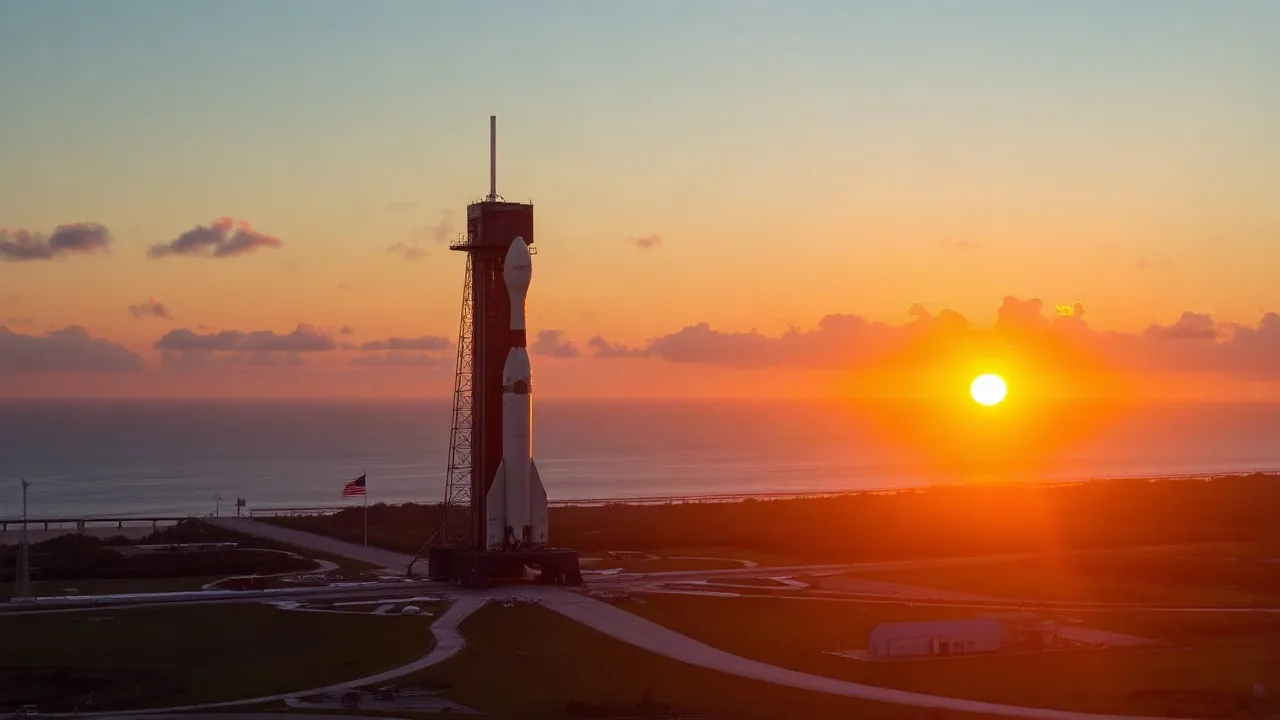
SpaceX is making final preparations to launch NASA's Roman Space Telescope aboard a Falcon Heavy rocket, marking one of the most anticipated space missions of 2026. The Roman telescope, named after astrophysicist Nancy Grace Roman, is poised to become one of the most powerful instruments in humanity's quest to understand the cosmos, particularly the mysterious force of dark energy that accelerates the universe's expansion.
The telescope represents a collaboration spanning multiple federal agencies and private industry, with SpaceX selected as the primary launch provider. Roman's 2.4-meter primary mirror and advanced imaging capabilities will allow astronomers to observe faint galaxies, measure cosmic distances with unprecedented precision, and search for signs of habitable exoplanets around distant stars.
"The Roman Space Telescope will revolutionize our understanding of the universe's large-scale structure and the nature of dark energy," said Thomas Zurbuchen, Associate Administrator for the Science Mission Directorate at NASA headquarters, during a recent briefing. "This mission builds on the legacy of Hubble and will prepare us for the next generation of space observatories."
Launch Timeline and Technical Details
The Falcon Heavy rocket is scheduled to lift off from Kennedy Space Center in Florida during the fourth quarter of 2026. This heavy-lift vehicle, capable of carrying approximately 64 tons to low Earth orbit, has become the workhorse for missions requiring immense payload capacity since its debut in 2018.
Roman will travel roughly one million miles to reach the second Lagrange point, or L2, a gravitational equilibrium location beyond Earth's orbit where gravitational forces from the sun and Earth essentially balance. This vantage point provides Roman with an unobstructed view of the cosmos and minimizes thermal fluctuations from Earth's infrared radiation.
The telescope carries several key instruments:
- Wide Field Instrument for imaging and spectroscopy across a field of view 100 times larger than Hubble's
- Coronagraph for directly imaging exoplanets and circumstellar disks
- Advanced detectors sensitive to near-infrared wavelengths
- Precision pointing systems accurate to within 0.05 arcseconds
The total cost for Roman's development, construction, and operations through its initial five-year mission is approximately 2.4 billion dollars. NASA has invested heavily in this observatory as part of its strategic initiative to answer fundamental questions about cosmic evolution.
Why Dark Energy and Exoplanet Science Matter Now
Dark energy comprises roughly 68 percent of the universe's total mass-energy content, yet scientists still lack a complete understanding of its properties and origin. Roman's observations will use multiple techniques, including weak gravitational lensing and baryon acoustic oscillations, to map the universe's geometry and measure how dark energy's strength may change over cosmic time.
The coronagraph instrument aboard Roman will be capable of blocking out starlight to reveal exoplanets orbiting their host stars directly. Current methods rely almost entirely on indirect techniques such as transit photometry and radial velocity measurements. Roman's direct imaging capability could identify potentially habitable worlds and characterize their atmospheric composition.
Between 2024 and 2026, discovery of confirmed exoplanets has accelerated dramatically, with missions like TESS adding thousands of candidates to the catalog. Roman will enable astronomers to study these worlds in detail and search for biosignatures or technological indicators on nearby stars.
"Roman represents a watershed moment in exoplanet science," noted Dr. Jennifer Lotz, Project Scientist for the Roman Space Telescope at the Space Telescope Science Institute in Baltimore. "We will move from simply finding exoplanets to characterizing them in ways that were impossible just five years ago."
SpaceX's Role and Industry Significance
SpaceX's selection as launch provider reflects both the Falcon Heavy's proven track record and the company's competitive pricing compared to other heavy-lift options. The rocket has successfully carried national security payloads, deep space probes, and interplanetary missions since 2018, accumulating a reliability record that earned NASA's confidence.
The partnership also signals a broader trend within NASA to leverage commercial launch capabilities for scientific missions. Over the past three years, the space agency has increasingly contracted with private firms like SpaceX, Blue Origin, and United Launch Alliance for exploratory and observational missions.
Successful deployment of Roman will open pathways for additional collaborative missions and may influence procurement decisions for future observatories. Roman's launch represents a major validation of SpaceX's capabilities for delicate, high-value government scientific instruments.
The mission also carries symbolic weight: it honors the legacy of Nancy Grace Roman, a pioneering female astronomer who played a crucial role in conceptualizing the space telescope program at NASA during the 1960s and 1970s. Her vision for orbital observatories paved the way for Hubble, Chandra, James Webb, and now Roman.
As 2026 progresses, updates on pre-launch preparations, weather forecasts, and final system checkouts will dominate the conversation among space enthusiasts and the scientific community. The successful deployment of Roman will mark a decisive chapter in humanity's effort to unlock the universe's deepest mysteries.