
SpaceX Stock: The Case for Aerospace Investment Today
SpaceX's rapid expansion in satellite launch, lunar missions, and Mars ambitions positions it as a cornerstone play in aerospace investment. Investors weigh soaring valuations against the company's demonstrated execution and industry leadership in 2026.

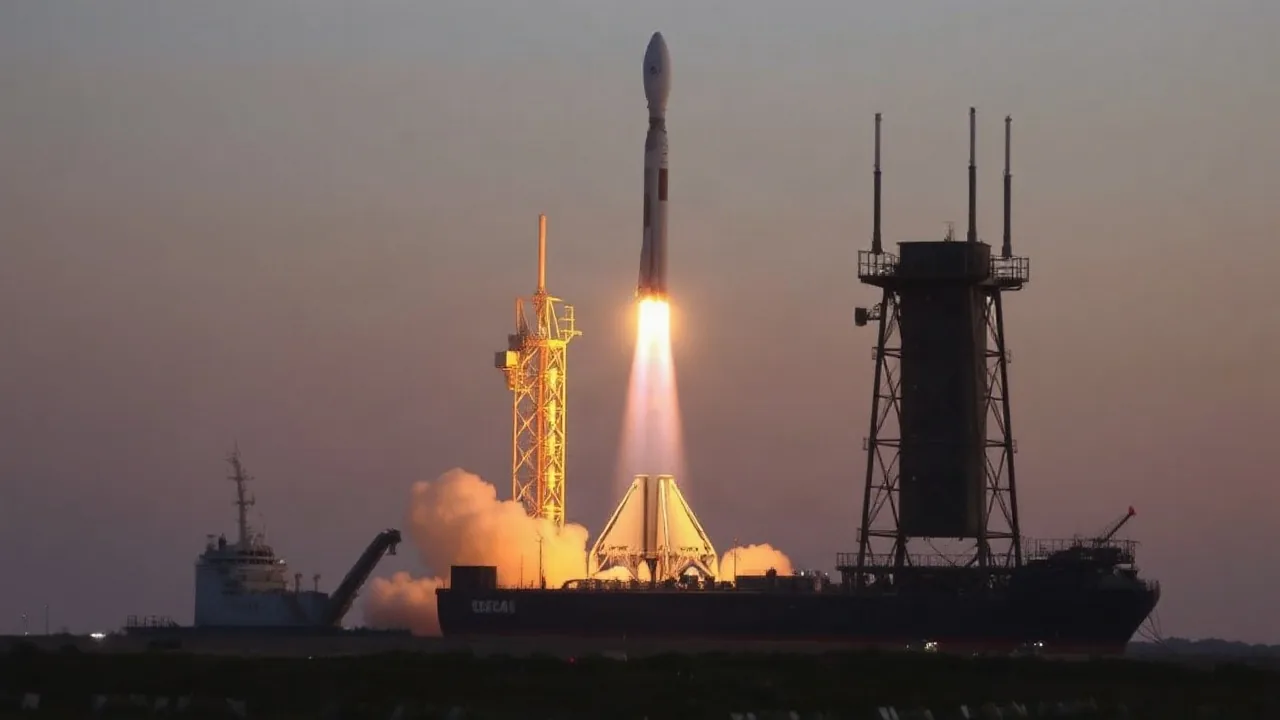
Elon Musk's SpaceX launched its Starship vehicle to unprecedented heights this October, completing another test flight that pushed the boundaries of reusable rocket technology and reinforced the company's position as the dominant force in commercial spaceflight. The milestone comes as investor appetite for SpaceX stock reaches new intensity, with private market valuations climbing sharply and widespread speculation about a potential initial public offering.
The company has fundamentally reshaped the launch industry. SpaceX's Falcon 9 rocket has become the workhorse of global space operations, handling roughly 70 percent of orbital launches in 2026. This dominance translates directly to revenue: the company reported an estimated $6.3 billion in annual revenue for 2025, up from $5.7 billion the prior year, driven by government contracts, commercial satellite deployments, and its emerging Starshield defense division.
"SpaceX has demonstrated operational excellence that legacy aerospace contractors took decades to achieve," said Casey Frazelle, senior analyst at Morgan Stanley's aerospace division, in a recent note to clients. "The question for investors is not whether the company can execute, but whether current valuations price in the full scope of its long-term opportunity."
Revenue Streams and Near-Term Growth
SpaceX generates income through several distinct channels. Its primary business remains launch services, where Falcon 9 commands premium pricing due to unmatched reliability and reusability. The company has successfully landed and reflown first-stage boosters over 300 times as of mid-2026, a feat that undercuts competitor pricing by 30 to 50 percent.
Government contracts provide stability. NASA has allocated $2.9 billion for SpaceX's cargo resupply missions through 2030, while the U.S. Space Force and Space Development Agency have awarded over $1.4 billion in launch and infrastructure contracts in 2026 alone. These agreements lock in steady revenue and reduce customer acquisition risk.
Starlink, the satellite internet constellation, represents the most speculative but potentially transformative revenue source. The division has deployed over 7,200 satellites in orbit and claims over 3.2 million subscribers globally as of September 2026. Starlink's path to profitability hinges on achieving higher penetration in rural markets, where it faces competition from Amazon's Project Kuiper and OneWeb, alongside traditional ISPs expanding broadband access.
The company's defense-oriented Starshield offering emerged in 2023 and generated an estimated $800 million in contracts during 2025-2026, targeting the Pentagon's need for resilient military communications infrastructure.
Valuation, Risk, and the IPO Question
SpaceX's private market valuation reached $180 billion in its most recent funding round this March, making it the highest-valued aerospace venture globally. That valuation implies a price-to-sales ratio of roughly 28 times on 2025 revenue, far above traditional aerospace contractors trading at 1.5 to 2.5 times sales. The premium reflects investor conviction about future growth, but also embeds significant execution risk.
An IPO remains unconfirmed, though Musk has hinted publicly that a public listing could occur within two to three years. Such a move would unlock liquidity for early investors and provide SpaceX with equity currency for acquisitions or large capital expenditures. The timing depends on regulatory clarity around aerospace investment rules and Musk's strategic priorities.
Key risks include regulatory delays in launch licensing, potential competition from emerging international players, and Starlink's unproven path to profitability. Additionally, the company's tight operational focus and limited public financial disclosure create information asymmetry for prospective public shareholders.
"SpaceX has removed many technical barriers to spaceflight, but the company still depends on a handful of critical engineers and a supply chain that could face disruption," cautioned Janet Levine, aerospace sector analyst at Barclays Capital. "Investors betting on a near-term IPO should anticipate higher governance scrutiny and lower margins post-listing."
The Broader Space Industry Context
SpaceX's success has catalyzed explosive growth across the space industry. Commercial space revenues globally exceeded $520 billion in 2025 and are projected to reach $650 billion by 2028, according to Morgan Stanley research. Satellite broadband, on-orbit servicing, and lunar resource extraction represent emerging subsectors.
Competitor dynamics shifted in 2026. Blue Origin, backed by Amazon founder Jeff Bezos, continues development of its New Glenn heavy-lift vehicle, expected to achieve operational status in 2027. Axiom Space has received additional NASA funding to build commercial space station modules. These companies and dozens of smaller ventures depend partly on SpaceX's launch capacity and pricing benchmarks.
The regulatory environment favors rapid commercialization. The Federal Communications Commission approved additional orbital slots for Starlink in August 2026, and Congress passed the Space Infrastructure Modernization Act, which streamlined licensing for launch providers and reduced bureaucratic timelines from 18 months to under 12 months.
For investors seeking technology stocks with near-term cash generation and decade-long upside, SpaceX presents both compelling fundamentals and material uncertainty. The company's demonstrated ability to execute, paired with tailwinds in satellite communications and government spending on space capabilities, justify a premium to traditional aerospace peers. Yet valuation, regulatory risk, and Starlink's profitability timeline remain open questions that a public listing would force into sharper focus.
The coming 24 months will clarify whether SpaceX's ambitions for Mars colonization, point-to-point hypersonic transport, and global internet coverage can translate into durable shareholder returns or remain aspirational. Until then, private equity investors and venture stakeholders holding SpaceX positions operate with incomplete visibility into true economic value.