
Arctic Sperm Whales Use Bubbles to Stay Afloat While Resting
Scientists discovered that resting sperm whales in the Arctic Circle release bubbles to manage buoyancy, preventing them from ascending too quickly to the surface while in a vulnerable state.

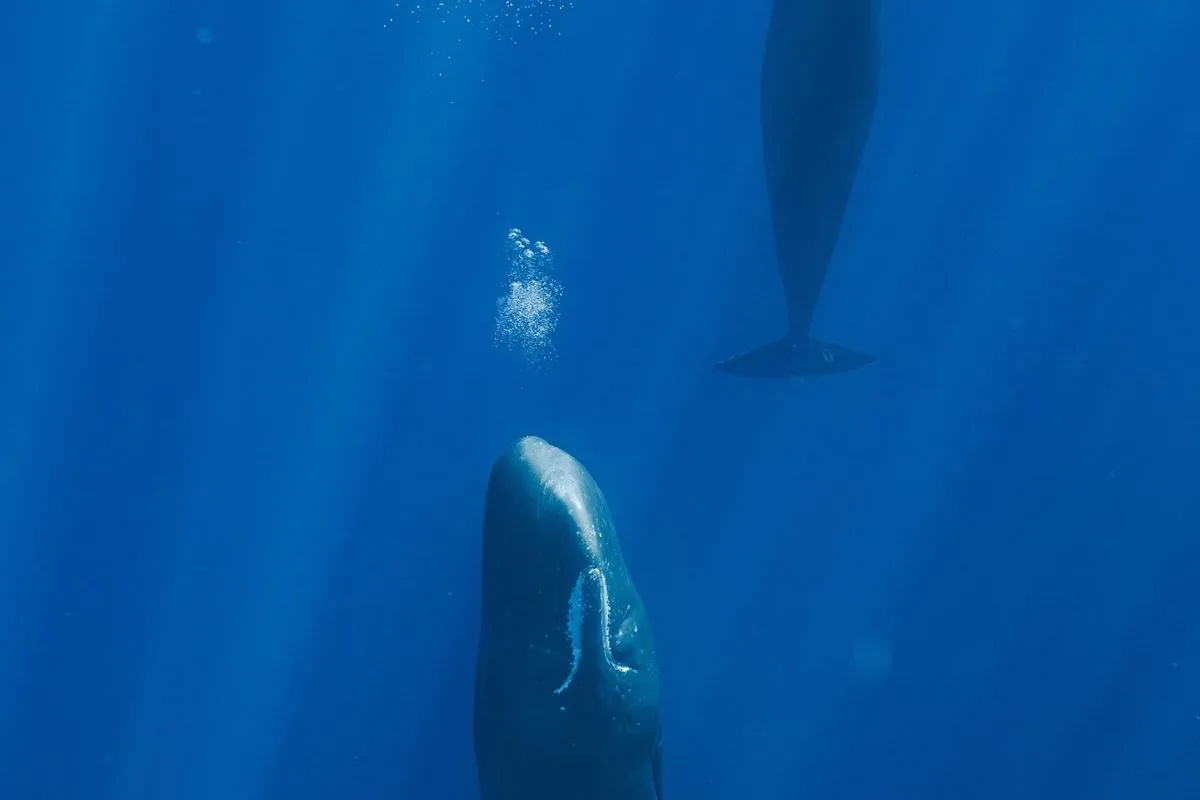
Researchers have observed a fascinating behavior in sperm whales within the Arctic Circle: the release of bubbles while they are in a resting state. These colossal marine mammals, known for their deep-diving capabilities, hover vertically near the surface, resembling a line of toy soldiers. A new study published in the Journal of Experimental Biology suggests that these bubbles play a crucial role in regulating buoyancy, preventing the whales from inadvertently surfacing too rapidly.
Sperm whales, the largest toothed whales on Earth, are air-breathing mammals that require conscious effort to take each breath. Unlike humans, they cannot achieve full, deep sleep for fear of drowning. Instead, scientists believe they practice unihemispheric sleep, similar to dolphins, where one half of the brain rests while the other remains alert, allowing them to monitor for threats. During these resting periods, which typically last between 10 and 15 minutes, the whales position themselves several meters below the surface—close enough to breathe but far enough to avoid choppy waves.
The release of bubbles during these rest bouts is theorized to be a sophisticated method of buoyancy control. As whales dive, the air in their lungs compresses. Upon ascending, this air expands, increasing positive buoyancy. According to the study's authors, releasing bubbles would allow the whales to counteract this expansion, achieving a neutral buoyancy that keeps them stable underwater.
Bubble Behavior and Buoyancy Regulation
A team of scientists, including Noémie Freymond from the Université de Neuchâtel, Switzerland, and Alec Burslem and Patrick Miller from the University of St. Andrews’ Sea Mammal Research Unit, investigated this theory. They equipped 42 sperm whales with specialized recorders capable of measuring depth and detecting bubble sounds during their resting periods. The researchers also ran simulations to determine if bubble releases effectively help sperm whales manage their net buoyancy.
The findings indicated a correlation between depth and bubble release frequency. Whales resting closer to the surface, typically after shallower dives, released more bubbles—around 11 instances compared to three or four from those returning from deep dives of 200 meters or more. In deeper waters, the increased pressure compresses lung air more significantly, reducing the need for extensive buoyancy modulation upon ascent. "In cases where resting dives started at depths exceeding 100m, the number of bubble releases decreased," the study authors noted. "This suggests that these individuals did not need to modulate buoyancy via bubble release to rest long enough because of the greater ascent distances."
While the study strongly suggests a buoyancy-regulating function for these bubbles, the authors acknowledge that it might not be the sole purpose. Other possibilities include roles in gas exchange, specifically the release of excess carbon dioxide. Furthermore, the ability to maintain position and regulate buoyancy during rest implies a level of spatial awareness even in a state of reduced consciousness. "If the whales are indeed sleeping during these resting periods, our findings indicate that they are capable of fine positioning control even during sleep," the study states.
This research sheds new light on the complex adaptations of these intelligent marine mammals. Understanding how Arctic Circle sperm whales manage their physiology during rest provides valuable insights into their behavior and survival strategies in challenging environments. The study underscores the intricate ways marine life has evolved to navigate and thrive in the ocean's depths, highlighting the importance of continued research into the behavior of these magnificent creatures.