
Trump Congratulates NASA's Roman Space Telescope After Budget Battles
President Trump surprised a NASA press conference by calling in to celebrate the successful launch of the Roman Space Telescope, a mission he previously sought to cancel.

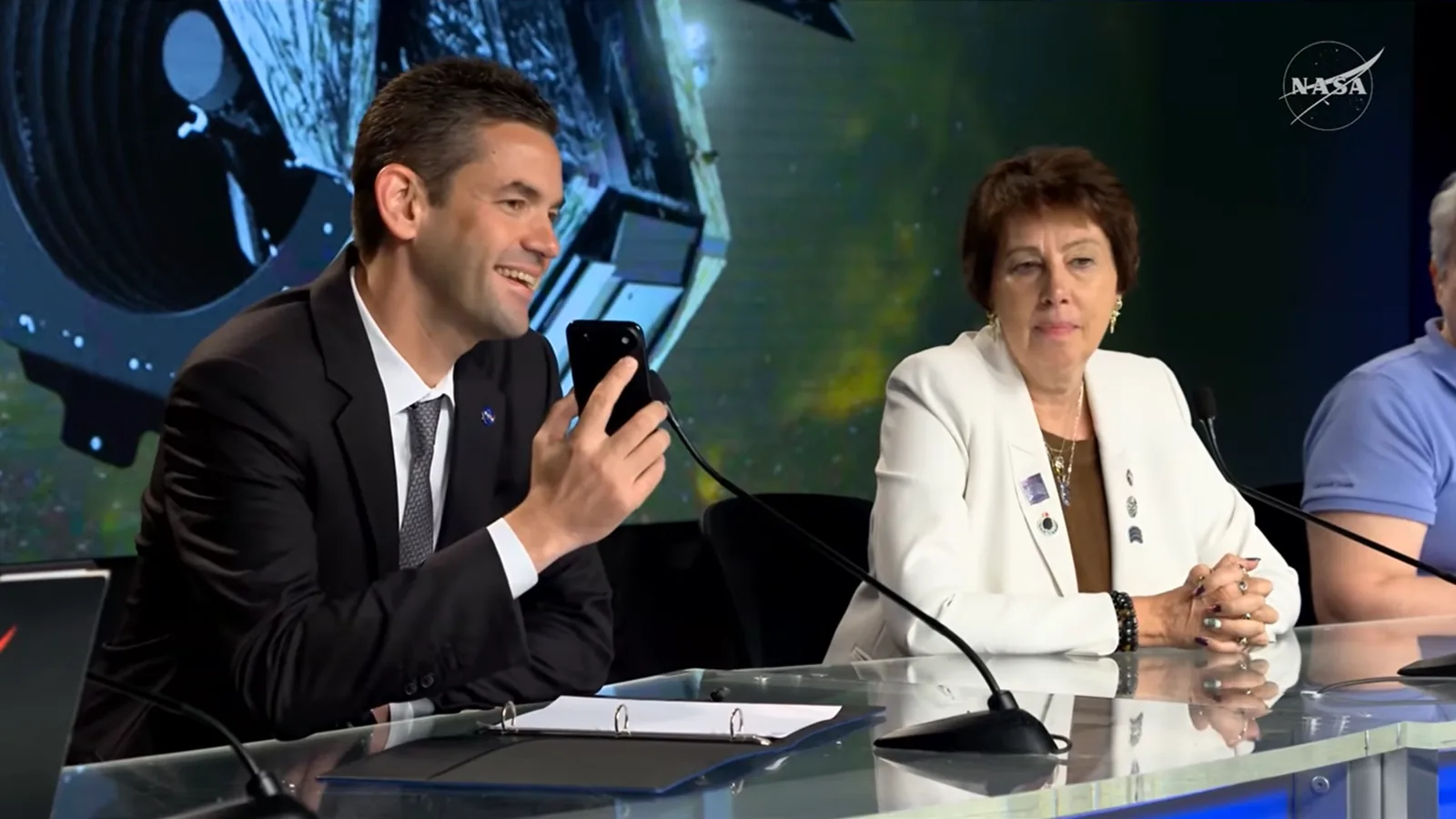
President Donald Trump made an unexpected appearance via telephone at a NASA press conference on August 30, 2026, to congratulate the team behind the successful launch of the Nancy Grace Roman Space Telescope. The call came just a few years after the former president's administration repeatedly attempted to defund or cancel the ambitious observatory, highlighting a complex history between the White House and the landmark scientific endeavor.
During a briefing detailing the Roman telescope's successful ascent and its anticipated scientific contributions, NASA Administrator Jared Isaacman received a call that momentarily silenced the room. Nicky Fox, NASA's associate administrator for the Science Mission Directorate, confirmed the call's significance, stating, "He's not kidding." Isaacman stepped out to take the call but returned to announce that the President of the United States wished to address and congratulate the mission personnel. "You're live, Mr. President," Isaacman announced before holding the phone to the microphone, displaying Trump's name.
"I just want to thank everybody and congratulate you," Trump stated during the nearly minute-long call, which was broadcast to the gathered science journalists. "Boy, it looked beautiful on television... You are doing a fantastic job, and I'm supplying you all that money." Trump also briefly reminisced about a visit to NASA's Kennedy Space Center in Florida early in his first term, which he described as being in disrepair. He contrasted this with his administration's impact, asserting, "Now, again, like we are with the country itself, we're the hottest there is. We're the hottest. You're the hottest in space, and we have the hottest country anywhere in the world." It was noted that Kennedy Space Center was only closed for two days in 2016 due to Hurricane Matthew.
Contradictions in Funding History
The congratulatory call stood in stark contrast to the Trump administration's prior actions regarding the Roman mission, then known as the Wide Field Infrared Survey Telescope (WFIRST). Between 2019 and 2021, the White House proposed eliminating Roman's funding in three separate budget requests. Despite these proposals, Congress consistently rejected the cuts and maintained funding for the project. More recently, in April 2025, leaked budget documents indicated potential slashes of approximately 50% to NASA's science division, which experts suggested could have effectively ended the Roman mission. However, Congress ultimately approved a fiscal year 2026 NASA budget of $24.4 billion, keeping the agency's overall funding relatively stable.
Following Trump's call, SpaceNews reporter Jeff Foust directly questioned Administrator Isaacman about the administration's past attempts to zero out or severely cut the Roman budget and what might have swayed the president's current enthusiasm. Isaacman did not directly answer the question regarding policy changes but expressed gratitude for the current support. "I'm incredibly grateful for his support, the space policy, the resources," Isaacman responded. "Sounds like from that call, maybe even more resources, which is also a great thing for more missions of science and discovery." The incident underscored the fluctuating political landscape surrounding major scientific projects, even those with widespread bipartisan support among lawmakers.
The Nancy Grace Roman Space Telescope, launched on August 30, 2026, is designed to tackle some of the most pressing questions in astrophysics. Its primary mirror is three times larger than Hubble's, and its wide-field instrument will survey 100 times the area of the sky. This allows it to conduct unprecedented surveys of exoplanets, dark energy, and the Milky Way galaxy. The mission's development has been a multi-year effort involving thousands of scientists and engineers across the United States and internationally, with significant contributions from NASA centers like Goddard Space Flight Center and contractors like Ball Aerospace and L3Harris.