
US Army Tests High-Tech Urban Warfare at Fort Irwin Exercise
Thousands of US soldiers simulated an urban assault at Fort Irwin, California, testing new drone and AI technologies in a high-stakes preparation for future conflicts.

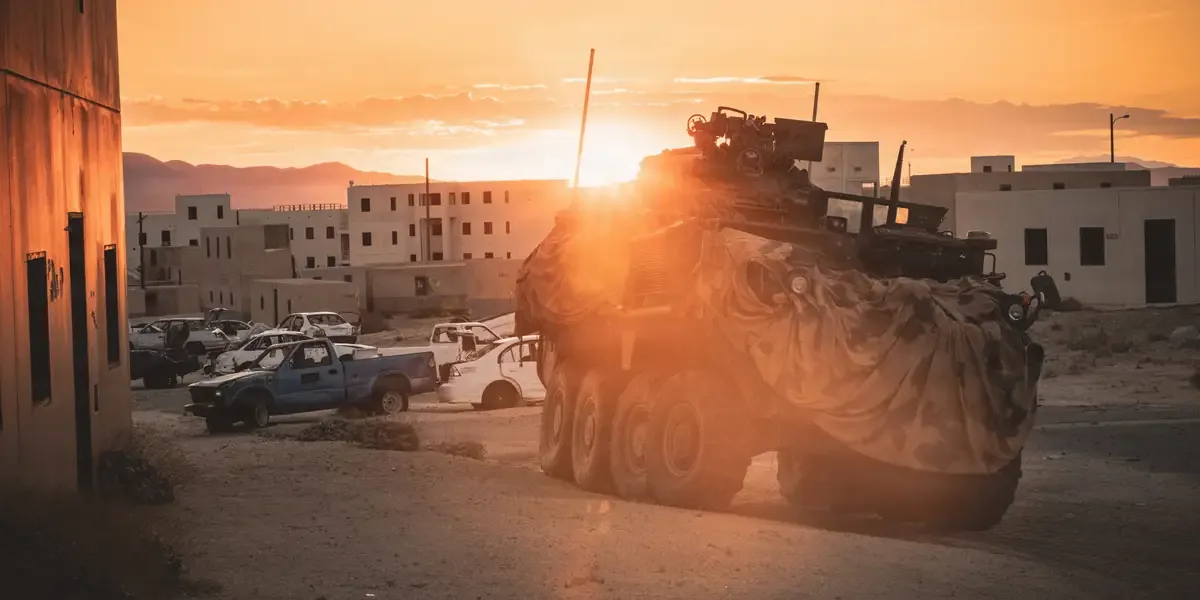
Thousands of U.S. soldiers stormed a simulated desert city at Fort Irwin, California, this summer during the Army's Project Convergence Capstone exercise. The massive drill, involving nearly 10,000 personnel, put soldiers through rigorous urban combat scenarios designed to prepare them for high-tech warfare against formidable adversaries.
The exercise centered on clearing streets and buildings within a mock city, known as Razish, against a backdrop of intense heat and simulated enemy obstacles. This included navigating barbed wire, vehicles, and concrete barriers. The opposing forces were represented by the Army's 11th Armored Cavalry Regiment, nicknamed "Blackhorse." Alongside traditional combat drills, the exercise integrated emerging technologies, including drones and advanced software, to evaluate their impact on situational awareness and combat effectiveness.
"I'm able to find with my UAS [uncrewed aerial system], I'm able to fix with fires, and then I finish with my AT [anti-tank] weapons systems," stated Capt. Mohamed Elmaola of the 4th Infantry Division, highlighting the potential advantages of uncrewed aerial systems for surveillance and targeting. While these remotely piloted aircraft proved valuable for initial reconnaissance, their use shifted to more sporadic scouting roles once fighting moved into the densely packed urban environment.
Integrating Technology in Realistic Scenarios
The integration of technology aimed to enhance how soldiers perceive, sense, and engage the enemy. Drones like the Black Widow quadcopter extended the unit's vision far beyond ground-level sightlines, capable of flying up to four kilometers away. Ground robots, such as the NOMAD, were also deployed, though not all experimental systems saw extensive use within the city's confines during the assault phase. Brig. Gen. Daniel Hibner, head of the Army Joint Modernization Command, emphasized a balanced approach, noting, "What we really want to be able to do is not just saturate the environment with a bunch of technology" to avoid overwhelming soldiers.
The simulated city of Razish was designed to mimic complex urban battlegrounds, featuring winding streets, varied building heights, underground tunnels, and concealed enemy positions. Key objectives for the assault forces included capturing a central palace and jail. As troops advanced, they worked in conjunction with Bradley Fighting Vehicles, with infantry dismounting to clear buildings and counter close-range threats while the Bradleys provided heavier, longer-range support.
During the simulated combat, enemy forces employed tactics like hiding in alleys and upper floors of buildings, targeting exposed soldiers and vehicle crews. One Bradley vehicle was successfully hit and simulated as destroyed during the engagement, underscoring the persistent dangers even in a training exercise. The intensity of the fighting, with waves of gunfire and explosions, mirrored aspects of recent real-world conflicts.
A critical element tested was the Next Generation Command and Control (NGC2) system. This software and AI-enabled battlefield network, accessed via devices like the End User Device smartphone, allowed soldiers to visualize friendly force locations and potential enemy hiding spots. However, the exercise also revealed challenges, with some soldiers reporting connection issues attributed to system glitches or enemy electronic warfare and jamming, which rendered the system largely unusable at times.
This mix of technological success and failure was precisely what Army leaders sought. "We're gonna have some failures out here in the desert, and that's good," said Gen. Christopher LaNeve, the Army vice chief of staff, shortly after the exercise concluded. "If there is something out here that's not living up to what has been advertised, we're going to walk away from that." The Project Convergence Capstone exercise provided a crucial, demanding environment for the US Army to gather vital feedback on experimental systems, ensuring that soldiers are equipped for the complexities of future high-tech warfare while still mastering fundamental combat skills.