
Vast Fan-Shaped Basin Discovered Under East Antarctic Ice
Geophysicists have identified a massive, fan-shaped geological structure beneath East Antarctica's ice sheet. The formation may offer insights into the continent's ancient tectonic history and influence current ice flow.

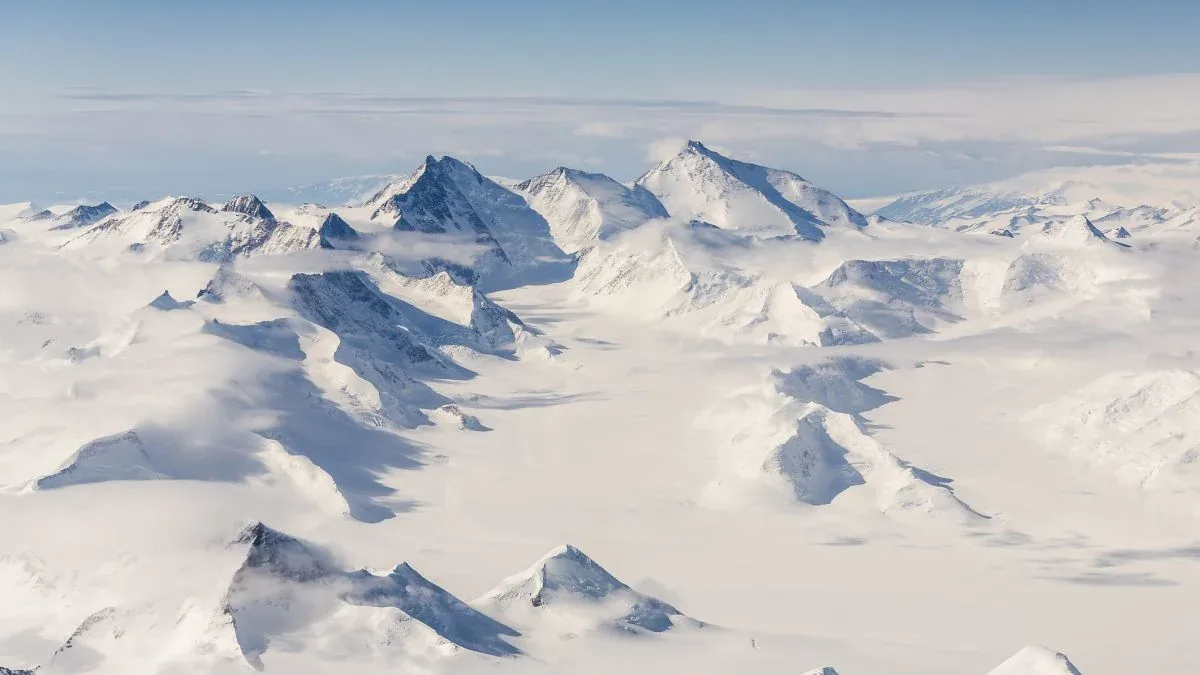
A colossal, fan-shaped geological structure, stretching across a significant portion of East Antarctica, has been discovered hidden beneath the continent's thick ice sheet. Researchers led by geophysicist Egidio Armadillo of the University of Genoa have identified approximately 30 interconnected basins forming this expansive province, named the East Antarctic Fan-Shaped Basin Province (EAFBP). This structure appears to widen towards the coast, suggesting it formed before the breakup of the ancient Gondwana supercontinent and may have played a role in the eventual separation of Antarctica and Australia.
The discovery, detailed in a recent scientific paper, is significant because these basins underlie roughly half of the East Antarctic Ice Sheet. "Because these basins underlie about half of the East Antarctic Ice Sheet, they are likely to heavily influence both ice-flow and landscape evolution, making them essential to Antarctic glacial and hydrological processes," the researchers stated. Understanding the bedrock's contours is crucial for predicting the speed and direction of ice movement, which is vital for climate modeling and anticipating potential sea-level rise.
Beyond its implications for current ice dynamics, the EAFBP offers a rare glimpse into Earth's deep terrestrial history. Antarctica, comprising about 10 percent of the planet's landmass, holds many unanswered questions about continental drift, ancient mountain formation, and crustal evolution. The vast amount of ice, estimated at 27 million cubic kilometers, presses down on the bedrock, a phenomenon known as isostatic depression. If the ice were to melt, the landmass would rebound, potentially gaining as much as a kilometer in altitude.
A Tectonic Puzzle Piece Revealed
The research team combined data from ice-penetrating radar, gravity, seismic, and magnetic surveys with reconstructed topography modeling that accounted for potential post-glacial rebound. While investigating what East Antarctica might look like without its ice, they observed a peculiar pattern: many subglacial basins in the region shared a similar geometry, fanning outwards from a common central point near the South Pole. This "coherent continent-scale radial pattern" bears a resemblance to a tectonic feature called a sphenochasm, which is a gap in the Earth's crust formed by the rotational separation of continental blocks.
The scientists proposed that the EAFBP was sculpted by a process known as rotational extension, where crustal blocks spread outward from a pivot point, much like the ribs of an opening fan. This interpretation suggests the feature originated from tectonic activity predating the breakup of Gondwana. The structure stretches along a coastline of approximately 2,000 kilometers.
This tectonic event could also provide explanations for other prominent subglacial features, such as the Gamburtsev Subglacial Mountains and the Transantarctic Mountains. The researchers theorize that as the fan-shaped basin opened, associated tectonic uplift may have contributed to the formation of these towering mountain ranges beneath the ice. While the interpretation aligns well with the observed data, the exact timing of these tectonic events remains challenging to pinpoint. Future studies are planned to refine this aspect and further unravel the complex geological history hidden beneath Antarctica.