
NASA Psyche Spacecraft Captures Rare Views of Mars During Flyby
NASA's Psyche spacecraft, en route to a metal asteroid, has provided striking new images of Mars captured during a recent gravity assist flyby. The photos offer an unusual perspective on the Red Planet, viewed from approximately 2,800 miles away.

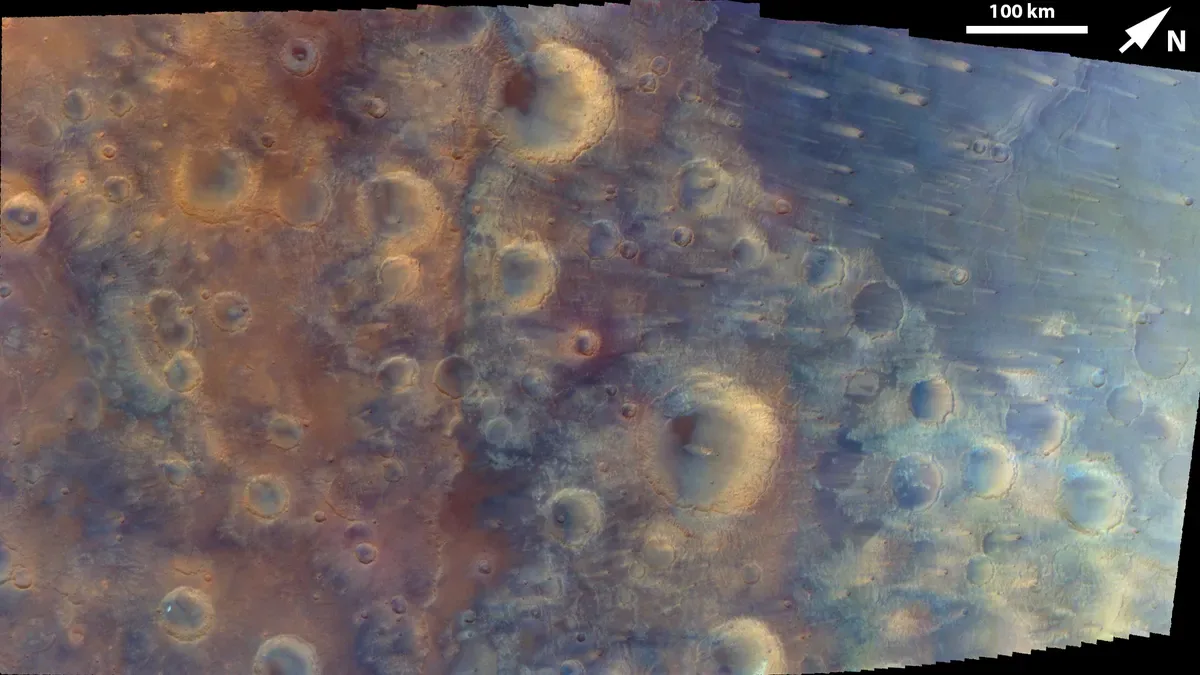
NASA's groundbreaking Psyche spacecraft, currently on its multi-year journey to explore a unique metal-rich asteroid, has captured and released a series of rarely seen images of Mars. The photos were taken during a gravity assist maneuver on May 15, 2026, as the spacecraft swung by the Red Planet en route to the main asteroid belt. These images offer a unique perspective of Earth's planetary neighbor, viewed from an altitude of about 2,800 miles above its surface.
The Psyche mission, launched in October 2023, is a six-year, 2.2 billion-mile expedition to study the asteroid 'Psyche' located between Mars and Jupiter. Scientists hope that by studying this metallic celestial body, they can gain valuable insights into the formation of planetary cores, including Earth's own. The spacecraft's recent encounter with Mars served not only as a vital gravitational slingshot to gain speed but also provided an unexpected opportunity for breathtaking photography.
A New Perspective on the Red Planet
While most images of Mars highlight its familiar rust-colored disk and arid surface, the photos from the Psyche spacecraft reveal the planet in a different light. NASA released these processed views on July 17, 2026, after weeks of data downlink and analysis. "These are rarely seen views of the red planet,” stated Jim Bell, the Psyche imager instrument lead at Arizona State University in Tempe. The spacecraft's trajectory allowed it to capture Mars from an angle and distance not typically observed by missions focused on close-up surface study.
In addition to still images, NASA also shared a time-lapse video detailing the spacecraft's approach to and departure from Mars. This visual narrative showcases the dynamic interaction between the visiting probe and the planet, demonstrating the power of the gravity assist maneuver. The Psyche spacecraft was traveling at approximately 12,333 mph when it encountered Mars, building upon the speed it had already gained since its launch. The mission team at NASA’s Jet Propulsion Laboratory in Southern California orchestrated this complex maneuver to optimize the spacecraft's trajectory and conserve propellant for its ultimate destination.
The gravity assist, a technique where a spacecraft uses the gravity of a planet to alter its speed and trajectory, is crucial for long-duration space missions. For Psyche, this maneuver was essential for propelling it towards the asteroid belt, setting an estimated arrival date by the end of 2029. This strategic use of planetary mechanics allows for more efficient travel across vast cosmic distances, reducing the need for extensive onboard fuel and enabling missions that would otherwise be unfeasible. The success of this Mars flyby marks a significant milestone in the Psyche mission's long voyage.