
Vega C Rocket Carries European-Chinese Space Weather Satellite SMILE Skyward
The Vega C rocket successfully launched the SMILE satellite on May 18, a joint European-Chinese mission to study space weather and its impact on Earth's magnetic field.

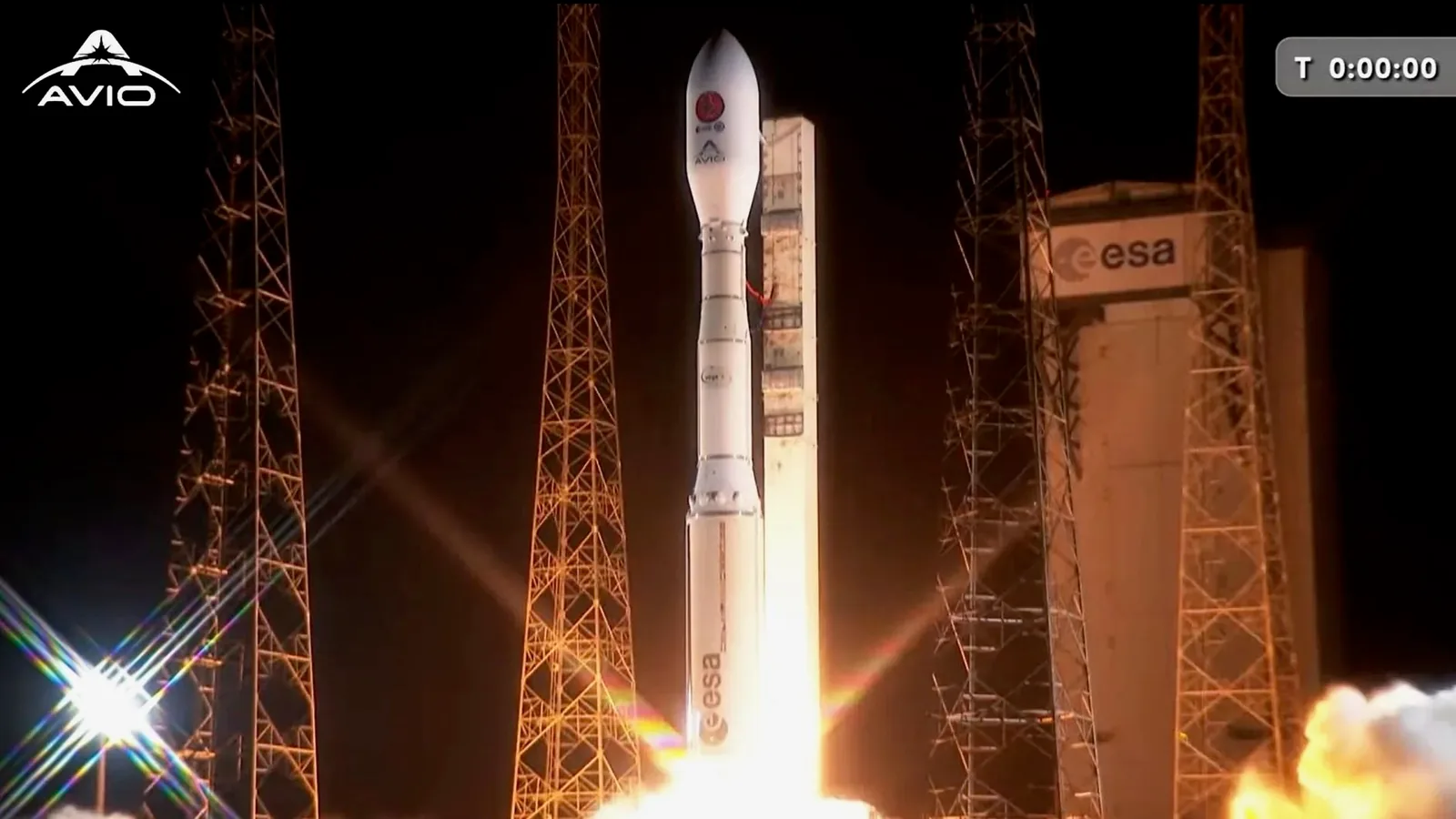
The European Space Agency (ESA) and the Chinese Academy of Sciences jointly launched their space weather satellite, SMILE, into orbit aboard a Vega C rocket on Monday night, May 18. The spacecraft lifted off from Europe's Spaceport in Kourou, French Guiana, at 11:52 p.m. EDT (0352 GMT, or 5:52 a.m. local time on May 19). This successful launch places the Solar wind Magnetosphere Ionosphere Link Explorer (SMILE) into a circular orbit approximately 439 miles (707 kilometers) above Earth, marking a significant collaboration in the study of our solar environment.
SMILE is equipped with four sophisticated science instruments designed to investigate the complex interactions between the solar wind and Earth's magnetosphere. The mission aims to enhance our comprehension of phenomena such as solar storms and geomagnetic disturbances, collectively known as space weather. The Chinese Academy of Sciences is taking the lead on the satellite platform, its operations, and three of the four instruments: the Ultraviolet Imager (UVI), the Light Ion Analyser (LIA), and the Magnetometer (MAG). The ESA contributed the payload module, the Soft X-ray Imager (SXI) instrument, the Vega C rocket itself, and has played a role in assembly, testing, and integration services. ESA will also support the UVI instrument and assist with ongoing orbital operations.
Understanding Earth's Shield: The Role of SMILE
The importance of understanding space weather cannot be overstated. The solar wind, a constant stream of charged particles emanating from the sun, can significantly impact Earth's technological infrastructure, including satellites, communication systems, and power grids. By studying how the sun's activity interacts with our planet's protective magnetic field, scientists hope to develop better prediction models for these potentially disruptive events. SMILE's mission is crucial for advancing this field, providing vital data that could help mitigate the effects of severe space weather on Earth.
Following its initial orbit insertion, SMILE will undertake a series of 11 engine burns over the next 25 days. This maneuver will transition the satellite into a highly elliptical orbit, stretching from 3,107 miles (5,000 km) above the South Pole to an impressive 75,185 miles (121,000 km) above the North Pole. Once in its final operational orbit, the mission team will conduct thorough checkouts of SMILE and its scientific instruments to ensure everything is functioning optimally. The mission expects to deliver its first X-ray and ultraviolet images approximately three months after launch, commencing its three-year planned science operations.
The Vega C rocket, a development of the European Space Agency, made its debut in July 2022. This launch marked its seventh flight, with six prior successful missions. Notably, Monday's liftoff was the first Vega C mission managed by the Italian company Avio, which took over operations from France-based Arianespace for this flight. The 115-foot-tall (35 meters) rocket's reliability is critical for such complex missions, and its successful deployment of the SMILE satellite underscores its growing capability in launching delicate scientific payloads. The collaboration between European and Chinese scientists on this mission highlights a growing trend in international cooperation for ambitious space exploration endeavors.