
Venus and Jupiter Align: Solar System's Order Fuels Earth's Life
Venus and Jupiter will appear close in the sky on June 9th due to a planetary conjunction, a common event in our stable solar system. This orbital order is crucial for life on Earth.

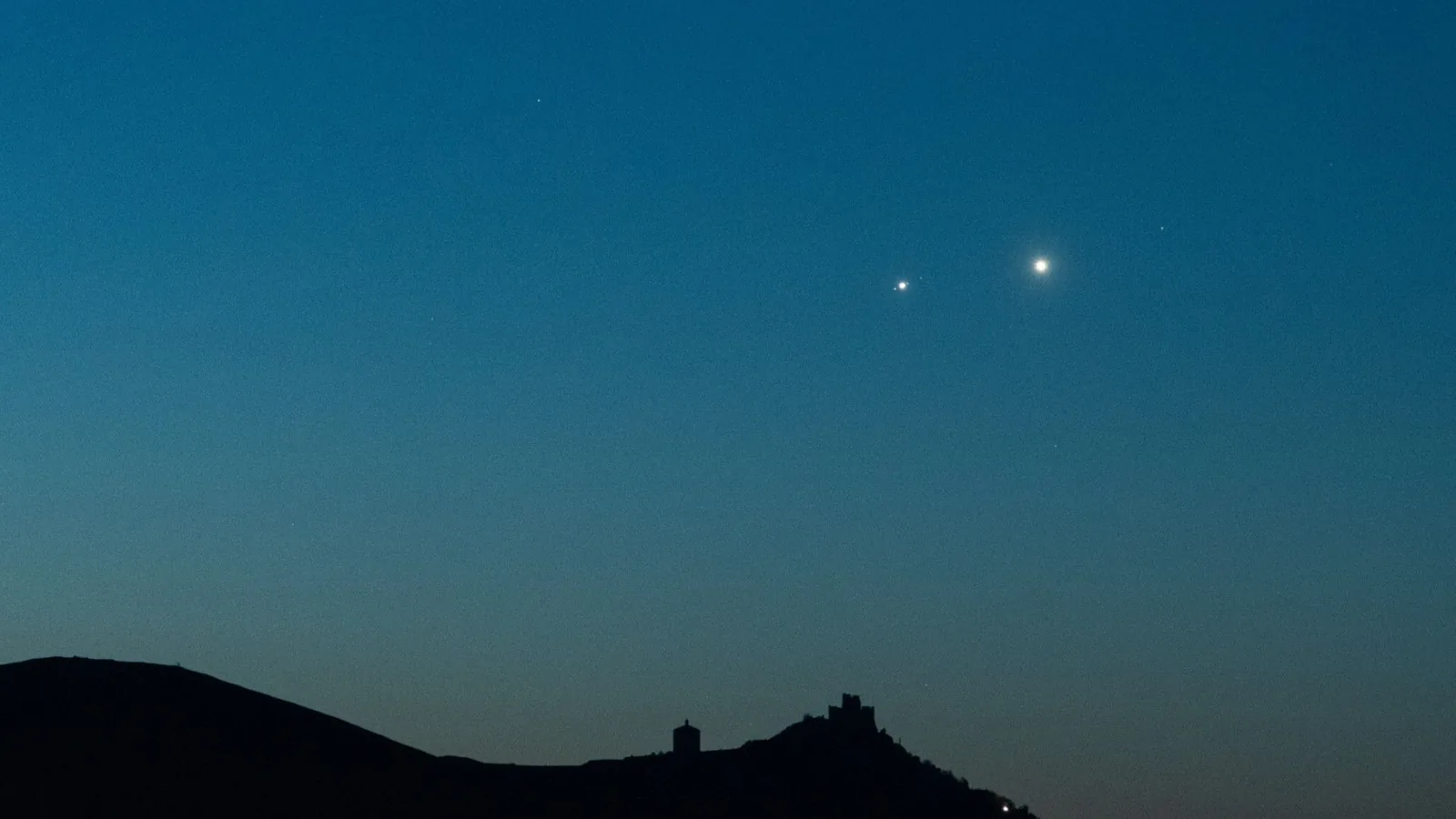
On the evening of June 9, 2026, skywatchers can witness Venus and Jupiter appearing exceptionally close together in the sky, a phenomenon known as a planetary conjunction. Sunlight will glint off the upper atmospheres of both planets, making them seem virtually touching from Earth. However, in reality, they will remain separated by a vast cosmic distance, equivalent to at least four times the span between the Earth and the sun. This close alignment follows a similar conjunction observed in August 2025, with previous occurrences in May 2024 and March 2023. The regularity of these events, happening approximately annually, is a telling sign of our solar system's remarkably ordered structure, a configuration that may be rare around other stars and is fundamental to the conditions supporting life on Earth.
The discovery of thousands of exoplanets in recent years has revealed that many distant worlds follow irregular, elongated orbits around their stars. In contrast, our solar system is characterized by a more orderly, flattened disk structure. The planets, including Venus and Jupiter, travel in near-concentric circles around the sun. This arrangement confines their apparent positions in the sky to a relatively narrow band along the ecliptic, which is the sun's apparent path. Dr. Kat Volk, a planetary scientist at the Planetary Science Institute in Tucson, Arizona, explains that Earth's orbit is only slightly tilted relative to the solar system's invariable plane. "That's why, as we're watching them in the sky, they're all kind of following a path along the ecliptic plane," Volk stated.
Cosmic Origins and Stability
This stable configuration is a direct reflection of how the sun and planets originally formed. "When the sun was being born out of some cloud of gas and dust, it was collapsing down to form the star," Volk described. "Then, angular momentum caused the material surrounding that [star], that didn't make it into the sun, to form a disk that is rotating and orbiting around the star. The really massive bodies in the solar system — the planets — tended to form within that disk." While this process creates a relatively flat plane for planetary orbits, not all star systems are so well-behaved. "If there's another Earth out there, there's no guarantee that the observers on that 'Earth' would see the same kind of nice ecliptic plane that we see in our solar system." External gravitational influences, such as interactions with other stars in crowded stellar clusters where the sun likely formed, can disrupt planetary systems, flinging planets into much more varied orbital inclinations. Our solar system, however, has achieved a state of relative stability, often referred to as a "dynamically cold" configuration. The migration of the gas giants to their current outer orbits and the gravitational influence of smaller bodies likely helped to settle the inner planets into their steady paths.
The precise orbital dynamics of our solar system are not just a curiosity; they are intrinsically linked to Earth's habitability. The stability of planetary orbits dictates a planet's distance from its star and the consistency of its climate. Exoplanets with highly eccentric or inclined orbits are more likely to experience dramatic temperature fluctuations, making the sustained presence of liquid water—a key ingredient for life as we know it—highly improbable. "If our planet's orbit was really elongated, you'd have different intensities with sunlight throughout the year. That would be an additional complication on the climate," noted Volk. The ordered, nearly circular orbits of the inner planets, including Earth, ensure a relatively consistent solar energy input, a critical factor for maintaining a stable climate. This "cosmic dance" of planets, with Venus and Jupiter meeting periodically, is thus a symptom of a celestial arrangement that is exceptionally conducive to life.