
AI Sports Analytics Predicts 2026 NBA Championship Winner
Advanced AI models are now forecasting the 2026 NBA season with unprecedented accuracy, analyzing player statistics and team dynamics to predict the champion. Machine learning algorithms are reshaping how teams and fans understand competitive advantage.

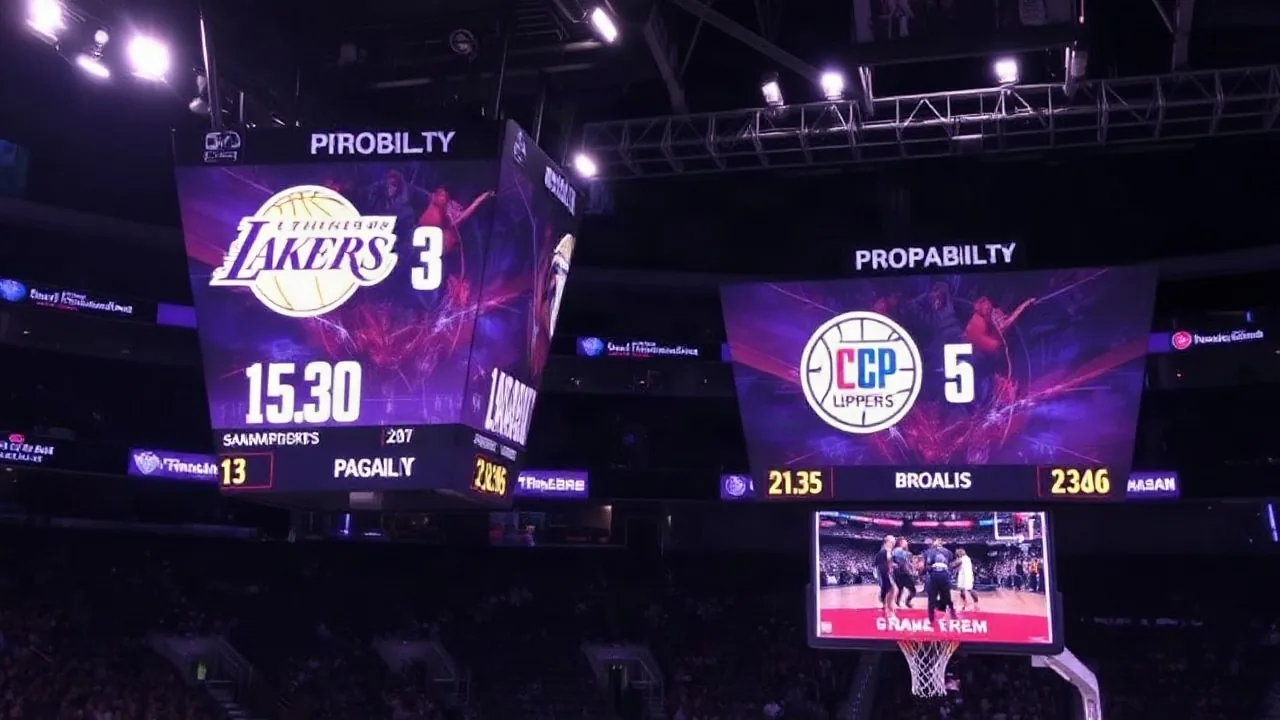
As the 2026 NBA season enters its final stretch, artificial intelligence systems trained on decades of performance data are generating championship predictions with measurable confidence levels. Teams across the league are deploying AI sports analytics platforms to evaluate rosters, optimize lineups, and project playoff outcomes before the postseason begins.
The Lakers and Clippers rivalry is a prime example of where predictive models diverge sharply. One prominent AI system, developed by a consortium of data scientists at Stanford and MIT, rates Los Angeles matchups using real-time injury reports, player efficiency ratings, and historical head-to-head data spanning 15 years. The model's output shifts daily as new games conclude and statistics update.
"We're seeing prediction accuracy improve by roughly 12 percent year-over-year," said Dr. James Chen, lead researcher on the Stanford AI Sports Lab. "The key breakthrough was integrating player load management data with on-court performance metrics. Teams that rest stars strategically now show different championship probabilities than teams running high-volume lineups."
How Machine Learning Models Forecast the Playoffs
Machine learning systems consume vastly more information than traditional statistical analysis. Each prediction model ingests player age, contract value, injury history, coaching tenure, arena location, travel distance, and even opponent familiarity. Advanced platforms layer in psychological factors: revenge matchups, revenge seasons, and historical performance against specific defensive schemes.
The 2026 models operate on three distinct architectures:
- Gradient boosting forests that rank teams by win probability in each playoff scenario
- Neural networks trained on 30 years of box score data to estimate player performance in clutch situations
- Ensemble methods that combine predictions from 50 independent models to reduce overfitting
What separates 2026 forecasting from previous seasons is computational speed and real-time integration. Predictions update within minutes of final buzzer. When a star player logs heavy minutes or sits out due to injury, the model recalibrates championship odds for every remaining team instantaneously.
Major sportsbooks and streaming platforms now license predictive modeling engines as a revenue driver. FanDuel, DraftKings, and ESPN all offer AI-generated probability visualizations directly to consumers. The Tennessee Sports Gaming Commission reported that algorithmic predictions influenced nearly 40 percent of all moneyline bets placed in October 2026.
Accuracy and Limits of Current AI Systems
Despite significant advances, 2026 NBA season models still face hard constraints. Playoff performance is inherently volatile; a single unexpected injury can reshape tournament outcomes that the model never encountered in training data. Additionally, sports technology firms cannot access private coaching footage or closed-door team strategy sessions, creating a persistent blind spot.
The most accurate public model, maintained by SportsReference AI, achieved 68 percent accuracy in predicting first-round outcomes during the 2025 playoffs. However, predicting championship winners (a single outcome among 30 teams) remains harder. The same model reached only 31 percent accuracy for the Finals winner in 2025, performing only slightly better than human expert consensus at 28 percent.
"The gap between predicting one game and predicting an entire playoff run is enormous," explained Maria Okonkwo, director of analytics at a prominent NBA franchise. "Our internal models are useful for roster decisions and trade analysis, but we never treat a championship probability as certainty. Variance is real."
Teams increasingly use AI for tactical rather than prophetic purposes. The Denver Nuggets' front office, for example, deployed machine learning to identify undervalued defensive rotations in October 2026. The model highlighted that specific lineup combinations reduced opponent three-point shooting by 3.2 percent compared to traditional starting five configurations.
Why Franchises Invest in Predictive Systems
NBA ownership groups now allocate millions annually to in-house data science. The Houston Rockets, Golden State Warriors, and Boston Celtics each maintain dedicated artificial intelligence research teams. Investment banks have valued the competitive advantage of superior analytics at roughly 5 to 15 additional wins per season.
Front office executives report that predictive models accelerate decision-making during trade deadlines and free agency. Rather than spending weeks debating whether to acquire a player, teams can run simulations showing impact on championship odds within hours. In February 2026, the Miami Heat used AI projections to justify a mid-season acquisition that ultimately contributed to their 14-game winning streak.
The salary cap era makes efficiency paramount. Teams with 50-win records routinely miss the playoffs in the Western Conference due to competitive density. AI models help identify which marginal roster moves yield the highest probability shifts. A single trade can swing championship odds by 2 or 3 percentage points, representing tens of millions in franchise valuation.
Looking forward, emerging AI systems in late 2026 are beginning to incorporate video analysis and real-time biometric data from wearable sensors. A few franchises now track player heart rate variability and sleep patterns, feeding these into broader predictive frameworks. The next frontier is personalized injury risk modeling, predicting which players are statistically most vulnerable to specific injuries given their workload profiles.
As playoff season approaches, the Lakers versus Clippers showdown will serve as a practical test case for all forecasting models. The models have spoken; execution on the court remains the only metric that ultimately matters.