
Dante's Inferno Poem May Depict Ancient Asteroid Impact, Scholar Suggests
An English professor suggests Dante Alighieri's 14th-century poem "Inferno" may describe the physical effects of a massive celestial impact, akin to an asteroid strike.

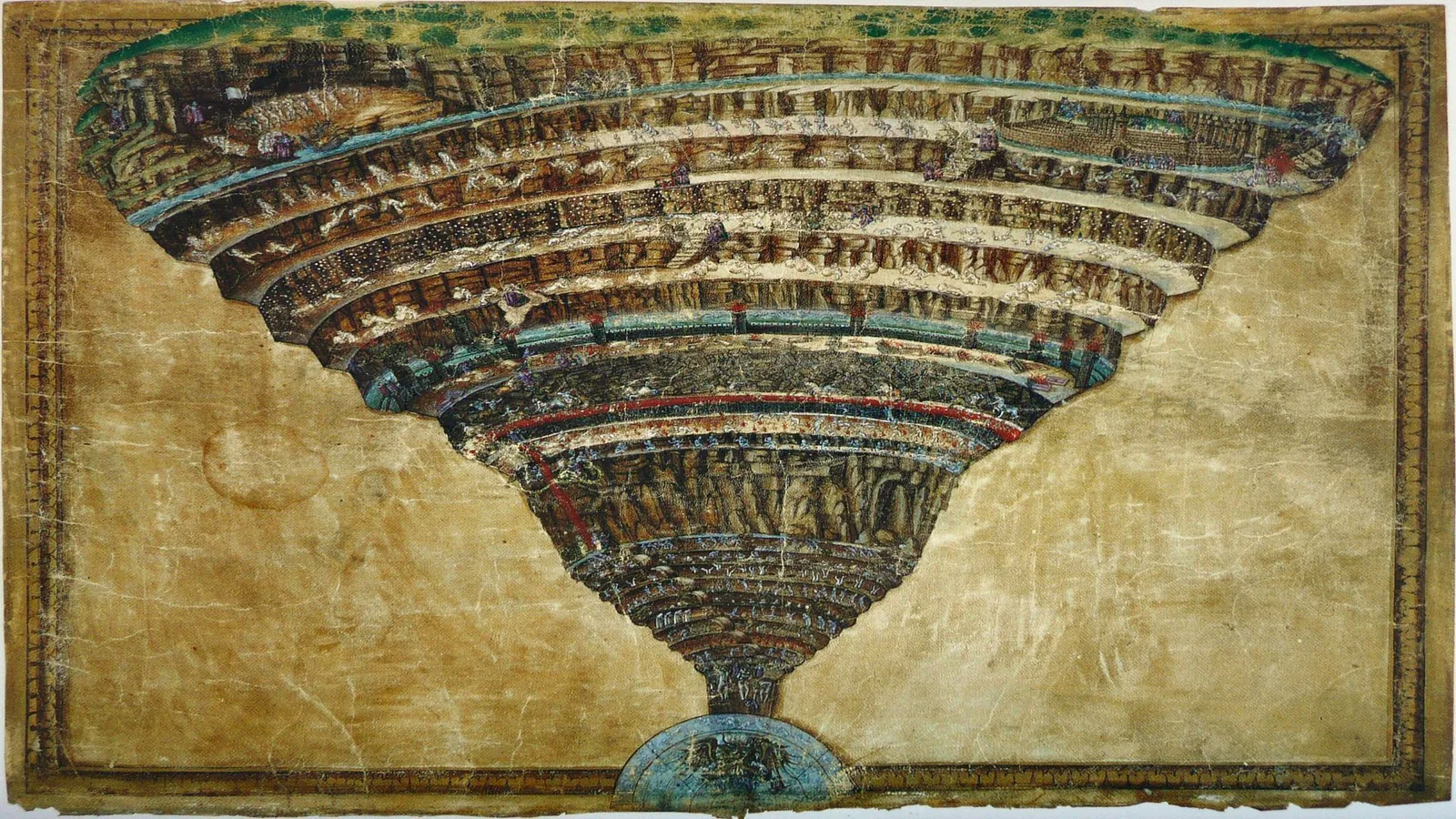
A 14th-century epic poem by Dante Alighieri, "Inferno," may contain an early, albeit symbolic, depiction of a massive celestial impact, according to Timothy Burberry, a professor of English at Marshall University. Burberry, an expert in geomythology—a field that seeks evidence of geological events within ancient stories—argues that Dante's description of Lucifer's fall from heaven and its impact on Earth bears striking resemblances to the physical effects of an asteroid strike.
"Inferno," written between 1308 and 1321, is the first part of Dante's "Divine Comedy." The poem guides readers through Hell, with the protagonist Dante accompanied by the Roman poet Virgil. Their journey traverses the nine concentric circles of Hell, encountering various sinners and mythological figures. At the deepest point, Lucifer, depicted as a monstrous, winged creature with three heads, is eternally chewing on the betrayers of history.
However, it is Dante's account of Lucifer's expulsion from heaven and subsequent descent that has captured Burberry's attention. According to the poem, Lucifer plummeted to Earth, breaching the surface and burrowing toward the planet's center, thereby creating Hell. The displaced earth is said to have reformed into the Mountain of Purgatory, forming the central peak of a multi-ringed crater, which Burberry posits corresponds to the nine circles of Hell. The landmasses of the southern hemisphere, he suggests, were reshaped by this cataclysmic event.
Reinterpreting Celestial Events in Literature
Burberry's geomythological interpretation suggests that Dante's vivid imagery reflects the physical consequences of an impact violent enough to reshape planetary geography. He draws parallels to catastrophic events like the Chicxulub impact, theorized to have contributed to the extinction of the dinosaurs 66 million years ago, or even the presumed impact event that formed the Moon approximately 4.5 billion years ago.
This interpretation is particularly noteworthy given the scientific understanding of the 14th century. At the time, the heavens were largely considered fixed and eternal, and the idea of objects falling from the stars was not part of conventional thought. It wasn't until the 19th century that meteors were scientifically recognized as celestial phenomena, with meteorites confirmed to originate from space. Burberry highlights that Dante, while not a scientist, may have been contemplating the physical repercussions of a high-speed, massive object striking the Earth, a concept that challenged the established norms of his era.
"Although Dante was not a scientist, he was one of the first persons in history to think through the physical effects of a large mass slamming into the Earth at high speed," Burberry writes in his research abstract. "In Dante's vision, the Devil's size and velocity are such that when he lands, he instantly creates Hell: a massive, circular, terraced crater that reaches to the center of the Earth."
Burberry presented his findings on this geomythological perspective of the Dante's Inferno at the European Geosciences Union General Assembly in Vienna, Austria, held from May 3-8. Regardless of Dante's original intent, Burberry argues that his work demonstrates how ancient narratives can sometimes foreshadow our understanding of natural disasters, even before scientific knowledge fully catches up.