
Milky Way's Cosmic Meal: New Star Cluster Hints at Ancient Galactic Cannibalism
Astronomers have identified a unique group of metal-poor stars believed to be remnants of a dwarf galaxy consumed by the Milky Way around 10 billion years ago. Dubbed "Loki," this ancient galactic meal could reshape our understanding of the Milky Way's evolution.

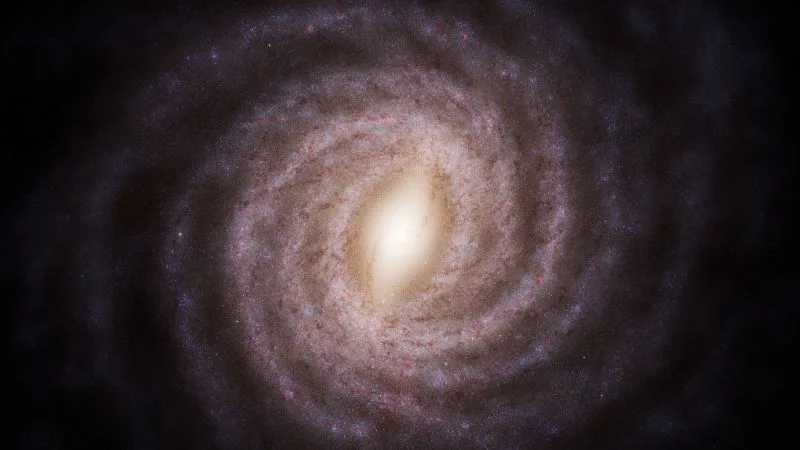
Astronomers have identified a cluster of stars exhibiting an unusual chemical composition, strongly suggesting they are the remnants of a dwarf galaxy devoured by the Milky Way approximately 10 billion years ago. This celestial remnant, nicknamed "Loki" by the research team, could significantly alter current scientific theories about the early evolution of our home galaxy.
The Milky Way, a vast galaxy spanning an estimated 100,000 light-years and housing between 100 billion and 400 billion stars, did not always possess its current massive stature. It has grown over cosmic timescales, beginning around 12 billion years ago, by merging with numerous smaller dwarf galaxies. However, the precise original size and mass of the Milky Way remain subjects of ongoing scientific inquiry, driving researchers to seek evidence of these consumed galaxies to reconstruct its history.
In pursuit of these cosmic puzzle pieces, astronomers focused on a group of metal-lacking stars discovered surprisingly close to the galactic disk. The discovery was detailed in a study published in May in the journal Monthly Notices of the Royal Astronomical Society. These stars are of particular interest because the earliest stars in the universe were primarily composed of hydrogen and helium. Heavier elements, often referred to as metals in astronomy, were forged within stars and dispersed through stellar explosions, enriching subsequent generations of stars. Therefore, metal-poor stars are frequently associated with ancient dwarf galaxies that the Milky Way may have absorbed during its growth.
Unveiling Ancient Galactic History
The metal-poor composition of these stars near the galactic disk implies that the Milky Way undertook a substantial galactic merger early in its existence. This finding could represent a critical, previously unrecognized building block of our galaxy. Dr. Cara Battersby, an associate professor of physics at the University of Connecticut who was not involved in the study, likened astronomers to detectives searching the cosmos for clues to its origins. She emphasized that very metal-poor (VMP) stars are potent tools in this quest, as they have existed for billions of years and contain embedded information about the formation of the universe’s earliest stellar generations.
Studying the composition and motion of these metal-poor stars offers insights into the conditions and dynamics of the early universe. Historically, the search for VMP stars in the Milky Way has predominantly concentrated on the galaxy’s stellar halo – a large, spherical region surrounding the galactic disk. Some researchers hypothesized that evidence of older mergers might lie deeper within the galaxy, specifically in its disk. However, the galactic disk is densely populated with younger, metal-rich stars and cosmic dust, making the detection of VMP stars challenging, according to lead study author Dr. Federico Sestito, a postdoctoral fellow at the University of Hertfordshire’s Centre for Astrophysics Research in England.
Using data from the European Space Agency’s Gaia telescope, which mapped the movements and compositions of 2 billion stars between July 2014 and January 2025, Sestito and his team identified 20 metal-poor stars in close proximity to the disk. Subsequent observations with the high-resolution spectrograph on the Canada-France-Hawaii Telescope in Hawaii allowed for a detailed analysis of these stars. While their exact age is difficult to determine, their chemical makeup suggests an age exceeding 10 billion years. All 20 stars are located approximately 7,000 light-years from our solar system and share similar chemical signatures, indicating a common origin in a single, metal-poor dwarf galaxy.
Intriguingly, 11 of these stars orbit in the same direction as the galactic disk (prograde), while nine move in the opposite direction (retrograde). This dual orbital pattern suggests they could be remnants of a dwarf galaxy that the Milky Way absorbed shortly after the Big Bang, which occurred approximately 13.8 billion years ago. Dr. Sestito explained that such a merger event, if it occurred when the Milky Way was significantly smaller and its gravitational pull weaker, could indeed scatter stars into both prograde and retrograde orbits. Cosmological simulations support the possibility of such an event occurring within the first 3 to 4 billion years after the Big Bang.
Dr. Hans-Walter Rix, director at the Max Planck Institute for Astronomy, praised the study for its sophisticated use of detailed chemical abundances as a unique identifier for a common birth origin, even with stars exhibiting opposing orbital paths. The team’s inspiration for naming the galaxy "Loki" stemmed from the mythological god's enigmatic nature, mirroring the initial difficulty in deciphering the origin of these accreted stars.
While another explanation could involve multiple merger events, the hypothesis of a single galaxy's stars being integrated into the Milky Way is compelling, noted Dr. Battersby. The Milky Way's growth through galactic cannibalism – the absorption of smaller galaxies by a larger one – provides astronomers with a means to reconstruct its evolutionary timeline. Dr. Alexander Ji, an astronomy professor at the University of Chicago, stated that while numerous minor mergers occur, major galactic meals can profoundly shape a galaxy's growth. He cited the merger with the Gaia-Sausage-Enceladus galaxy, which occurred between 8 and 10 billion years ago, as an example of a transformative event that helped stabilize the Milky Way's disk. The potential merger with the "Loki" galaxy appears to have been of a comparable scale, though its remnants are obscured within the dense galactic disk. If confirmed, this discovery implies that a significant chapter of the Milky Way’s formation history has been overlooked, necessitating a revision of current models.