
Darwin's Carnivorous Plant Prediction Confirmed by Scientists in China
Scientists have confirmed Charles Darwin's 1875 prediction that certain Saxifraga plants are carnivorous. New research in China shows Saxifraga candelabrum lures, traps, and digests insects.

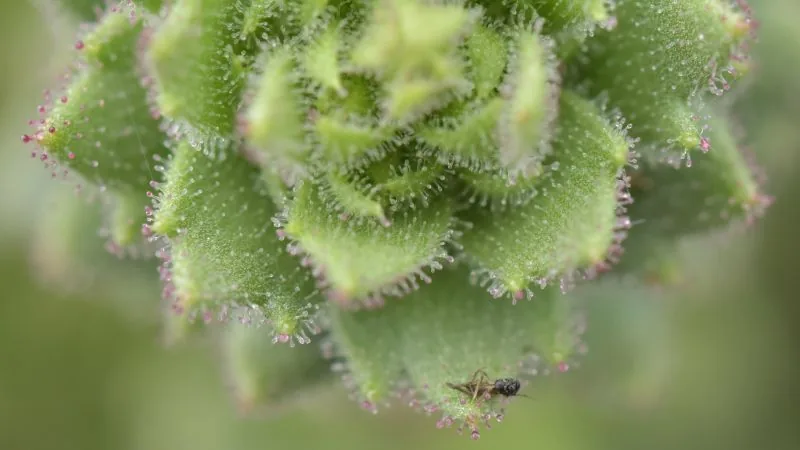
More than 150 years after famed naturalist Charles Darwin theorized about their predatory nature, scientists have confirmed that certain species of the Saxifraga genus are indeed carnivorous. Researchers studying Saxifraga candelabrum, a flowering plant found at high altitudes in China, have provided definitive evidence that it attracts, traps, and digests insects, fulfilling a prediction Darwin made in 1875.
Darwin's initial suspicions were based on observations of sticky, hair-like structures called glandular trichomes on Saxifraga rotundifolia and S. umbrosa. He proposed that these plants might consume insects, but his experiments at the time could not conclusively prove carnivory. Now, a new study published in Nature Communications has validated his hypothesis through extensive chemical, isotopic, and genetic analysis of Saxifraga candelabrum.
The research team, led by Professor Hang Sun from the Kunming Institute of Botany at the Chinese Academy of Sciences, demonstrated that S. candelabrum attracts small gnats using enticing odors. Once trapped by the sticky secretions of its glandular trichomes, the plants digest the insects using an enzyme called phosphatase. Isotope labeling with nitrogen-15 confirmed the transfer of nutrients from captured prey to the plant, solidifying the evidence of its digestive capabilities.
Uncovering Hidden Carnivory
Genetic analysis further revealed that S. candelabrum shares genes associated with prey attraction, digestion, and nutrient absorption with other known carnivorous plants. This discovery suggests that carnivory might be more widespread among flowering plants than previously understood. Senior study author Hang Sun noted that many species previously thought to only incidentally trap insects may possess undiscovered digestive abilities. "Carnivory is likely far more widely distributed among angiosperms—or flowering plants—than previously believed, and new carnivorous plant lineages may be discovered in the future," Sun stated.
The study also identified dozens of genes across various plant groups linked to the processing of insect remains, a finding that could aid botanists in identifying other stealthy carnivores. Botanist Susan Myers of the Pittsburgh Botanic Garden, who was not involved in the study, praised the research design, particularly the use of labeled nitrogen tracing. "What Darwin surmised from observation and inference, these researchers confirmed with modern technology," Myers commented.
Douglas Soltis, a study coauthor and distinguished professor at the Florida Museum of Natural History, has studied the Saxifragaceae family for over 40 years. He shared Darwin's initial intrigue, observing insects frequently caught on the sticky hairs of many family members. However, he cautioned that such hairs can also serve a defensive purpose. The team’s field and controlled experiments showed that S. candelabrum captures numerous gnats, with up to 70 insects found on some branches. The scent proved to be a significant lure, though the plant appeared to trap less effective pollinators rather than its own flower pollinators.
The adaptation to carnivory is often driven by nutrient-poor soil conditions, particularly a lack of nitrates, which plants need to supplement their photosynthetic food production. This strategy is particularly advantageous for S. candelabrum, which thrives at altitudes between 8,200 and 10,800 feet (2,500 to 3,300 meters) in rocky, dry alpine environments. The plant's high-altitude habitat is a novel setting for carnivory, as most known carnivorous plants inhabit boggy soils.
Fortunately, the remote alpine location of Saxifraga candelabrum currently protects it from threats like climate change and human activity. Sun confirmed that the species is not considered endangered, thriving under its present environmental conditions.
This confirmation of Darwin's prediction echoes another instance where his foresight was later validated. In 1862, Darwin predicted the existence of a moth with an extraordinarily long proboscis to pollinate the Madagascar star orchid. This insect, the Madagascar hawk moth (Xanthopan morganii praedicta), was only discovered in 1903, long after Darwin's death. Sun views these discoveries as a testament to the ongoing, collaborative nature of scientific inquiry. "It allows us to truly appreciate the continuous academic inheritance of fundamental research in the field of plant evolution passed down from generation to generation," he said.
The identification of S. candelabrum as a carnivorous plant highlights the vastness of botanical knowledge yet to be uncovered. "We are still barely scratching the surface of botanical knowledge," Myers emphasized, underscoring the continuous potential for discovery in the plant kingdom.