
Chimpanzees Share More, Steal Less From Friends, Study Finds
New research indicates chimpanzees are less likely to steal valuable food items from social partners, even when tempted with a highly desirable treat like pineapple. This behavior suggests a capacity for social tolerance and cooperation.

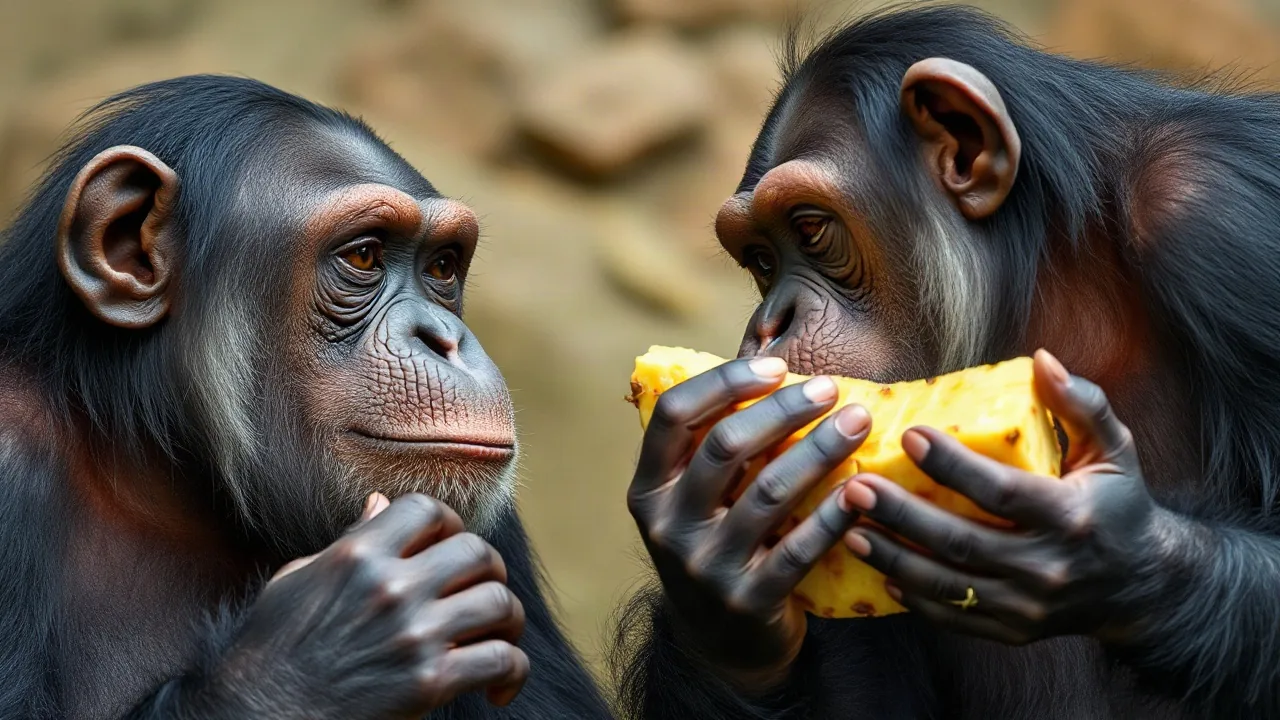
Chimpanzees demonstrate a notable inclination to refrain from stealing prized food from their close associates, according to a recent study published in the journal Current Biology. This social restraint holds true even when the potential thief is presented with an exceptionally tempting reward, such as pineapple, a fruit known for its high desirability among these primates. The findings shed light on the complex social dynamics and decision-making processes within chimpanzee communities.
Researchers conducted a series of experiments involving chimpanzees in both captive and wild settings. In these trials, individual chimpanzees were given the opportunity to steal a piece of food, such as grapes or pineapple chunks, from a social partner. Crucially, the partner chimp was either a close friend or a less familiar individual. The study observed that while theft did occur, it was significantly less frequent when the victim was a social partner compared to a stranger. This effect persisted even when the potential thief was offered a highly palatable treat like pineapple, which might otherwise override social considerations.
Social Bonds Influence Behavior
The investigation, led by Dr. Sarah Clement of the Max Planck Institute for Evolutionary Anthropology, revealed that chimpanzees appear to possess a nuanced understanding of their social relationships when it comes to resource competition. "We observed that the chimpanzees were more tolerant of resource competition from their allies," Dr. Clement stated. "This suggests that social bonds play a significant role in modulating their behavior, even in situations involving valuable food items." The study's design aimed to isolate the effect of social relationships, controlling for other factors that might influence stealing behavior, such as hunger levels or the individual's dominance status.
The research involved observing 40 chimpanzee pairs, each with varying degrees of social affiliation. The experiments were carefully designed to ensure that the chimpanzees understood the rules of the game, so to speak. For instance, in some setups, one chimp could access food, while another chimp had the option to take it. The presence of pineapple, known to be a high-value food, was used as a critical test to see if even such a strong temptation could sway the chimpanzees into stealing from friends. The results consistently showed that the cost of potentially damaging a valuable social relationship outweighed the immediate gain from stealing, even when the stolen item was as desirable as pineapple.
This behavior offers a fascinating glimpse into the evolutionary roots of cooperation and prosocial tendencies. While chimpanzees are known for their complex social lives, their capacity for what appears to be tolerance and strategic restraint in resource acquisition highlights sophisticated cognitive abilities. Understanding these behaviors in chimpanzees can provide valuable context for human social development and the evolution of altruism and fairness. The findings challenge the notion that such behaviors are solely human traits, suggesting that precursors to complex social decision-making may be present in our closest living relatives.