
Venus Flytrap's Lightning Snap Explained by Softening Cells
Scientists have finally unveiled the surprising mechanism behind the Venus flytrap's rapid capture of prey. New research reveals outer leaf cells soften to enable the swift closure.

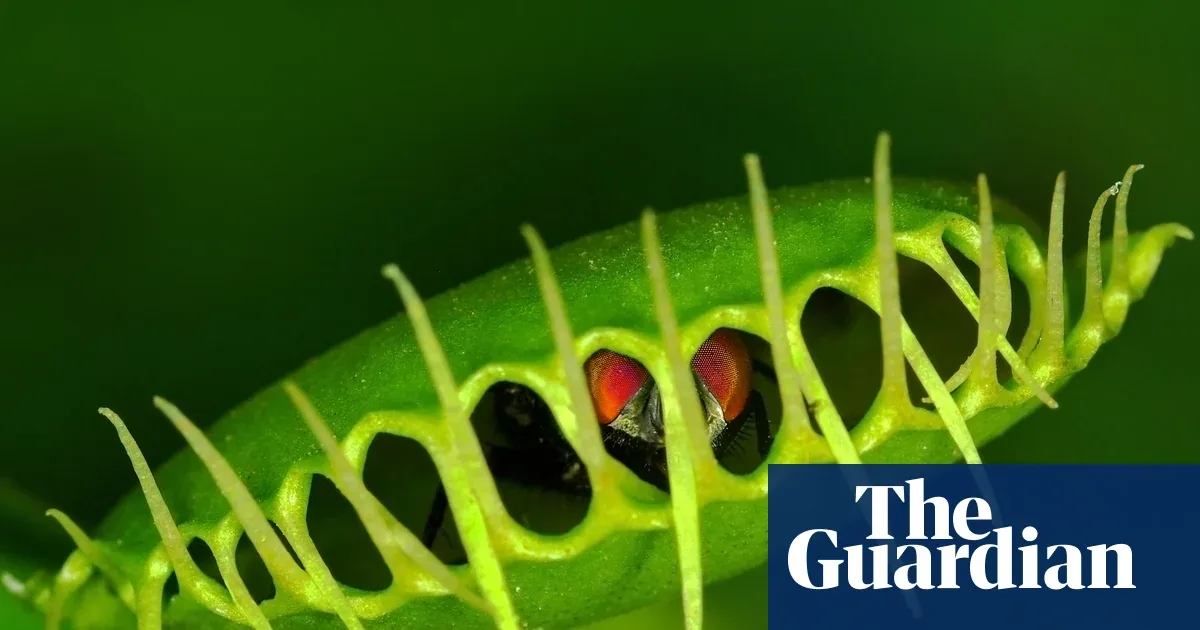
Researchers have unraveled the mystery behind the Venus flytrap's astonishingly swift predatory action, a mechanism that has puzzled scientists, including Charles Darwin, for over a century. A new study, published this year, demonstrates that the plant's rapid snap is triggered by a sudden softening of cells on the outer surface of its leaves, allowing the trap to close in less than a second.
The Venus flytrap (Dionaea muscipula) is renowned for its ability to lure unsuspecting insects with sweet nectar before ensnaring them in its jaw-like lobes. "When Darwin saw these plants move so fast, he was convinced that the plant had a muscle inside, but plants do not have muscles and they do not have nerves," explained Dr. Yoël Forterre, a physicist at the French National Centre for Scientific Research (CNRS) and Aix-Marseille University, and the study's senior author. "For more than a century, there have been many hypotheses. It’s very surprising that plant cell walls can tune their mechanical properties so fast." Forterre has been fascinated by the plant's mechanics for two decades, spurred by a colleague's lab visit, stating, "As a physicist, I thought we should understand the motor, the forces."
The key challenge for researchers was accurately measuring the mechanical properties of such a fast and delicate system. "As soon as you perturb it, it closes," Forterre noted. "If you close it accidentally with a drop of water, it will close and then reopen the next day. If it catches an insect, it has to digest it and dissolve the skeleton, which will take several weeks." To overcome this, scientists conducted experiments using a nanoindenter, a precision device with a metal tip, to measure the pressure and stiffness of the leaf's outer surface. They carefully immobilized the plant’s leaves with dental glue, allowing the trap to be triggered and measured without fully closing.
Cellular Softening and Mechanical Flips
Previous research established that Venus flytraps possess sensitive trigger hairs, typically three on each lobe. Bending these hairs initiates an electrical signal that rapidly spreads across the trap. The latest findings, however, pinpoint a crucial physical change: the outer leaf cells instantaneously become more flexible immediately after the trap is activated. This cellular softening, rather than changes in water pressure within the cells as previously hypothesized, is the driving force behind the rapid closure. The effect is akin to how a flexible dome-shaped toy might spontaneously flip inside out when placed on a surface.
"I’m not aware of any other plants with this kind of very rapid change of mechanical properties of the cells," Dr. Forterre remarked, highlighting the uniqueness of this Venus flytrap mechanism. This discovery offers a compelling answer to Darwin's long-standing question about how plants, lacking muscles and nerves, achieve such rapid movement. The findings underscore the sophisticated biophysics at play in the natural world.
The study's innovative methodology involved precise measurements of the leaf's topology and mechanical response. By poking the outer surface with the nanoindenter, scientists could quantify the immediate change in stiffness. The results indicated a dramatic decrease in rigidity, confirming the role of cell wall elasticity. This breakthrough sheds light on plant biophysics and provides a fundamental understanding of rapid plant responses, opening avenues for future research into similar mechanisms in other plant species.
The ability of plants to sense their environment and react quickly is a testament to their complex biological systems. "Plants are just amazing," Forterre concluded. "It makes you realize how all plants can sense their surroundings, transport information, react, defend themselves, feed." This research not only solves a botanical puzzle but also emphasizes the remarkable evolution of plant life and its intricate adaptations for survival and predation, showcasing the sophisticated plant biology that allows such rapid movements.