
Wyoming Ice Age Cat DNA Offers Clues to Save Big Cats Today
New research from Wyoming's Natural Trap Cave reveals DNA and diet details of the prehistoric "American cheetah," Miracinonyx trumani. These findings could offer insights into conserving modern cheetahs, lions, and tigers.

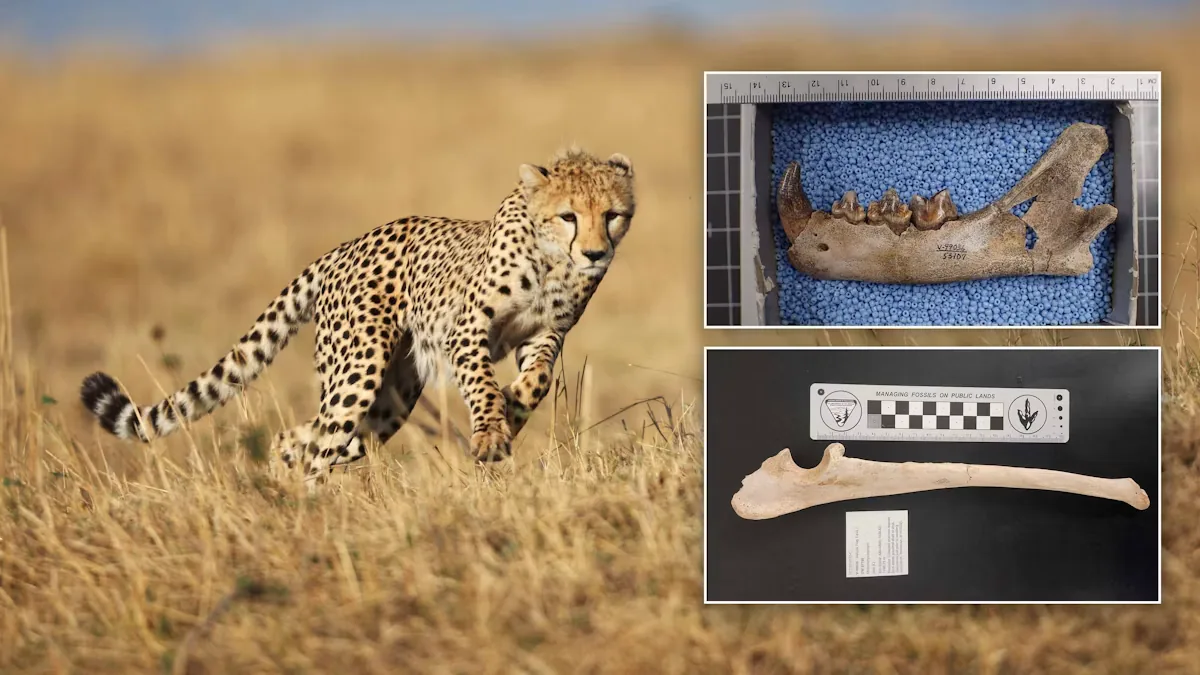
Paleontologists have unearthed significant insights into the diet and genetics of an Ice Age predator, dubbed the "American cheetah," from Wyoming's Natural Trap Cave. A new study published in the journal Current Biology analyzed DNA from the prehistoric cat, Miracinonyx trumani, potentially providing crucial information for the conservation of today's cheetahs, lions, and tigers.
The research, which utilized tiny bone fragments and teeth, revealed surprising details about how these ancient felines survived. Dr. Julie Meachen, a mammalian biologist at Des Moines University, expressed astonishment at the findings. "It turns out something that we all assumed about modern-day cheetahs was wrong. It was a bad assumption," she stated. While named the "American cheetah" due to its resemblance to its modern African counterpart, the study clarifies that Miracinonyx is more accurately described as a "cheetah-like cat." Its closest living relatives are the mountain lion and the jaguarundi, with a more distant relationship to the modern cheetah.
During the Late Pleistocene epoch, Miracinonyx was a formidable pursuit predator. Its elongated body and legs enabled it to reach speeds of approximately 55 mph, allowing it to chase down prehistoric horses, camels, and pronghorn. Unlike modern cheetahs, however, it possessed forearms capable of subduing its prey. The end of the last Ice Age brought widespread extinction of North American megafauna, including mammoths and saber-toothed cats. As the climate shifted and humans populated the Americas, Miracinonyx was among the species that did not survive.
Many of the most well-preserved Late Pleistocene specimens have been recovered from the sandy depths of Natural Trap Cave in the Bighorn Mountains. This 80-foot-deep cavern contains thousands of 20,000-year-old animal bones perfectly preserved in its cool, moist sediment. The recent study compared specimens from Natural Trap Cave with those newly acquired from the Bluefish Caves in Yukon and Upper Quartz Creek in Alaska.
Dietary Adaptations Revealed Through Isotope Analysis
The researchers began by examining the elemental isotopes within the Miracinonyx bones and teeth. Stable isotope ratios of elements like calcium, carbon, and nitrogen provide a clear picture of an animal's diet. "In mid-continental North America, and Wyoming specifically, Miracinonyx was eating all sorts of different ungulates," Dr. Meachen explained. "Our published isotope data shows it was eating bighorn sheep, pronghorn antelope, and probably horses, too."
Intriguingly, specimens from Alaska presented a starkly different dietary profile. In the Yukon, Miracinonyx primarily consumed fish. This regional dietary variation is attributed to the availability of food resources. While Wyoming offered an abundance of grazing herbivores, these were scarce in the colder, more remote Alaskan regions. The prevalence of fish in the Yukon likely drove the dietary choices of the local Miracinonyx population, a behavior not typically associated with modern cheetahs. This finding underscores a significant difference between the extinct and extant species, reinforcing that their ecological roles were not identical. Evidence from a 57,000-year-old mummified Pleistocene wolf pup found in Yukon permafrost, which also showed a fish-dominated diet, supports the idea of abundant fish resources in the region during that era.
The extraction of nuclear DNA from Miracinonyx marked a significant advancement. Previous studies relied on mitochondrial DNA, which provides only a partial genetic picture. Nuclear DNA, present in every cell nucleus, offers a comprehensive view of an animal's genetic code. These crucial genetic samples were obtained from petrosal bones, dense, small ear bones found in mammals that enclose the inner ear structures. The density and preservation of these bones in Miracinonyx specimens from both Wyoming and Alaska made nuclear DNA extraction feasible.
Analysis of the nuclear DNA not only confirmed Miracinonyx's placement within the big cat family tree but also provided its effective population size during the Late Pleistocene. This data revealed a surprising trend: concerningly low population sizes for the cheetah-like cats, mirroring issues faced by modern cheetah conservation efforts. "What we're seeing is that, even in the Pleistocene, the population sizes of the cheetah-like cats are extremely low," Dr. Meachen noted. This suggests that low population numbers and genetic diversity may be inherent traits for these types of large predators, rather than solely a consequence of human impact. The findings highlight the importance of understanding the deep evolutionary history of threatened species to inform effective conservation strategies for [big cats](https://example.com/search/big%20cats) like [cheetahs](https://example.com/search/cheetahs) and [lions](https://example.com/search/lions).