
Microsoft's New AI Model Aims for Smarter Cybersecurity at Lower Cost
Microsoft introduced MAI-Cyber-1-Flash, a new AI model for its MDASH platform, claiming it achieves high scores in vulnerability identification while significantly reducing costs. Access is currently limited to select customers.

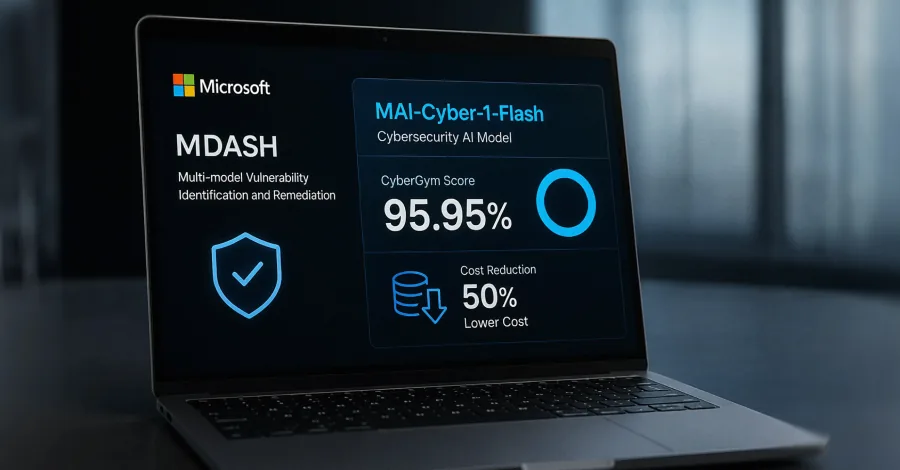
Microsoft has unveiled its latest artificial intelligence model, MAI-Cyber-1-Flash, specifically designed to enhance its multi-model vulnerability identification and remediation harness, known as MDASH. The tech giant announced on July 28, 2026, that this new model, integrated with GPT-5.4, achieved a notable 95.95% score on the CyberGym benchmark. This advancement reportedly comes at half the cost compared to previous top-performing MDASH configurations that utilized a combination of GPT-5.4, GPT-5.4 mini, and GPT-5.3 Codex.
The new cybersecurity AI is accessible only to approved MDASH customers through a private preview within Azure AI Foundry. MAI-Cyber-1-Flash is engineered to manage approximately 90% of the tasks within MDASH, reserving the more complex challenges for GPT-5.4. Microsoft emphasizes that this model is not available as a standalone public application or general-purpose API; its capabilities are exclusively harnessed within the MDASH environment.
The headline-grabbing 95.95% score reflects the performance of the complete MDASH system powered by MAI-Cyber-1-Flash and GPT-5.4, rather than the new model in isolation. CyberGym Level 1, the benchmark used, simulates known vulnerabilities by providing an agent with a description of a flaw and the unpatched source code, then evaluating its ability to generate a working proof-of-concept. It's important to note that this test does not assess the discovery of unknown vulnerabilities or the accuracy of generated code fixes.
A review of CyberGym's public leaderboard on July 28, 2026, did not immediately display Microsoft's claimed 95.95% result. The leaderboard at that time showed Wiz's Atlas agent in the leading position with a 90.9% score as of July 27, while Microsoft's earlier MDASH submission from May 12 registered at 88.4%. Microsoft has not publicly confirmed if the latest result was submitted for inclusion on the leaderboard. Furthermore, the company's prior MDASH result of 96.55% from June is not directly comparable, as that figure included any type of crash, not exclusively target vulnerabilities. The criteria for the 95.95% score have not been detailed, making a direct before-and-after trend analysis uncertain.
Context and Technical Specifications
According to Microsoft's official model card, MAI-Cyber-1-Flash is a sophisticated sparse mixture-of-experts transformer architecture. It boasts 137 billion total parameters, with 5 billion active parameters, and supports an extensive 256,000-token context window. This model represents a fine-tuned version of MAI-Code-1-Flash, which itself was developed from an intermediate checkpoint of the MAI-Thinking-1 model. The evaluation that led to the claimed score indicated that the new configuration replaced 80% of the existing models within MDASH, boosting the reported CyberGym result from 88.4% to 95.95%.
The technical claims suggest a strategic approach to AI task management within MDASH. The MAI-Cyber-1-Flash model is intended to handle the bulk of the workload, with GPT-5.4 stepping in for the most challenging 10% of tasks. This efficient routing mechanism is central to the reported cost savings and performance improvements. Microsoft's announcement detailed the 50% cost reduction in comparison to its previous best MDASH model mix, which included GPT-5.4, GPT-5.4 mini, and GPT-5.3 Codex. The product page further elaborates on this, stating the system offers "comparable performance at 50% of the cost of leading models." However, crucial details such as token usage, call volume, latency, task distribution, and compute allocation for this comparison remain undisclosed, preventing independent verification of the cost-saving claims.
Taesoo Kim, Microsoft's vice president of agentic security, highlighted the distinction between the model and the encompassing system in June, stating, "The model is one input, the system around it is the product." This perspective underscores the integrated nature of MDASH. Beyond the CyberGym benchmark, the model card also reports other performance metrics. Under a lightweight terminal harness, MAI-Cyber-1-Flash achieved scores of 0.314 on CVEBench, 0.553 on CyberSecEval4 threat intelligence, 0.33 on its malware analysis test, and 0.651 on CRSBench at a specific parameter setting. Notably, the model scored zero across several categories in ExploitGym, which tests the ability to generate code execution exploits from provided vulnerabilities.
Microsoft has clarified that all benchmark testing was conducted in a secure, network-isolated environment, detached from production systems, the public internet, or any external services. The model card also includes a standard disclaimer warning that generated text and code may contain inaccuracies or be incomplete, advising users to review outputs before critical application. The integration of MAI-Cyber-1-Flash into MDASH for software vulnerability management marks the initial application of Microsoft's Project Perception. This broader system aims to coordinate defensive security agents and is slated for a public preview on August 3, 2026. Microsoft plans to expand the model's utility beyond software vulnerabilities to encompass a wider array of security workflows.