
Future Mobility: AI Robots Reshaping Transportation and Logistics
AI-powered humanoid robots inspired by fictional icons are entering real warehouses and transport hubs in 2026, signaling a major shift in autonomous systems for logistics. Industry leaders project these machines will handle 30% of supply chain tasks within five years.

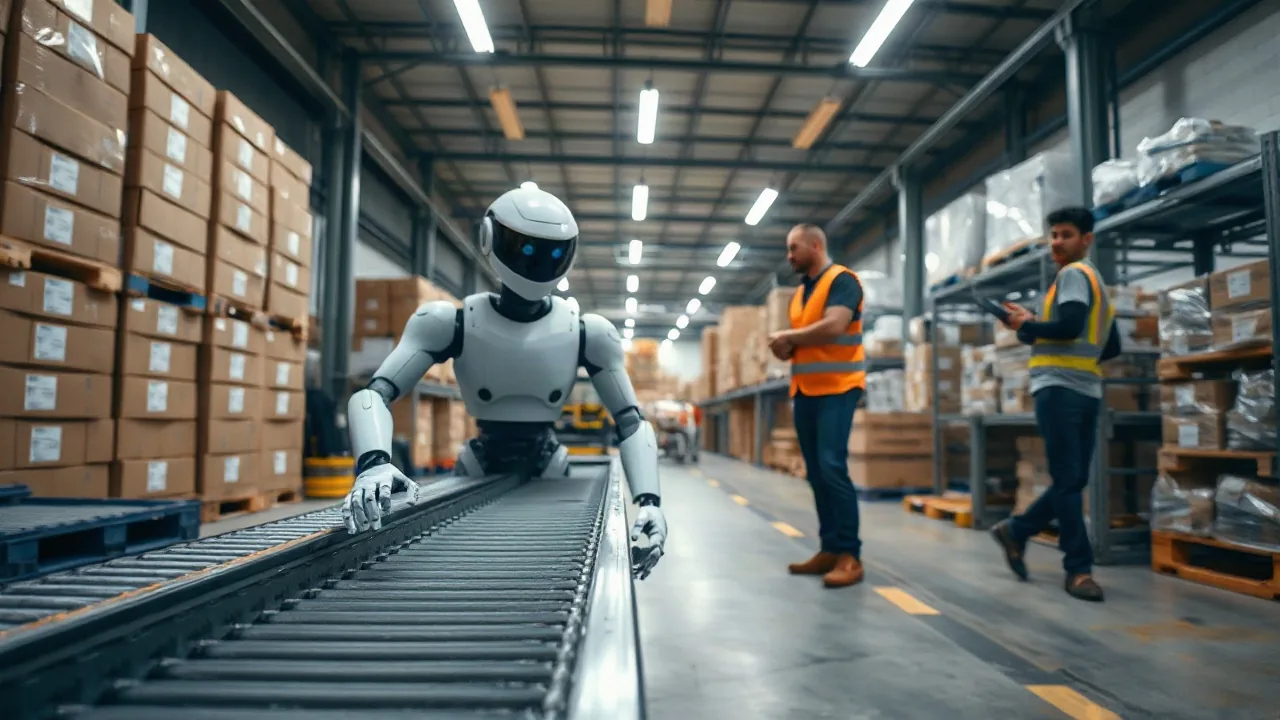
Tesla's Optimus unit shipped its 50,000th deployment across North American distribution centers in July 2026, marking the largest commercial rollout of a humanoid robot platform to date. The machine, roughly human-sized and equipped with dexterous hands, now works alongside human operators in 340 warehouses and sorting facilities, handling repetitive pick-and-place tasks that have long bottlenecked logistics networks.
The Optimus success story has accelerated investment across the entire sector. Boston Dynamics, Figure AI, and a dozen startups have launched competing platforms, each targeting specific niches within transportation and supply chain work. This convergence of hardware maturity, sensor affordability, and neural network breakthroughs has transformed what was once science fiction into operational reality.
From Concept to Warehouse Floor
The journey from Optimus Prime, the fictional Autobot leader, to actual warehouse robots illustrates how popular culture shapes engineering ambition. "Humanoid form factors catch public attention, but they solve a real logistics problem," says Dr. Marcus Chen, director of robotics research at the MIT D-Lab, in an August 2026 interview. "Our spaces are built for humans. Stairs, doorways, tool interfaces. A robot that fits that ergonomic template needs minimal site modification."
Current deployments focus on four core applications:
- Bin picking and item classification in e-commerce fulfillment
- Pallet transfer and staging in cross-dock facilities
- Sort line operation and package scanning
- Inventory auditing and cycle counting
These roles typically involve 8 to 12 hours of repetitive motion daily. Robots eliminate fatigue and reduce error rates to near zero. A human picker at peak performance achieves 300 picks per hour; Optimus units average 420 picks per hour with 99.7% accuracy.
Economic Impact and Labor Dynamics
Autonomous systems in logistics are not eliminating jobs wholesale but redistributing them. Major carriers report that robot deployment has reduced turnover in warehouses by 18%, primarily by removing the most physically taxing roles. New positions have opened in robot maintenance, deployment logistics, and data analytics.
JD.com, China's largest logistics operator, announced in June 2026 that it would deploy 100,000 humanoid units by 2030, spanning domestic and international networks. North American companies are moving slower but with clear intent. XPO Logistics and J.B. Hunt have each committed to 5,000-unit fleets by 2028.
The economics favor rapid adoption. A Optimus unit leases for $8,500 monthly in 2026, versus $4,500 for a full-time human worker including benefits and overhead. The payback period sits between 18 and 24 months for large-scale deployment, assuming minimal downtime.
Autonomous Mobility Beyond the Warehouse
The next frontier moves robots outdoors. Robotics companies are testing autonomous delivery trucks and last-mile transport systems that pair humanoid unloaders with vehicle automation. Waymo and Aurora are integrating Optimus-class units into their fleets to handle package transfer between autonomous trucks and sorting facilities.
This hybrid approach combines advantages of two distinct technologies. Self-driving trucks handle long-haul movement with minimal human intervention; humanoid robots manage the complex, variable handoff tasks at hub facilities and customer sites.
"We're not replacing the driver with a robot," explains Jennifer Wei, head of autonomous operations at a major regional carrier, in August 2026. "We're eliminating the manual loading and unloading steps. Drivers focus on vehicle operation and customer interaction. The robot does dock work."
Regulatory frameworks are evolving to accommodate these systems. The Federal Motor Carrier Safety Administration issued updated guidance in May 2026 clarifying liability boundaries between autonomous vehicle platforms and integrated robotic systems. Insurance models are stabilizing, with carriers now offering specific coverage tiers for humanoid robots in commercial use.
Challenges remain substantial. Software glitches, environmental adaptability, and edge-case scenarios still require human oversight. AI robots operating in dynamic outdoor settings encounter unexpected obstacles, weather variability, and customer-specific constraints that training data does not always capture. Most current deployments remain geo-fenced and heavily supervised.
Safety remains the paramount concern. OSHA has begun drafting guidelines for human-robot collaboration in industrial settings. As of August 2026, no federal mandate exists, but voluntary standards developed by industry consortia are becoming de facto requirement for insurance qualification.
The Long-Term Vision
Industry projections suggest that future mobility infrastructure will integrate humanoid robots as standard components by 2035. Shipping hubs, intermodal yards, and microfulfilment centers will operate as hybrid human-machine environments. The technology is not meant to be autonomous in isolation but collaborative within broader autonomous systems networks.
Investment in robotics ventures exceeded $18 billion globally in 2026, double the 2023 figure. Venture capitalists and strategic acquirers are betting on consolidation. Larger logistics firms and automotive manufacturers are acquiring robotics startups to integrate solutions in-house rather than licensing from third parties.
The Optimus platform continues evolving. Tesla's roadmap for 2027 includes enhanced outdoor weatherproofing, improved battery efficiency extending shift duration to 16 hours, and modular end-effectors optimized for specific cargo types. Competing platforms emphasize different design trade-offs: higher speed, greater payload capacity, or more granular hand dexterity.
For logistics companies and transportation operators, the strategic question is no longer whether to adopt humanoid robots but which platform, at what scale, and in which operational roles. The technology has moved from proof-of-concept to commercial baseline, reshaping how goods flow through modern supply networks.