
EV Charging Infrastructure: Powering Mass Adoption
The US electric vehicle market faces a critical bottleneck: insufficient charging infrastructure. Major utilities and startups are racing to deploy thousands of stations nationwide to support EV adoption targets.

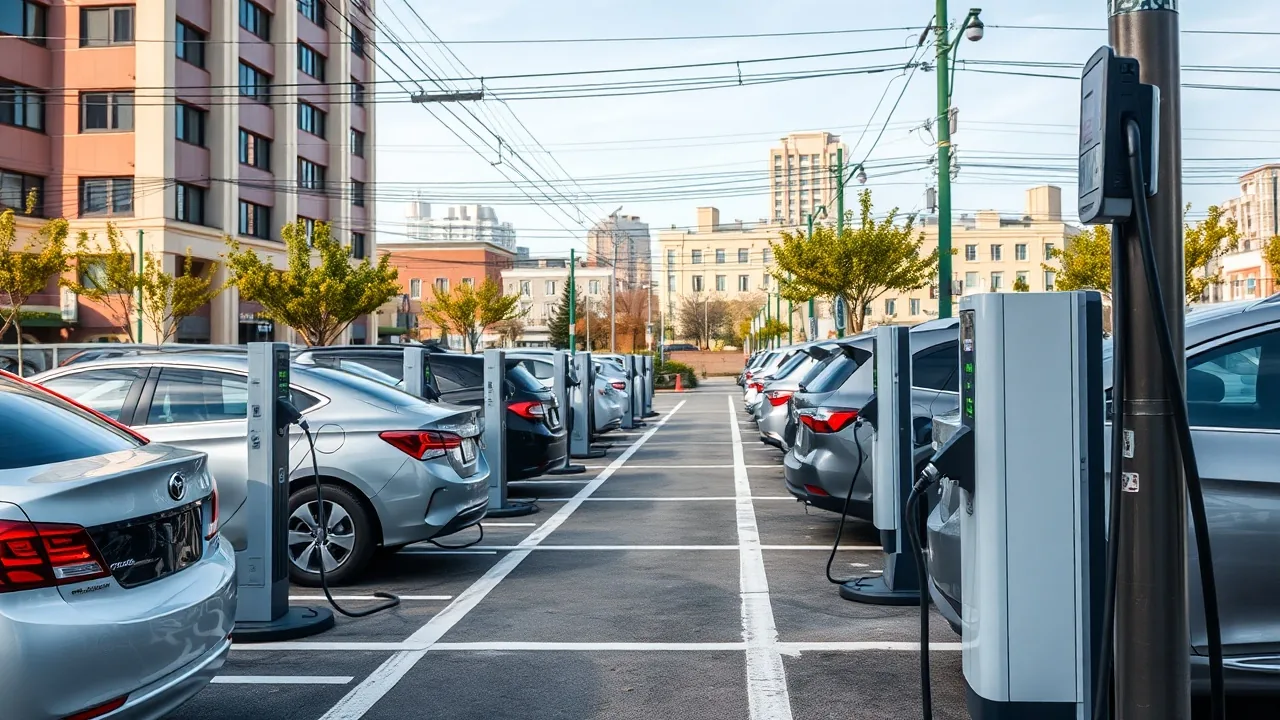
The Biden administration's goal of 500,000 public charging stations by 2030 remains on track, but the infrastructure deployment gap is widening. As of January 2025, the US had approximately 55,000 operational public charging ports, with 48% concentrated in just five states, leaving vast regions without adequate EV charging access.
Tesla's network of Superchargers has set the baseline for fast charging, yet legacy automakers depend on third-party providers to build competing networks. Electrify America, ChargePoint, and Evgo now operate tens of thousands of plugs combined, competing for real estate, grid capacity, and consumer loyalty.
"The infrastructure challenge is not technical but logistical and financial," said Sam Jaffe, energy analyst at Cairn Energy Research Advisors, in a December 2024 industry report. "Every additional 100,000 charging ports requires approximately $4 billion in capital investment and grid upgrades that utilities are only now beginning to prioritize."
The Grid Connection Bottleneck
Local utility companies hold the keys to rapid deployment. Most public charging stations require transformer upgrades, trenching, and new circuit capacity that utilities historically have not planned for. Peak demand modeling suggests that a typical urban block requiring 50 new charging ports could demand 10-15 megawatts of new capacity during peak charging hours.
Several states have begun addressing this. California's investor-owned utilities received regulatory approval in 2024 to invest $10.2 billion in EV charging infrastructure through 2035. New York and Massachusetts launched similar utility-backed programs. These initiatives bypass private developers and embed charging costs directly into ratepayer budgets.
However, rural and secondary markets remain underserved. Charging stations cluster along Interstate corridors where traffic density justifies economics. A 2024 report by the Rocky Mountain Institute found that only 18% of charging infrastructure sits in communities with median household incomes below $50,000.
Private Deployment and Consumer Expectations
Fleet operators and commercial vehicle companies are accelerating electric vehicles adoption faster than consumer markets. UPS, Amazon, and FedEx have jointly committed to deploying over 200,000 EVs by 2030, requiring proprietary charging networks at distribution centers. This parallel infrastructure accelerates technology maturation and cost reductions.
Consumer expectations are shifting. Early EV adopters accepted 30-minute charging sessions; today's buyers demand parity with gasoline fueling times. Ultra-fast chargers delivering 350 kilowatts exist but remain expensive at roughly $500,000 per unit. Deployment has slowed as developers wait for hardware costs to fall and revenue models to stabilize.
Residential charging remains the weak point in EV adoption strategy. Roughly 80% of current EV owners charge at home overnight, but apartment dwellers and renters lack access to dedicated outlets. Multi-unit housing represents 45% of US housing stock but accounts for fewer than 15% of home charging installations.
Key barriers to residential expansion include:
- Landlord liability concerns and split incentives between property owners and tenants
- High per-unit installation costs ($1,200 to $2,500 per outlet with electrical upgrades)
- Lack of standardized utility rebate programs across jurisdictions
- Grid constraints in older urban neighborhoods with aging electrical infrastructure
The Software and Payment Layer
Fragmentation in payment systems creates friction. A driver might need separate accounts and mobile apps for ChargePoint, Evgo, Electrify America, and Tesla's network. The industry has begun converging on the North American Charging Standard (NACS), which Tesla opened to competitors in 2023, but legacy CCS plugs still dominate deployed infrastructure.
Interoperability software layers are emerging. Companies like Volta and New Motion provide aggregated networks allowing drivers to find, reserve, and pay across multiple operators. Yet adoption among independent station operators remains incomplete, fragmenting the user experience.
Pricing transparency is another pain point. Some networks charge per-minute, others per-kilowatt-hour, and still others via subscription tiers. A driver could pay $0.25 to $0.50 per kilowatt-hour depending on location and time of day, making cost comparison difficult and preventing rational consumer behavior.
Federal and state governments have begun requiring interoperability standards for recipients of public funding. The Infrastructure Investment and Jobs Act's $7.5 billion for charging infrastructure includes provisions mandating open-access payment systems, forcing greater standardization by 2026.
The transport infrastructure transition will not complete overnight. Charging networks must expand faster, grid capacity must increase, and payment systems must converge. Until these three elements align, mass EV adoption will remain constrained by logistics rather than vehicle availability or consumer desire.