
Clean Energy Solutions Reshape the Global Transition
Major advances in renewable technology and grid infrastructure are accelerating the shift away from fossil fuels, with new deployments reaching record levels in 2024.

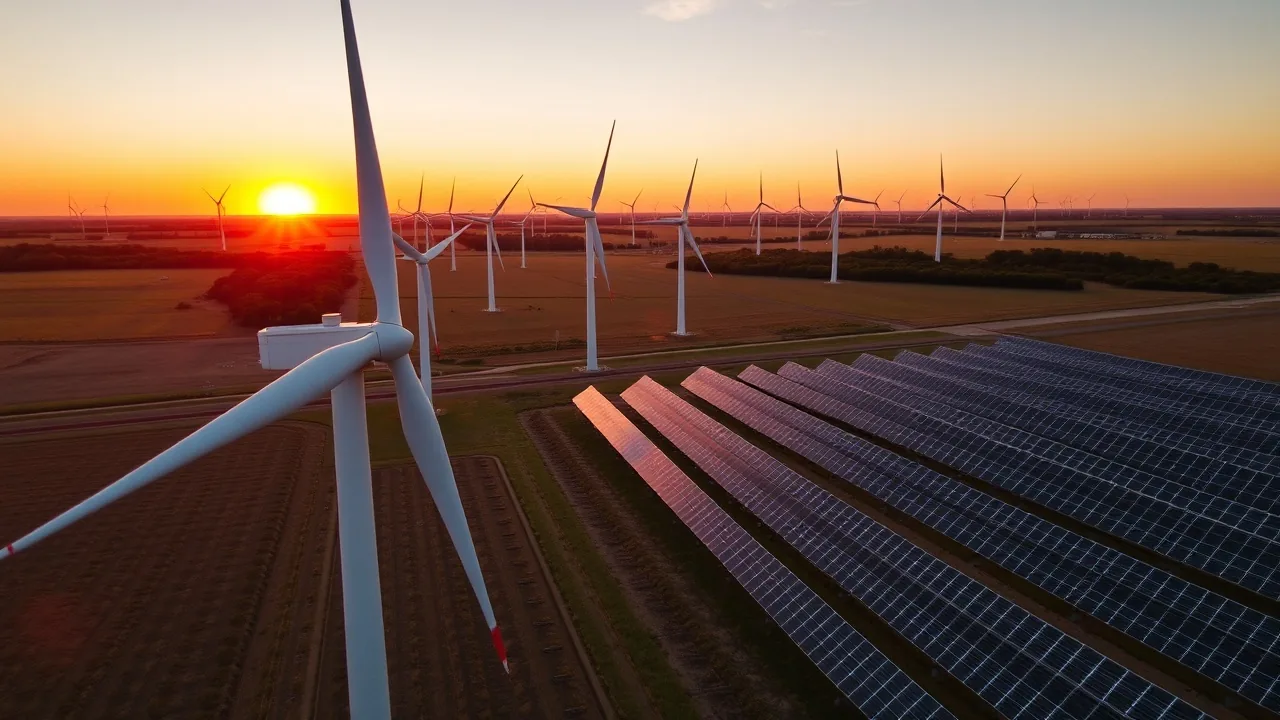
On a wind farm outside Lubbock, Texas, Ørsted completed a 300-megawatt onshore wind project in early 2024 that powers roughly 100,000 American homes without emitting a single ton of carbon dioxide. This represents the kind of tangible momentum now driving clean energy adoption across the United States and globally, as private developers and utilities race to meet both climate targets and surging electricity demand.
The International Energy Agency reported in its October 2024 outlook that renewable capacity additions worldwide reached 510 gigawatts in 2023, with solar and wind accounting for 90 percent of that growth. Battery storage installations tripled year-over-year, signaling a critical shift in how grids manage intermittency from variable sources.
"We are at an inflection point," said Michael Liebreich, founder of Bloomberg NEF, in a recent industry panel. "The economics of renewables have decoupled from subsidies in most markets. The question is no longer whether clean energy is viable, but how quickly infrastructure can scale to meet demand."
Technology Driving the Transition
Current innovations in three sectors are reshaping energy markets. Solar cell efficiency now exceeds 26 percent in commercial production, compared to 22 percent five years ago. Wind turbine capacities have grown to 15+ megawatts offshore, dramatically reducing the number of units needed per installation.
Energy storage remains the bottleneck. Lithium-ion battery costs fell 89 percent between 2010 and 2023, according to BloombergNEF data, yet grid-scale storage still requires technological breakthroughs to enable 100 percent renewable grids. Emerging alternatives include:
- Long-duration flow batteries, which store energy in liquid electrolytes and operate for 4-12 hours
- Compressed-air storage coupled to underground caverns in geologically suitable regions
- Green hydrogen production via electrolysis, enabling seasonal storage and industrial feedstocks
- Thermal storage using molten salt at concentrated solar facilities
Several US utilities have announced grid-scale pilot projects. NextEra Energy is deploying a 4-hour lithium-ion battery in Florida to support solar ramp rates. Duke Energy and Southern Company are jointly funding a green hydrogen pilot in the Southeast aimed at hard-to-decarbonize sectors like cement and steel.
Policy and Investment Drive Scale
The Inflation Reduction Act, enacted in August 2022, allocated $369 billion toward renewable energy and climate change solutions through tax credits and direct investments. Manufacturing incentives have already spurred announcements of 71 new battery and solar factories in the US since the law's passage, according to the Clean Energy Industries Association.
Venture capital deployment into early-stage green tech totaled $27.7 billion in 2023, down from the 2022 peak but concentrated in high-impact areas. Startups pursuing industrial heat decarbonization, grid software, and next-generation battery chemistries attracted the largest funding tranches.
Global capital markets are also realigning. In October 2024, institutional investors controlling $130 trillion in assets signed onto a commitment to accelerate energy transition financing, pledging to increase clean energy allocation to at least 50 percent of their sustainability-focused portfolios by 2030.
Corporate procurement is accelerating timelines. Amazon, Google, and Meta have signed power purchase agreements (PPAs) worth more than 60 gigawatts of renewable capacity combined since 2019. These long-term contracts provide developers with revenue certainty, reducing financing costs for projects.
Barriers and Realistic Timelines
Despite momentum, significant hurdles remain. Transmission infrastructure in the US is constrained; the grid's backbone has not expanded materially since the 1990s, creating bottlenecks where renewable output cannot reach demand centers. The Department of Energy estimates that $2.1 trillion in infrastructure investment is required through 2050 to enable full decarbonization of the electricity sector alone.
Supply chain risk persists. China manufactures roughly 80 percent of global solar cells and panels, creating geopolitical vulnerability. The US solar manufacturing base remains underdeveloped relative to domestic installation rates; tariff policies and Inflation Reduction Act incentives are gradually reversing that deficit, but lead times for factory buildout extend to 3-5 years.
Grid reliability concerns have emerged in regions with high renewable penetration. Texas' February 2024 winter storm tested the state's ability to balance wind curtailment and ramping battery storage within seconds. Real-time software that orchestrates generation, storage, and demand response is becoming as critical as the hardware itself.
Most energy analysts project that the US electricity grid will reach 80 percent renewable generation by 2035 if current deployment rates hold and major transmission upgrades advance on the current Federal Energy Regulatory Commission timeline. A 100 percent renewables grid remains feasible but requires breakthrough improvements in long-duration storage and sector coupling (using electricity to decarbonize heat and transport).
Environmental sustainability gains measurable traction through these deployments. Solar and wind installations now displace roughly 650 million tons of carbon dioxide annually across the US, equivalent to removing 140 million passenger vehicles from roads.
The transition is neither complete nor guaranteed to meet climate targets without persistent policy support and infrastructure investment. Yet the scale of capital mobilization, the speed of cost declines, and the diversification of solutions suggest that clean energy is now the default trajectory for new electricity capacity in most developed economies.