
Fossil Fuels Halted Looming Ice Age, Study Suggests
A recent study indicates that human industrial activity, primarily the burning of fossil fuels, may have prevented the Earth from entering a new ice age. The findings challenge previous understandings of climate cycles.

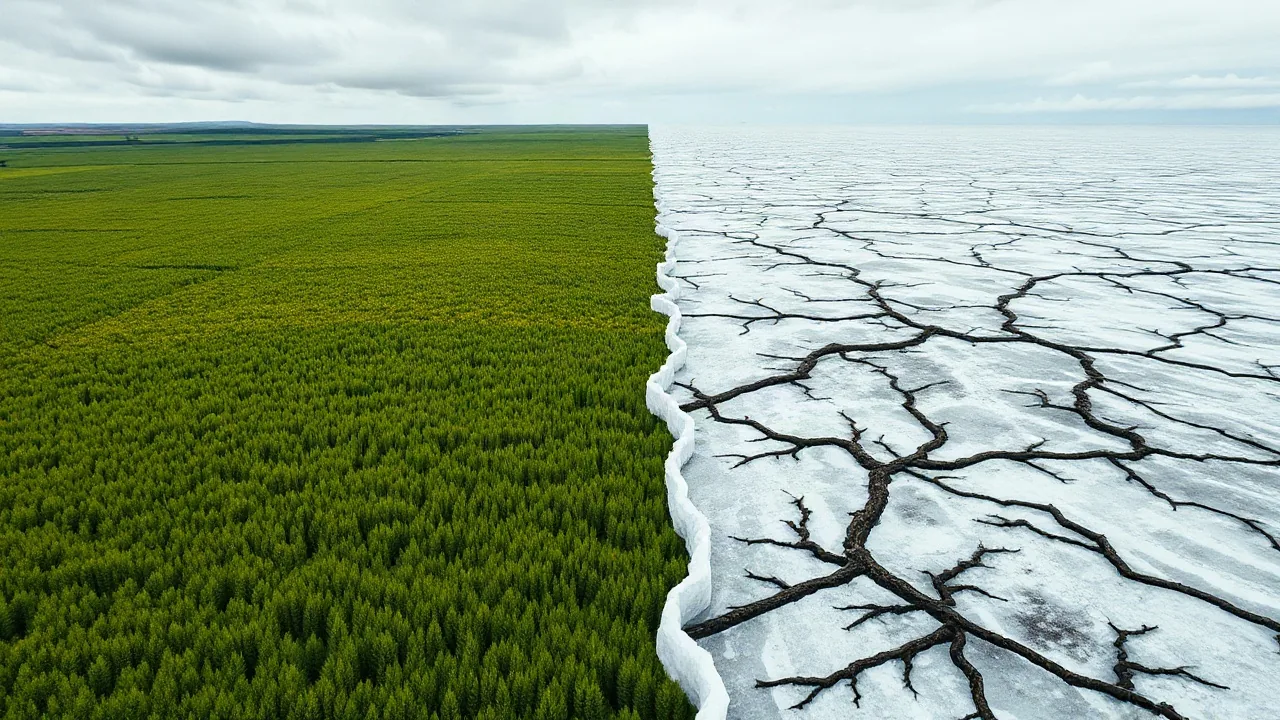
Scientists suggest that the Earth was on the cusp of entering a new ice age before human industrial activities, specifically the widespread burning of fossil fuels, began to significantly warm the planet. A new study published in Nature Geoscience indicates that the continued emissions of greenhouse gases have likely staved off a period of glaciation that would have otherwise begun around 2026. This finding offers a surprising perspective on the long-term impact of human civilization on global climate patterns.
For millennia, Earth's climate has oscillated between glacial periods, commonly known as ice ages, and warmer interglacial periods. These cycles are largely driven by predictable changes in Earth's orbit, known as Milankovitch cycles, which affect the amount of solar radiation reaching the planet. Paleoclimate data has historically allowed scientists to project when the next ice age might naturally occur.
However, the current research, led by scientists at Brown University, analyzed deep-sea sediment cores to reconstruct past climate conditions. The data suggests that the natural cooling trend, driven by orbital shifts, was strong enough to initiate glacial conditions. Without the influence of human-caused warming, large ice sheets would likely have begun to form in North America and Eurasia.
Human Impact Alters Natural Climate Trajectories
The industrial revolution, beginning in the late 18th century, dramatically increased the concentration of greenhouse gases, such as carbon dioxide and methane, in the atmosphere. These gases trap heat, leading to a gradual but significant rise in global average temperatures. This anthropogenic warming has apparently been substantial enough to counteract the natural cooling forces that typically usher in an ice age. The study emphasizes that the planet's trajectory towards glaciation has been overridden by human-induced climate change.
"We are living in the Holocene, the interglacial period that began about 11,700 years ago," explained Dr. David McGee, a lead author of the study, in a press release. "But the long-term orbital cycles suggest we should be heading into an ice age right now. Humans have put the brakes on that." The research team utilized sophisticated climate models to simulate past and future climate scenarios, incorporating both natural orbital variations and human-influenced greenhouse gas emissions. The results consistently showed that the warming effect of fossil fuel combustion has been the dominant factor in preventing renewed glaciation.
This new understanding of climate dynamics has profound implications. While the immediate concern for many remains the adverse effects of ongoing global warming, such as rising sea levels and extreme weather events, this study highlights a different, long-term consequence of fossil fuel use. The human intervention has not only altered the current climate but has also fundamentally changed the planet's natural climate cycles for millennia to come. The prospect of a new ice age, once a predictable future event based on astronomical cycles, has been pushed back indefinitely by human activity.
The findings also underscore the immense power of sustained industrial emissions on Earth's systems. The very activities that have fueled technological advancement and economic growth over the past two centuries have, inadvertently, also preserved the relatively warm climate that has allowed human civilization to flourish. The researchers noted that while this intervention has prevented a potentially disruptive ice age, the continued global warming presents its own set of severe challenges that require urgent attention and mitigation strategies.