
LG's FLiPP OLED Tech Promises Brighter, Longer-Lasting Displays
LG Display has announced FLiPP, a new OLED manufacturing process that significantly boosts brightness, extends panel lifespan, and reduces power consumption. This innovation removes size and resolution constraints, paving the way for diverse applications.

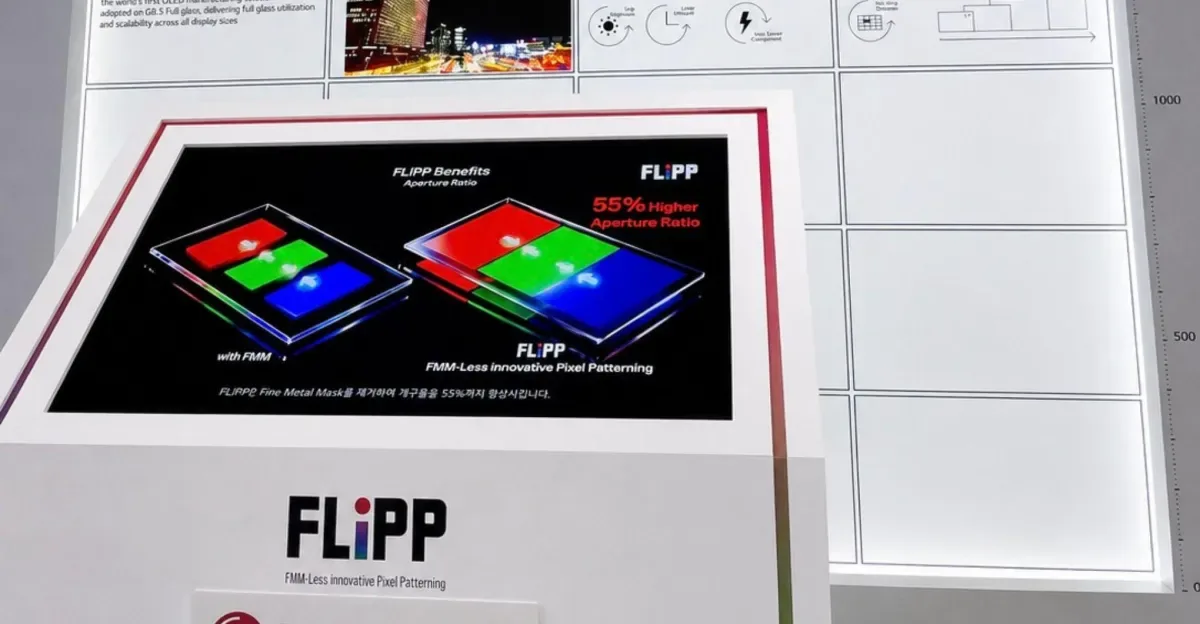
LG Display has unveiled an innovative manufacturing technique for OLED panels, dubbed FLiPP (FMM-Less innovative Pixel Patterning). This new method promises to overcome key limitations of current OLED technology, resulting in displays that are not only brighter and more durable but also more energy-efficient. The company describes FLiPP as a "dream next-generation OLED" patterning method, designed to enhance performance and expand the potential applications for OLED screens.
Traditionally, RGB OLED panels rely on a fine metal mask (FMM) during manufacturing. This metal plate, perforated with microscopic holes, is used to precisely stencil light-emitting materials onto the panel. However, the FMM process can be expensive, and its accuracy can degrade with larger panel sizes, leading to issues like sagging and alignment problems. FLiPP bypasses this FMM step entirely. Instead, it arranges RGB pixels in sequence and then utilizes photolithography and ultraviolet light to sculpt the desired pattern, removing unneeded areas.
According to LG Display, this shift in manufacturing offers substantial gains. The company reports that panels produced using FLiPP can achieve 1.6 times greater brightness and last an impressive 2.4 times longer compared to those made with FMM. Furthermore, the new process slashes power consumption by 13 percent. This efficiency improvement is crucial for mobile devices and also contributes to overall energy savings.
Expanding OLED Possibilities
A significant advantage of FLiPP is its liberation from conventional panel size and resolution limitations. This means LG Display can theoretically produce OLED screens for virtually any requirement, from the smallest wearable displays to the largest television panels. The technology is particularly well-suited for emerging applications like virtual reality (VR) and augmented reality (AR) headsets, where high resolution and durability are paramount.
LG Display intends to roll out this groundbreaking OLED tech initially to the IT sector. This includes applications such as tablets and computer monitors, where enhanced visual quality and longevity are highly valued by consumers and professionals alike. Following this initial phase, the company plans to expand the application of FLiPP to a wider range of products. This expansion will eventually encompass ultra-large televisions and even tiny, 1-inch wearable devices, showcasing the technology's versatility.
While the details regarding the production timeline and the availability of the first FLiPP-enabled products remain undisclosed, the announcement marks a significant step forward in display technology. This advancement from LG Display could reshape the future of screens across consumer electronics, offering a compelling blend of performance, efficiency, and adaptability. The LG Display innovation addresses key drawbacks of current OLED manufacturing, potentially accelerating adoption in new and existing markets.