
New Mamyshev Oscillator Laser Achieves Nanojoule Pulse Energy
Researchers have developed a novel integrated mode-locked laser using a Mamyshev oscillator architecture. This compact device achieves nanojoule pulse energy, surpassing previous on-chip lasers and matching fiber lasers, opening new avenues for spectroscopy and metrology.

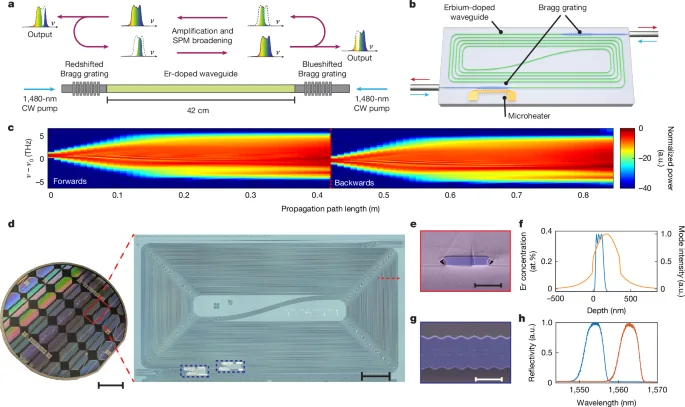
Scientists have developed a groundbreaking high-pulse-energy integrated mode-locked laser, leveraging a Mamyshev oscillator architecture built on erbium-ion-implanted silicon nitride photonic integrated circuits (PICs). This innovative device, detailed in a recent study, overcomes a critical limitation in existing PIC-based lasers by delivering pulse energies comparable to traditional fiber lasers, a feat previously unattainable for on-chip systems. The laser operates autonomously, producing a 176-MHz pulse train with an impressive nanojoule pulse energy, which is two orders of magnitude greater than prior PIC demonstrations.
The Mamyshev oscillator design is key to this advancement. It utilizes a cycle of alternating spectral filtering and self-phase modulation. This process effectively enables mode-locking and supports substantial nonlinear phase shifts, a crucial factor for achieving higher pulse energies. Unlike many laser systems, this integrated ultrafast laser does not require external seeding, simplifying its operation and making it more amenable to compact and portable applications. The output from the laser is highly coherent and can be compressed to a pulse duration of 147 femtoseconds (fs).
Advancements in Compact Spectroscopy and Metrology
A significant application demonstrated by this new laser is its ability to directly drive a 1.5-octave-spanning supercontinuum in a silicon nitride waveguide, without the need for additional amplification stages. This capability is vital for nonlinear optical processes. Furthermore, a compact terahertz time-domain spectrometer, powered by this source, achieved a broad bandwidth of 5 terahertz (THz) and a remarkable 90-decibel (dB) dynamic range. This opens doors for enhanced non-contact chemical analysis and inspection tasks, potentially revolutionizing fields that rely on precise material characterization.
The development signifies a major step forward in the pursuit of compact, wafer-scale manufactured lasers with advanced functionalities. Integrated photonics platforms like silicon nitride offer the potential for further integration with other on-chip components, paving the way for even more sophisticated systems. Historically, achieving high pulse energy from integrated lasers has been a significant hurdle, limiting their utility in applications demanding high peak power. This new architecture effectively bridges that gap.
The implications of this research extend to various scientific and technological domains. Potential applications include chip-scale frequency metrology, where precise timing and frequency standards are essential, and portable spectroscopy systems that can be deployed in the field for diverse analytical purposes. The ability to generate high-energy pulses from a compact, integrated device promises to democratize access to advanced laser functionalities, driving innovation in areas from fundamental research to industrial inspection and medical diagnostics.