
Atmosphere Detected Around Earth-Like Exoplanet in Habitable Zone
Astronomers have identified the first definitive evidence of an atmosphere around a rocky exoplanet within its star's habitable zone. This discovery on LHS 1140 b marks a significant step in the search for potentially life-supporting worlds beyond our solar system.

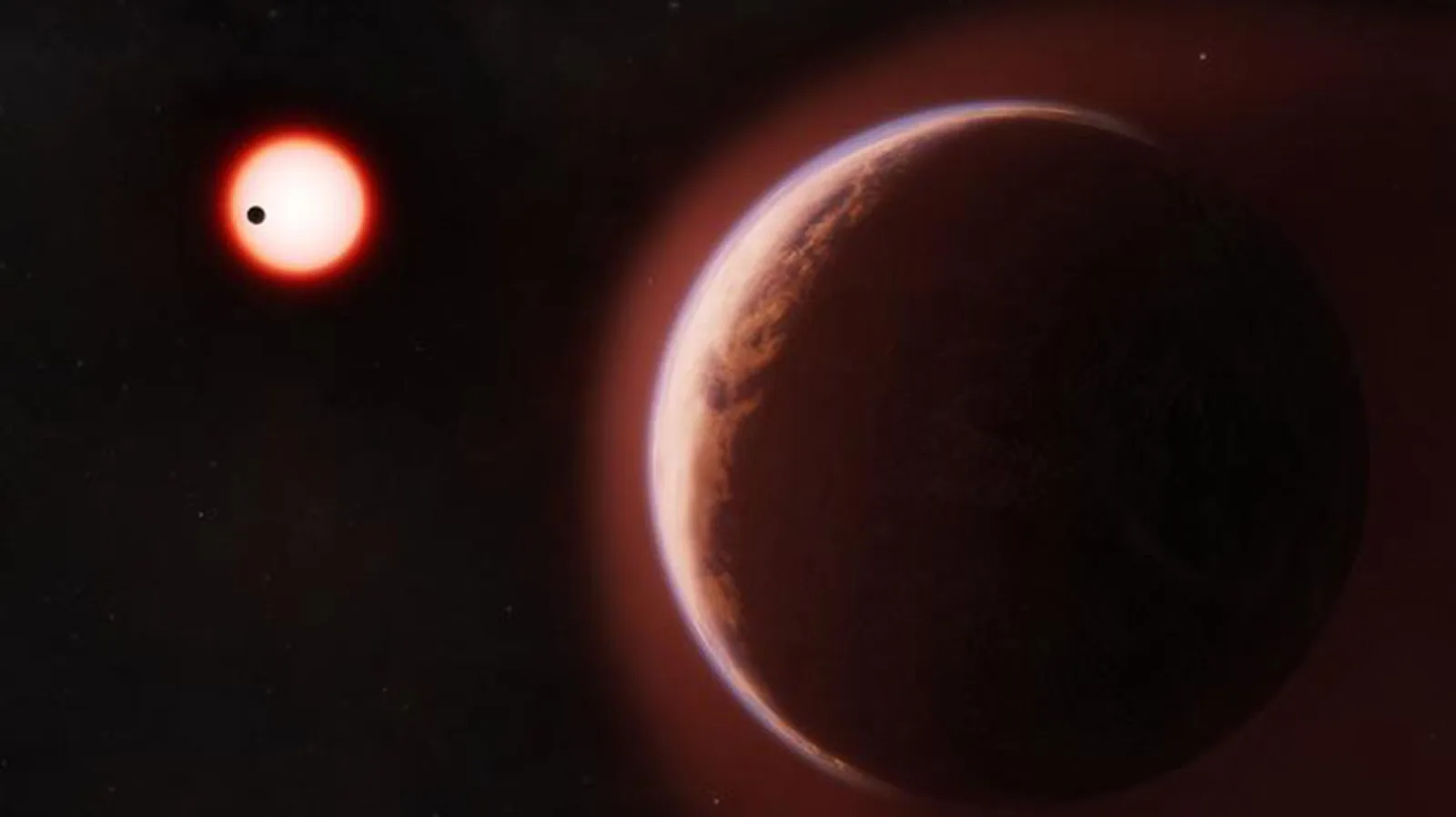
Astronomers have identified the strongest evidence to date of an atmosphere surrounding a rocky exoplanet located within its star's habitable zone, a landmark discovery that could significantly advance the search for extraterrestrial life. The planet, designated LHS 1140 b, is the first such world where scientists have detected atmospheric presence, a key component for potential habitability. The findings were published on July 16 in the scientific journal Science.
"It's absolutely exciting," stated Edward Schwieterman, an associate professor of astrobiology at the University of California, Riverside, who was not directly involved in the research. "We are getting closer to studying the atmospheres of worlds that could plausibly harbor life, with evidence of that life embedded in their observable spectra." This breakthrough offers a new avenue for identifying planets that might possess conditions suitable for life as we understand it.
LHS 1140 b is situated approximately 48 light-years from Earth, orbiting a small, cool red dwarf star. Classified as a super-Earth, it possesses a mass roughly 5.6 times that of our own planet. While it receives less than half the sunlight Earth experiences, leading to an estimated surface temperature around minus 53 degrees Fahrenheit (minus 47 degrees Celsius) without atmospheric considerations, this range is still considered within the habitable parameters by astronomers. The presence of an atmosphere would significantly influence these surface temperatures.
Detecting a 'Cosmic Gas Leak'
While thousands of exoplanets have been cataloged, confirming atmospheres on rocky worlds has been a persistent challenge. These atmospheres are considerably thinner than those of gas giants, making them exceedingly difficult to detect across interstellar distances. The research team employed an innovative indirect method: searching for signs of helium gas escaping into space. Using the WINERED spectrograph on the Magellan Clay Telescope in Chile, scientists observed LHS 1140 b as it passed in front of its host star. During this transit, a small fraction of the star's light filtered through the planet's atmosphere en route to Earth. The team analyzed this starlight for a subtle reduction at the specific infrared wavelength absorbed by helium, indicating gas was venting from the planet.
This detection method relied on a mathematical model previously unconfirmed for rocky planets. The critical observation occurred in September 2024, when researchers managed to observe both LHS 1140 b and its smaller, hotter neighbor, LHS 1140 c, transiting their star on the same night, separated by less than 40 minutes. A distinct helium signature was detected for LHS 1140 b, while LHS 1140 c showed no such signal. This contrast is significant: LHS 1140 c orbits closer to its star, enduring approximately five times more radiation. Despite these conditions that should theoretically make escaping gas more detectable, no signal was found, suggesting its atmosphere was likely stripped away eons ago. LHS 1140 b, positioned farther out in cooler conditions, appears to have successfully retained its atmosphere.
This discovery directly addresses a long-standing question in exoplanet research. "Twenty years ago we wondered whether other terrestrial-type planets even existed," said study co-author Robin Wordsworth, a professor of Earth and planetary sciences at Harvard University. "Then we learned they're common, and found some in the habitable zone. The next question was whether any of them had managed to keep an atmosphere. Now we know at least one has."
The find is particularly noteworthy given the nature of red dwarf stars like LHS 1140. These stars are known to emit high-energy radiation that can erode planetary atmospheres over time. Considering the star's estimated age of at least 3.1 billion years, LHS 1140 b's atmosphere has apparently withstood this stellar bombardment, suggesting that some rocky planets orbiting these prevalent stars can preserve their atmospheres for much longer periods than previously assumed. However, scientists emphasize that detecting helium does not confirm the planet is inhabited or even definitively habitable. The current observations only provide insight into the planet's upper atmosphere, leaving its full composition unknown. Crucial gases like oxygen, carbon dioxide, or water vapor, which are vital for Earth-like habitability, remain undetected. This groundbreaking research nonetheless opens a new frontier for studying distant rocky worlds, with future observations aiming to ascertain the composition of LHS 1140 b's atmosphere and explore signs of potential oceans or other life-supporting features.