
MIT's Amphibious Robot Flies and Dives Using Single Wing Design
Researchers at MIT have developed a novel robot capable of seamlessly transitioning between flight and underwater propulsion using the same adaptable wings. This innovation mimics natural behaviors observed in seabirds.

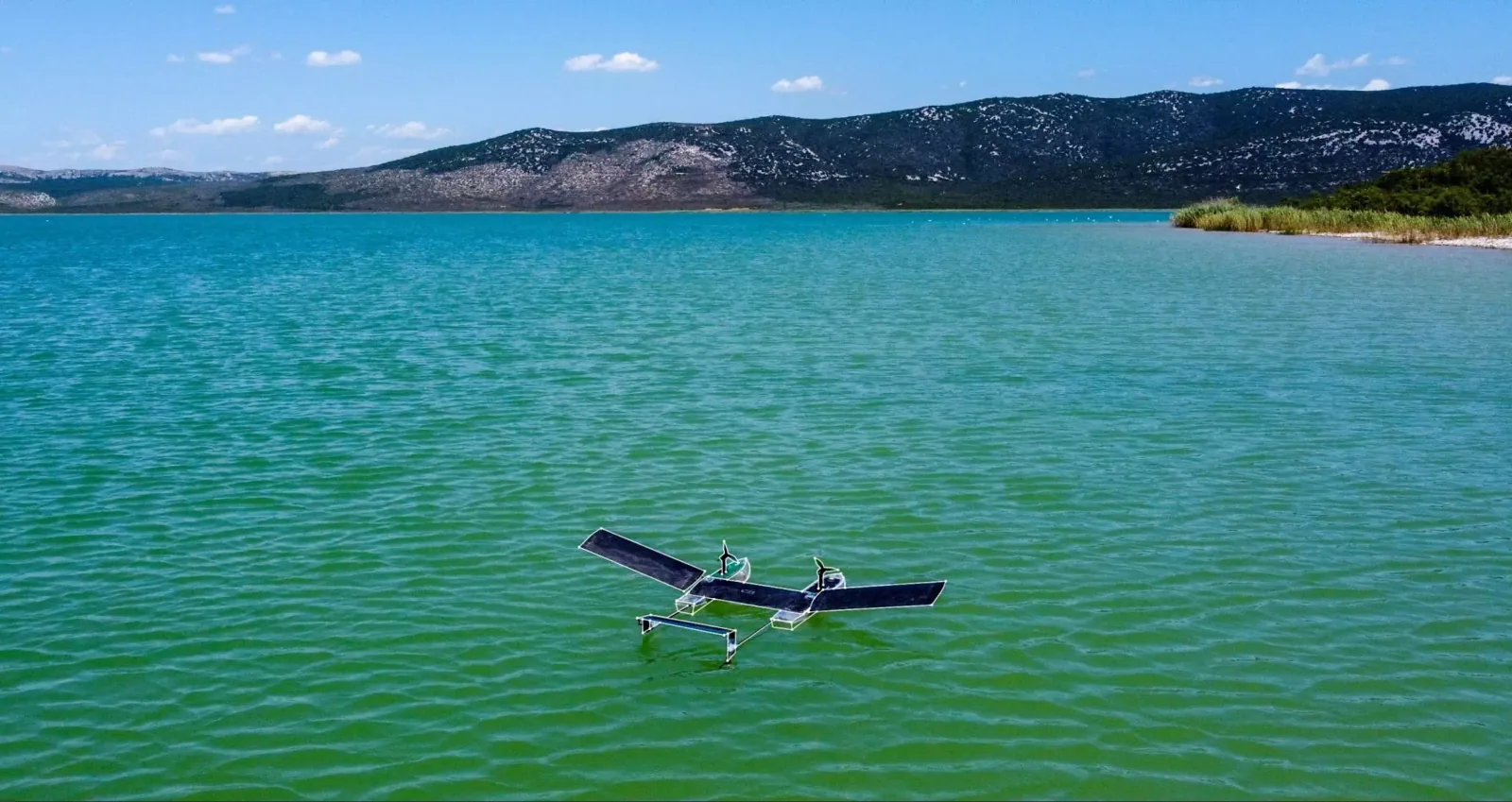
Researchers at the Massachusetts Institute of Avenue of Technology (MIT) have unveiled a groundbreaking robot that navigates both air and water with remarkable agility, utilizing a single set of wings for both environments. This innovative design allows the robot to transition between aerial flight and underwater submersion without requiring any additional hardware. The project draws inspiration from natural phenomena, specifically the dual capabilities of diving seabirds like puffins, which employ their wings for both flying and swimming despite the significant differences in air and water dynamics.
"Thinking of a wing that could operate in both [air and water] somewhat efficiently seems implausible," stated Raphael Zufferey, a mechanical engineer leading the research. The resulting robot, detailed in a recent publication in the journal Science, weighs approximately half a pound and boasts a wingspan just shy of three feet. A key design principle was to achieve functionality in both air and water without introducing unnecessary complexity. This led to several significant design choices, including the complete omission of legs.
In the natural world, many avian species rely on their legs for launching from water surfaces. However, for a robot, incorporating this feature would introduce substantial mechanical challenges that the MIT team aimed to circumvent. "Instead, we thought, 'can we go from the water straight to the air simply with the wings themselves?'" Zufferey explained. This approach emphasizes the wings' versatility as the primary means of locomotion and transition.
Wing Flexibility Over Folding Mechanisms
The robot's wings also diverge from those found on actual diving birds. While many diving birds instinctively fold their wings when submerged, integrating such a mechanism into a robot would necessitate additional joints and motors. "You need to add joints, you need to add motors. So instead we rely on wing flexibility," Zufferey noted. This reliance on inherent material properties streamlines the design and reduces potential failure points.
Constructed from translucent nylon fabric reinforced with carbon fiber struts, the wings possess the necessary flexibility to perform effectively in both air and water. The wings exhibit continuous flapping, operating at approximately five to six flaps per second while in the air. To achieve liftoff from the water's surface, the robot intensifies its flapping rate to around ten flaps per second, generating the requisite force for a successful transition.
The robot's body design is equally unconventional. Its central structure is open, exposing the internal components. Rather than attempting to seal the entire system against water ingress, each individual component has been waterproofed. "So water floods the whole system here," Zufferey elaborated, explaining that this method maintains the robot's lightweight profile for flight while ensuring neutral buoyancy underwater, preventing it from drifting upwards or sinking.
In rigorous testing, the robot demonstrated the ability to move from a water surface into flight in under a second. Observational footage captured at Lake Geneva vividly illustrates a brief disturbance on the water's surface, followed by the robot's dramatic ascent into the air. Glenna Clifton, an animal movement biologist at the University of Portland who was not involved in the research, lauded the robot as both an engineering triumph and a valuable research instrument. "This is a beautiful robot," she commented, adding that such projects significantly advance our understanding of animal locomotion. "The biology inspires the robotics, but then also the robotics are used to understand the biology."
The MIT team foresees practical applications for this technology, particularly in environmental monitoring. A robot capable of flying to remote areas, landing on water, and collecting data could be invaluable for assessing coastal ecosystems, tracking algal blooms, observing marine life, and studying coastal erosion patterns. The current iteration is estimated to achieve a flight range of just under four miles or a swimming range of slightly over a mile on a single charge. Clifton highlighted the significance of this dual-environment performance: "It is light and powerful and a monumental step in the performance at both swimming, flying, and transitioning between the two." The development process spanned approximately two years, and the researchers are actively pursuing further enhancements. Future versions are anticipated to incorporate sensors for data collection and continue refining the robot's locomotion capabilities. For Zufferey, the ultimate inspiration remains the natural world. "You see that it has already been done in biology," he concluded. "So that gives you hope as a robotics researcher. It tells you that it should be possible.". This development represents a significant leap in robotics and biomimicry.