
Stunning 2026 Solar Eclipse Photos Capture Europe's Totality
Astrophotographers and aviation units captured breathtaking images of the August 12, 2026 total solar eclipse from Spain, Greenland, and Iceland. The celestial event offered rare views of solar prominences and the corona.

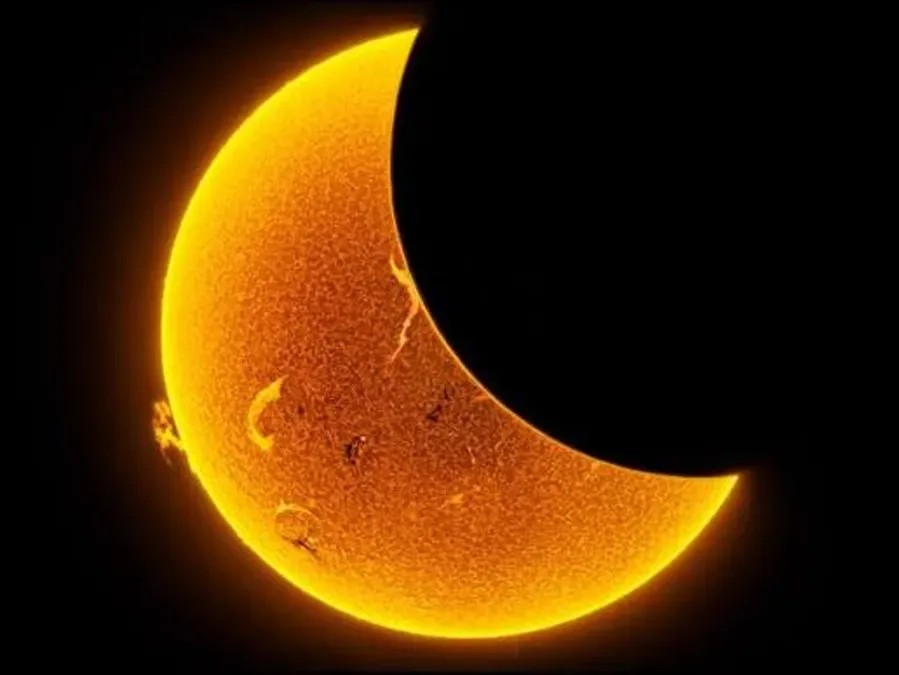
The total solar eclipse of August 12, 2026, offered a spectacular celestial display visible across parts of Europe, with photographers and aviation enthusiasts sharing stunning images of the rare phenomenon. While the path of totality primarily crossed Spain, Greenland, and Iceland, millions worldwide observed the event through shared photographs and videos circulating on social media and online platforms.
Renowned astrophotographer AJ Smadi captured a dramatic scene as the Moon’s shadow enveloped the Burgos Cathedral in Spain. Another notable image from Zaragoza, Spain, featured the eclipse over the Cathedral-Basilica of Our Lady of the Pillar, with the work highlighted on NASA's Astronomy Picture of the Day (APOD). Bill Ingalls of NASA also provided spectacular shots from San Millán de los Caballeros, Spain, showcasing the intricate details of the eclipse.
One of the most captivating features observed was the solar prominence, a distinct loop of plasma extending outward from the Sun, visible at the 9 o'clock position. Some reports suggest this feature was even discernible to the naked eye during the brief period of totality. The solar eclipse provided opportunities for unique photographic compositions.
Aviation Units Capture Unique Perspectives
Beyond traditional astrophotography, military aviation units also contributed remarkable imagery. The Spanish Air Force, operating from an A400M Atlas tanker, captured EF-18BM Hornet fighter jets in flight against the backdrop of the eclipsed sun. These photos, taken during a refueling mission over Spain, offered a dynamic and powerful perspective on the celestial event.
Similarly, the French Air and Space Force documented the eclipse during in-flight refueling exercises over the Bay of Biscay. Aircraft from Air Base 123 in Orléans-Bricy, supported by Rafale fighter jets, were involved in operations that provided a unique aerial vantage point. These images underscore the collaborative efforts and diverse platforms used to document the 2026 eclipse.
The celestial event also inspired creative endeavors, such as a time-lapse captured by Juan Carlos Muñoz from Peñafiel, Spain. Additionally, National Geographic photographer Reuben Wu documented the eclipse from the Picos de Urbión. Astrophotographer Andrew McCarthy also shared a stunning image of the total solar eclipse over the Mediterranean Sea, further expanding the visual record of the event. The diverse locations and approaches highlight the global fascination with solar eclipses.
A particularly daring shot involved a five-person team who positioned photographers high on the Serra d’Alfàbia mountains in Spain. Ten-time Acro World Cup champion Horacio Llorens navigated a paramotor in front of the Sun as totality neared, creating an extraordinary silhouette. This creative capture, along with many others shared online, serves as a testament to the dedication of individuals in documenting these fleeting astronomical phenomena.
The August 12, 2026 total solar eclipse provided a crucial opportunity for scientific observation and public engagement. The detailed photographs and videos captured not only serve as artistic records but also contribute valuable data for understanding solar activity. The widespread sharing of these images demonstrates the power of the internet to disseminate scientific wonder and connect people across the globe through shared visual experiences.