
96% Partial Lunar Eclipse Viewers Can See This Week
A nearly total partial lunar eclipse is set to dazzle skywatchers across North America, South America, Africa, and Europe on August 27-28. Earth's shadow will cover 96% of the moon, painting it a crimson hue.

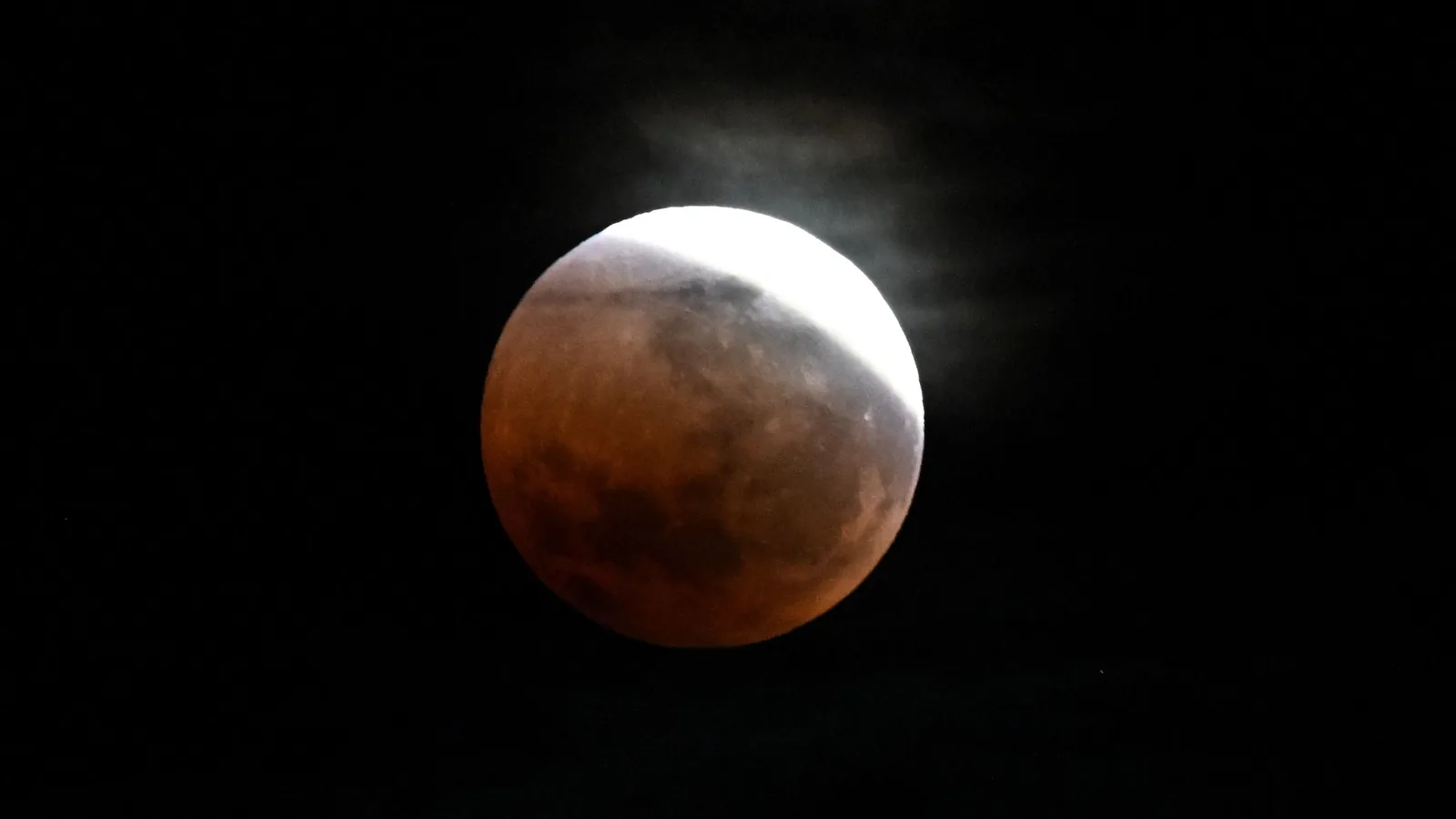
Skywatchers across North America, South America, Africa, and Europe are set for a spectacular celestial event this week: a 96% partial lunar eclipse occurring on the night of August 27-28, 2026. During this event, Earth's shadow will obscure nearly the entire face of the moon, casting a deep crimson glow on the visible sliver. This occurs when Earth positions itself directly between the sun and the moon during the full moon phase, though the alignment will not be perfect, resulting in a significant portion of the moon remaining outside Earth's darkest shadow.
The eclipse's visible journey begins at 10:33 p.m. EDT on August 27 (02:33 GMT on August 28), as Earth's umbra, the darkest part of its shadow, starts to creep across the lunar surface, according to astronomical data. This dramatic advance will continue for several hours, reaching its peak at 12:12 a.m. EDT on August 28 (04:12 GMT). At this moment of maximum eclipse, the shadowed part of the moon may exhibit a distinct reddish-orange color. This phenomenon, sometimes called a "Blood Moon," happens when sunlight filters through Earth's atmosphere and is bent onto the lunar surface, much like during a total lunar eclipse.
Visibility and Timing
While the phases of a lunar eclipse occur simultaneously for all observers on Earth's night side, local timings will vary significantly based on geographic location. For instance, viewers on the West Coast of the United States, such as those in California, will witness the peak of the eclipse shortly after midnight local time on the night of August 27-28. Meanwhile, observers in the United Kingdom will experience the maximum eclipse just before sunrise on August 28, with the moon appearing low on the southwestern horizon.
It is advisable to consult a reliable source, such as TimeandDate.com, for precise eclipse timings specific to your particular location. Unlike solar eclipses, which pose a significant risk of eye damage if viewed directly without specialized protection, lunar eclipses are entirely safe to observe with the naked eye. However, enhancing the viewing experience is possible with optical aids. A pair of quality binoculars or a telescope can provide a more detailed and awe-inspiring view of Earth's shadow traversing the moon's cratered surface.
This upcoming partial lunar eclipse serves as a compelling reminder of the dynamic celestial mechanics that govern our solar system. Understanding these events helps foster a greater appreciation for astronomy and the constant interplay between Earth, its moon, and the sun. Such astronomical phenomena have captivated humanity for millennia, influencing cultures, calendars, and scientific endeavors. The precise 96% coverage offers a near-total experience, allowing for detailed observation of the subtle color variations and the sharp terminator line between light and shadow.