
BepiColombo Spacecraft Reaches Mercury After Eight-Year Journey
The BepiColombo spacecraft is arriving at Mercury after an eight-year journey traveling nearly six billion miles to enter orbit around the planet.

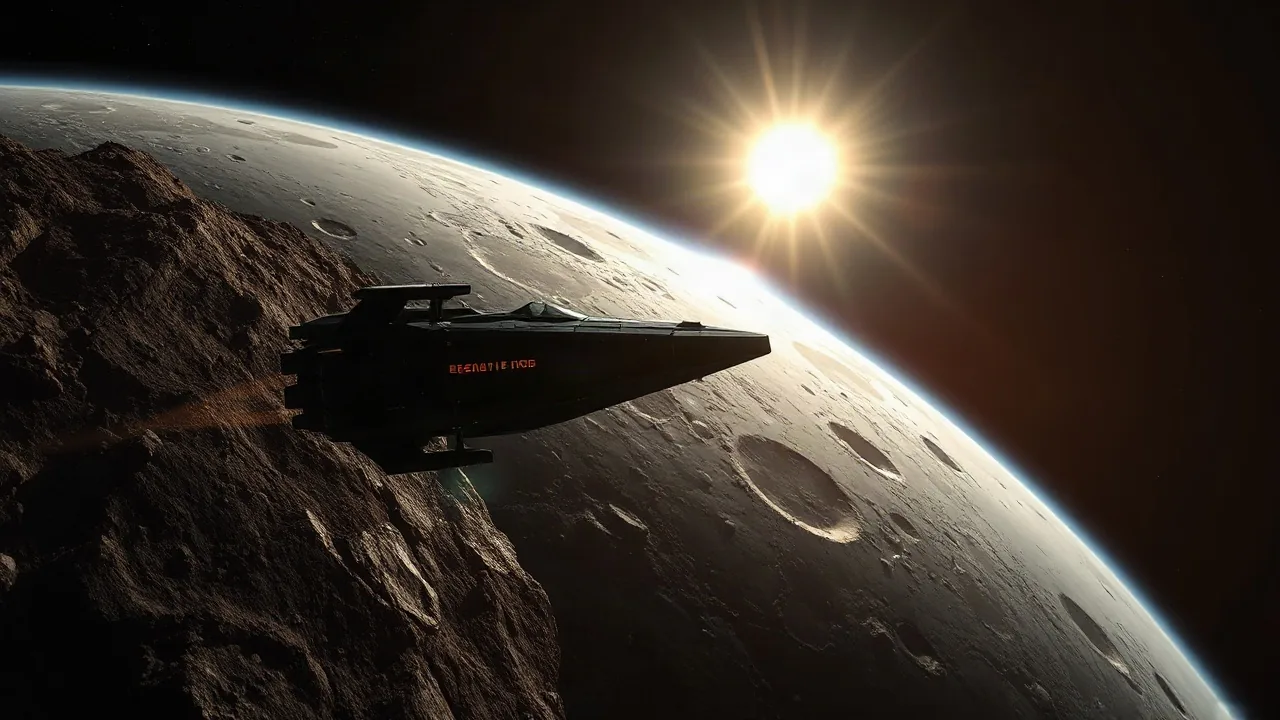
After an eight-year journey traveling almost six billion miles (10bn km), the BepiColombo spacecraft is about to reach its final destination and enter orbit around Mercury. The mission operates in an extremely hostile environment, as Mercury is the closest planet to the Sun where temperatures can reach a fierce 430C, plunge to -180C, and face constant bombardment from intense solar radiation. Until now, the planet has been little explored, but scientists hope this mission will solve major mysteries, including why there is ice in its craters despite the proximity to the Sun, and understanding the mysterious hollows dotted across its surface.
“I think it's a little bit of an under-loved planet in the inner Solar System, but I think that's one of the reasons why it is so compelling,” said Prof Emma Bunce, from Leicester University, who is a principal investigator on the mission. “There are lots of reasons, scientifically, why we really want to understand Mercury, how it formed, how it evolved, what it looks like today, but also how it interacts with the Sun and the extreme space weather that it experiences.”
The BepiColombo mission is a collaboration between the European Space Agency and Japanese Space Agency, having blasted off in 2018 from French Guiana. Because the spacecraft headed deep into the inner Solar System, it had to battle the Sun's immense gravitational pull by keeping its brakes on for the entire journey. It took a convoluted path—looping once around the Earth, twice around Venus, and six times around Mercury—to slow down enough to get into orbit. While the journey was originally planned for seven years, a problem with the propulsion system extended the voyage by an additional year. The final orbital maneuver is a perilous one requiring a 37-minute handbrake turn to be captured by the planet's gravity.
Investigating Mercury's Core and Surface Mysteries
Only two spacecraft have visited Mercury previously, both of which were Nasa missions: Mariner-10 flew past the planet three times in the 1970s, and the Messenger spacecraft arrived in 2011 to spend four years in orbit. Yet, much remains unknown about the tiny world, which is only slightly larger than the Moon and covered in ancient volcanoes, towering cliffs, and colossal craters. Time on the planet functions unusually, as a year on Mercury lasts just 88 Earth days, while a single day spans 59 Earth days.
Alongside investigating polar ice in craters, the mission will study thousands of shallow hollows with steep sides that are approximately 100,000 years old. Researchers also hope to understand why Mercury possesses a huge metal core despite its tiny size. Prof Emma Bunce explained that the planet might have been the victim of a hit-and-run early in its history. “One of the explanations is that the mantle was stripped away in a large collision,” she noted, or it formed that way in a metal-rich part of the early Solar System.
The mission features two spacecraft onboard that will separate a few weeks after arrival: one European craft to study the surface close-up, and another belonging to the Japanese Space Agency to view the planet from a distance. Jessica Marshall, a systems engineer at Airbus, described the upcoming separation as nerve-wracking. “We have designed a special mechanism that we have thought very carefully about,” Marshall said. “It's been exposed to the harsh radiation of space and highly different thermal temperatures, and after eight years this is a spring mechanism that has to then release very gently.”